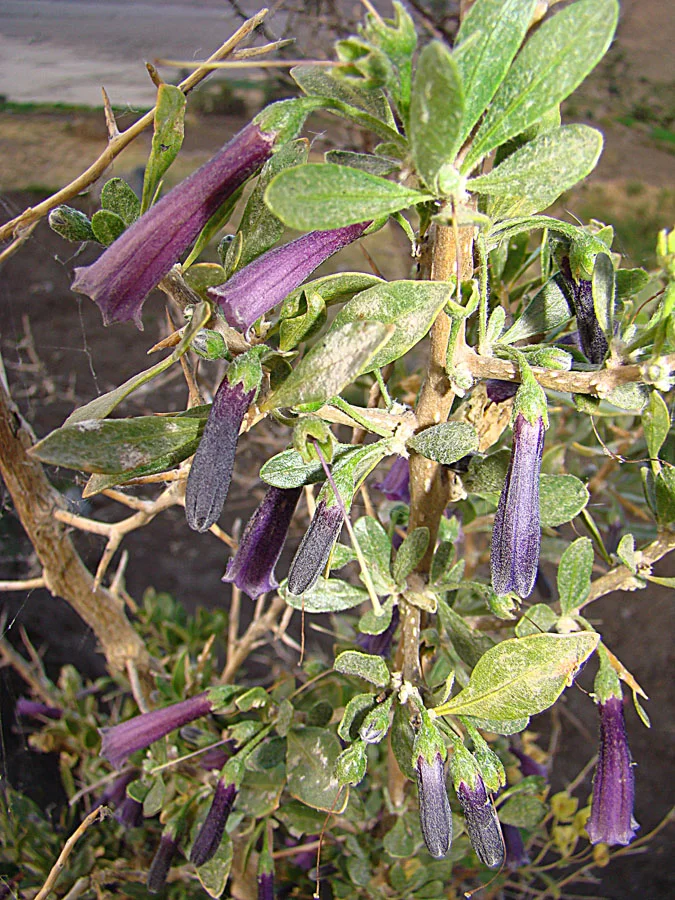
Dunalia spinosa (T'anqar): Andean Spiny Shrub Guide and Uses
Dunalia spinosa, known in Quechua as t'anqar, is a rugged, multi-stemmed shrub that thrives across the arid valleys and sun-drenched mountain scrublands of the central Andes from Peru through Bolivia to northern Chile. Its specific epithet spinosa directly highlights the formidable woody thorns, up to 5 centimeters long, that arm its branches against browsing animals.
Belonging to the nightshade family (Solanaceae), the species was first described in 1834 by the Prussian physician and botanist Franz Julius Ferdinand Meyen as Atropa spinosa, and later placed in the genus Dunalia by Carl Lebrecht Udo Dammer in 1913 in honor of the French botanist Michel Félix Dunal.
Growing between 1.6 and 2 meters tall, Dunalia spinosa branches heavily from the base to create an irregular, impenetrable thicket. Many of its lateral shoots modify into sharp, rigid woody spines that persist along the stems for years.
Leaves, flowers, and berries
Foliage: Small, narrow, somewhat leathery leaves grow in clusters along the short shoots, minimizing surface area exposed to the dry mountain wind.
Flowers: Narrow, trumpet-shaped corollas of deep violet to bluish-purple flare into five small lobes at the tip, offering concentrated nectar deep within the floral tube.
Fruits: Ripening into glossy, spherical orange berries about 8 to 10 millimeters across, the fruits stand out brightly against the gray-brown thorny twigs.
Flowering season
Typically flowers during the Andean wet season and early dry transition from December to May, depending on local rainfall.
Jan
Feb
Mar
Apr
May
Jun
Jul
Aug
Sep
Oct
Name
Dec
Applications
In traditional Andean agroforestry, local farmers plant Dunalia spinosa along field perimeters to form dense, living thorny fences that protect crops from livestock while anchoring dry, erosion-prone hillside soils with its deep root system.
Within Andean folk medicine, preparations of the plant are used externally and internally to relieve toothaches, earaches, diarrhea, and postpartum discomfort, while the ripe berries have occasional local culinary uses.
Interesting facts
Thermal and hydraulic balance on high Andean slopes
Growing at elevations between 500 and 2,000 meters where rain may not fall for six to ten months at a stretch, Dunalia spinosa combines defensive architecture with high-altitude pollination engineering. Every structural feature of the shrub serves a dual purpose in the dry Andean scrub.
Spines as microclimate shields: Beyond deterring grazing camelids and goats, the dense network of woody thorns breaks up desiccating mountain winds and casts partial shade over the clustered leaves, lowering daytime tissue temperatures.
Hummingbird-matched floral tubes: The elongated violet flowers hold their nectar deep inside a narrow tube where dry air cannot easily evaporate it, matching the long bills of high-altitude Andean hummingbirds that transfer pollen while hovering from bush to bush.
Once pollination is complete, the transition to bright orange, moisture-rich berries attracts fruit-eating birds that swallow the seeds and deposit them beneath other thorny perches across the valley.