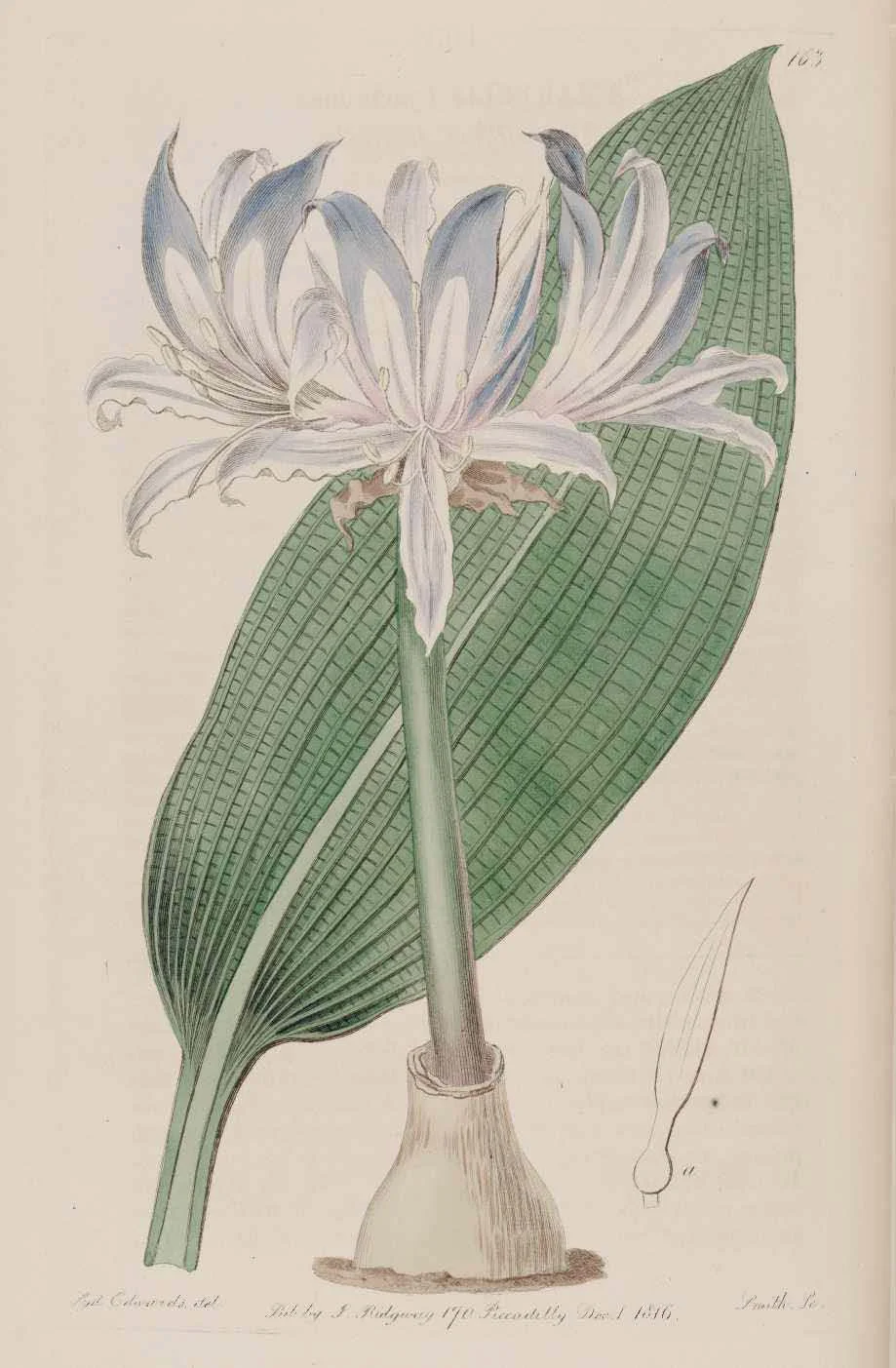
Griffinia hyacinthina: the blue amaryllis of the Atlantic Forest
Griffinia hyacinthina is a shade-dwelling bulbous perennial from the humid rainforests of southeastern Brazil that produces striking, unscented flowers in shades of hyacinth blue and violet. Its specific epithet, hyacinthina, directly references this deep blue-violet floral pigment, a rare color palette among its close relatives.
Belonging to the family Amaryllidaceae, the plant was first described in 1817 by British botanist John Bellenden Ker Gawler as Amaryllis hyacinthina. Three years later, in 1820, Ker Gawler established the genus Griffinia and designated Griffinia hyacinthina as its type species.
The plant grows from an ovate, tunicate bulb—a подземная storage organ wrapped in papery outer layers—that reaches up to 7.5 cm in width. Each bulb produces a rosette of 5 to 7 dark green, oblong leaf blades supported by distinct petioles (leaf stalks), an unusual trait for amaryllids.
The smooth leaf blades measure up to 20 cm long and 5 to 7 cm wide, tapering to an acute or acuminate tip. Their surface displays reticulate venation, a fine lattice-like network of cross-veins spanning between the main nerves, with a prominent midrib raised along the underside.
Inflorescence and flowers
Rising above the foliage on a solid, cylindrical scape (a leafless flower stem tinged red near the base) up to 60 cm tall, the umbellate inflorescence carries up to 17 flowers. Up to five blossoms open simultaneously and last for about a week, with each flower composed of six lanceolate tepals—undifferentiated petals and sepals—measuring 6 to 7 cm in length.
Floral coloration: The tepals are rich blue to violet toward their pointed tips and transition to crisp white at the base.
Androecium structure: Six stamens with whitish anthers sit shorter than the tepals, arranged with one upper stamen held erect while the remaining five curve downward.
Fruit and seeds: Following pollination of the three-chambered subglobose ovary, the plant develops a pear-shaped, three-valved loculicidal capsule containing 1 to 3 large, fleshy, dark brown rounded seeds.
Flowering season
March to April in its native habitat
Jan
Feb
Mar
Apr
May
Jun
Jul
Aug
Sep
Oct
Name
Dec
Applications
In specialized horticulture and botanical living collections, Griffinia hyacinthina is cultivated as a rare tropical ornamental and conservation specimen. Growers value it for having the largest flowers within Griffinia subgenus Griffinia and for its ability to bloom in deep shade under warm greenhouse conditions.
Because the species grows slowly and requires loose, organic-rich substrates that mimic rainforest leaf litter, it remains primarily a collector's plant rather than a mass-market bulb.
Interesting facts
Engineered for the dark rainforest floor
While most members of the amaryllis family thrive in open, sun-baked savannas or seasonally dry scrublands with strap-like leaves, Griffinia hyacinthina is precision-built for the dim, saturated understory of Brazil's Atlantic Forest. Every part of its vegetative and reproductive anatomy coordinates to harvest scarce light and ensure survival on a forest floor blanketed in decomposing organic matter.
Solar-collecting petioles and mesh veins: Instead of stiff, upright ribbons, the leaves narrow into distinct stalks that hold the wide, oblong blades horizontally like solar panels, reinforced by a lattice-like network of veins that prevents tearing under heavy tropical raindrops.
Fleshy, fast-acting seeds: Rather than producing dry, paper-thin seeds carried by wind—which would be useless in the still air beneath a dense forest canopy—the pear-shaped capsules drop 1 to 3 large, moisture-rich seeds directly onto the damp humus, where they germinate within one to three months.
Dual reproductive backup: Because seedlings take three to four years to reach flowering maturity in low light, the mother bulb simultaneously buds off clusters of vegetative bulbils around its base, maintaining a stable local colony even when pollination fails.