Guatteria blainii (Haya Minga): Cuban Montane Tree Profile
Guatteria blainii, known in Cuba as haya minga, is an evergreen tropical tree native to the humid montane and lowland forests of the Greater Antilles, including Cuba, Hispaniola, and Puerto Rico. It forms a straight-boled canopy or subcanopy tree with aromatic bark and glossy, leathery leaves; its specific epithet blainii honors José Blain y Cervantes (1810–1878), a Cuban naturalist and botanist who explored the flora of western Cuba.
Originally described in 1866 by August Heinrich Rudolf Grisebach as Asimina blainii and transferred to the genus Guatteria by Ignatz Urban in 1905, this species belongs to the custard-apple family (Annonaceae).
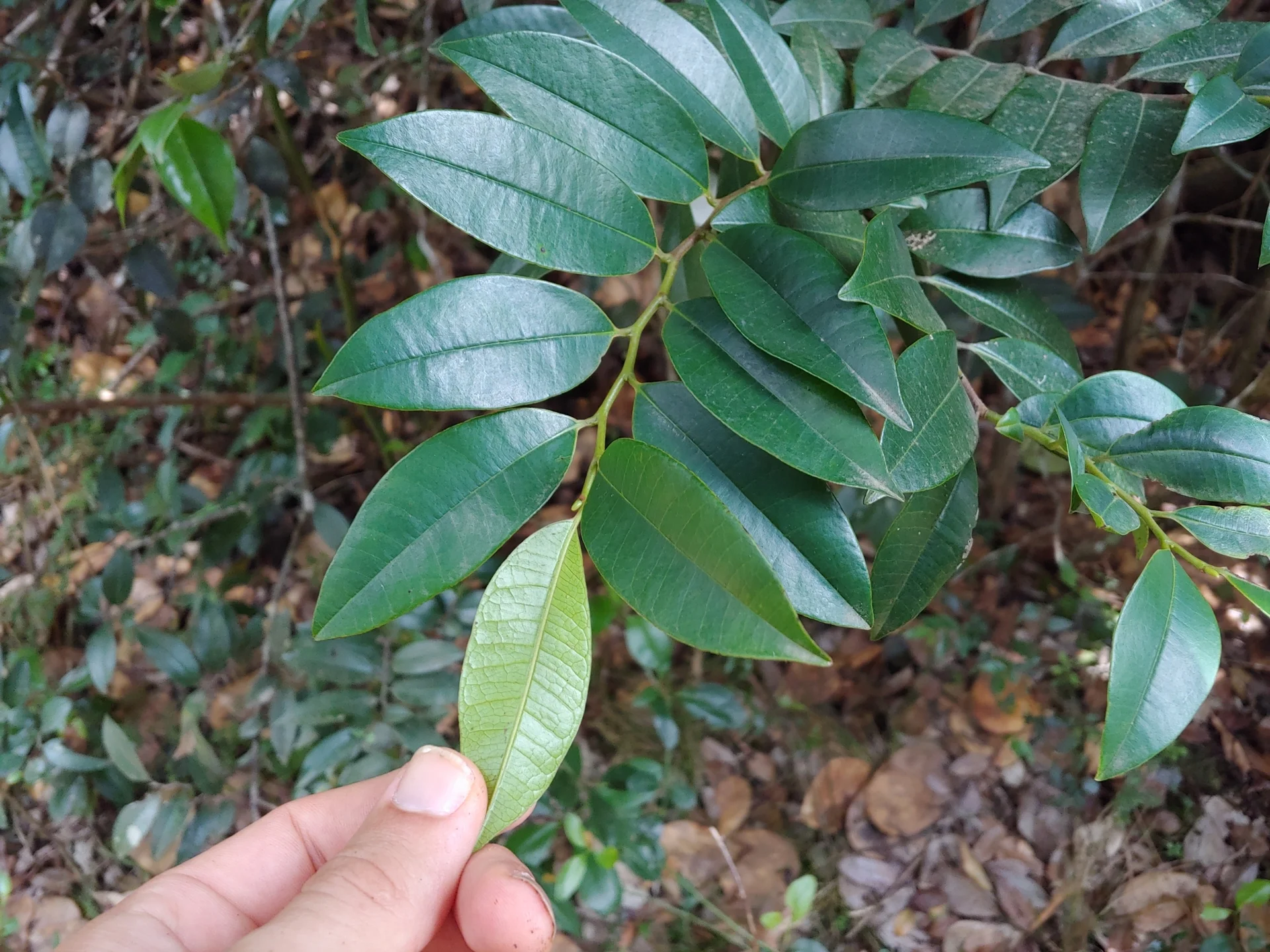
Guatteria blainii grows as a medium-sized evergreen tree reaching 8 to 20 meters in height, supported by a cylindrical trunk clothed in dark, fibrous, aromatic inner bark. Its twigs bear alternate, two-ranked (distichous) leaves without stipules.
The leaf blades are elliptic to oblong-lanceolate, coriaceous (leathery), and dark glossy green above, tapering to an acute apex and turning characteristically dark brown or blackish when dried in herbarium specimens.
Flowers and apocarpous fruit
Solitary or paired flowers emerge from the leaf axils on slender pedicels lined with tiny bracts:
Perianth structure: Each flower consists of three small, valvate sepals and six fleshy petals arranged in two whorls of three, which open to expose a dome-shaped receptacle packed with numerous stamens and free carpels.
Monocarps: After pollination, the separate carpels develop independently into a cluster of stalked, ellipsoid, single-seeded berry-like fruitlets called monocarps, which turn dark purple to black at maturity while their slender stalks (stipes) flush bright red.
Applications
In rural Cuba and Puerto Rico, the tough, fibrous inner bark and straight, resilient timber of Guatteria blainii (haya minga) have been used locally for rural construction posts, tool handles, and rustic cordage. The tree is also maintained in Caribbean botanical gardens and forest reserves as a native shade and reforestation species for humid limestone and montane habitats.
Interesting facts
Color-coded dispersal and floral pollination chambers
Surviving in the dense, shaded understory of Antillean cloud and karst forests requires precise coordination between flower mechanics and seed dispersers:
Beetle-trapping pollination chamber: The six thick, fleshy petals of Guatteria blainii curve inward over the reproductive center to form a sheltered, fragrant micro-chamber that stabilizes humidity and temperature, inviting small nocturnal beetles inside to feed and transfer pollen before the petals spread open.
High-contrast fruitlet display: Rather than fusing into a single heavy fruit, each fertilized carpel elongates on its own crimson stalk (stipe) and ripens into a glossy black monocarp, creating a two-tone red-and-black visual signal that stands out in dim forest light so fruit-eating birds can pluck individual single-seeded units without dropping the rest of the cluster.
Geography of distribution
Cuba
Dominican Republic
Haiti
Puerto Rico
Sources
Plants of the World Online (POWO). Royal Botanic Gardens, Kew: Guatteria blainii (Griseb.) Urb.
Maas, P. J. M., et al. (2015). Confronting a morphological nightmare: revision of the Neotropical genus Guatteria (Annonaceae). Blumea, 60(1–3), 1–219.
World Flora Online (WFO) & Global Biodiversity Information Facility (GBIF): Guatteria blainii.