West Indian Elm (Guazuma ulmifolia)

Bay cedar Bastard cedar Mutamba Guácima
IUCN: Least Concern
#5F6D39
#2A3810
#889C4B
#A2B164
#40501D

Guazuma ulmifolia (West Indian elm): botany, uses, and habitat

Guazuma ulmifolia, widely known as the West Indian elm or bay cedar, is a fast-growing, medium-sized tree with a broad, rounded crown that thrives across the pastures, hillsides, and dry tropical forests of the Americas. Its specific epithet, ulmifolia, means "elm-leaved" and refers to its rough, serrated, asymmetrical foliage that closely resembles the leaves of a European elm, while the tree itself stands out for its dark, warty, honey-scented fruits.

This resilient pioneer species belongs to the mallow family (Malvaceae) and the cacao tribe (Theobromateae), making it a close botanical relative of the chocolate tree. Although Carl Linnaeus originally placed it in the cacao genus in 1753, the French naturalist Jean-Baptiste Lamarck transferred the plant to the genus Guazuma—derived from its indigenous Taíno and Mexican vernacular names—and formally published its current scientific name in 1789.

Taxonomy

  • ∟ царство Plantae
  • ∟ division Tracheophytes (Vascular Plants)
  • ∟ subdivision Spermatophytes (Seed plants)
  • ∟ Angiosperms
  • ∟ mesangiosperms (Core angiosperms)
  • ∟ eudicots
  • ∟ core eudicots
  • ∟ Superrosids
  • ∟ rosids
  • ∟ malvids
  • ∟ order Malvales
  • ∟ family Malvaceae
  • ∟ subfamily Byttnerioideae
  • ∟ genus Guazuma
  • ∟ species Guazuma ulmifolia (West Indian Elm)

Living Pulse

Morphology

Trunk and crown

In open habitats, Guazuma ulmifolia develops a spreading, densely branched crown and typically reaches 8 to 20 meters in height, though forest specimens can grow up to 30 meters tall. Its straight or slightly twisted trunk measures 30 to 60 centimeters in diameter and is wrapped in grayish-brown bark furrowed with longitudinal and transverse cracks.

Beneath the outer bark lies a tough, fibrous inner layer filled with colorless, mucilaginous sap—a slippery, water-retaining gel composed of complex plant polysaccharides. Young twigs are slender and densely coated with microscopic, rust-colored hairs.

Leaves

The leaves are simple and arranged alternately in two flat rows along the branches—a horizontal layout known as distichous phyllotaxis that maximizes light capture without self-shading. Each leaf sits on a short petiole measuring 6 to 20 millimeters and is accompanied at the base by tiny, deciduous stipules (small, scale-like appendages that protect the emerging bud before falling away).

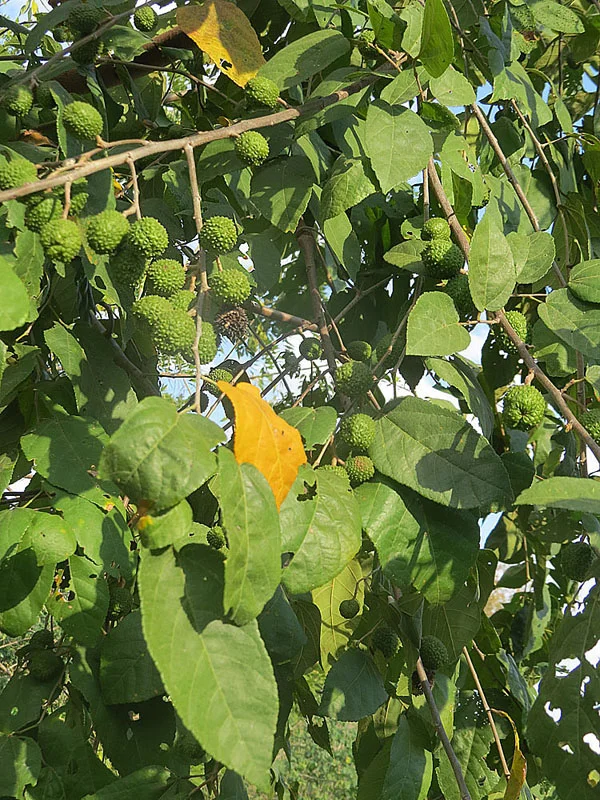
  • The leaf blades are ovate to oblong-lanceolate, measuring 6 to 16 centimeters long and 2.5 to 6 centimeters wide, with a finely serrated margin and a sharply pointed apex.
  • The leaf base is distinctly asymmetrical and slightly heart-shaped, giving rise to three to five prominent main veins that are sunken on the upper surface and raised underneath.
  • Both surfaces—especially the paler underside—are covered in stellate trichomes, which are microscopic, star-shaped hairs that scatter harsh sunlight and impart a rough, sandpaper-like texture.

Flowers

Small, fragrant, yellowish-brown to cream-colored flowers emerge in dense, branched clusters called thyrses or panicles, measuring 2.5 to 5 centimeters long in the leaf axils. Each radially symmetrical, five-parted flower measures about 1 centimeter across and exhibits a specialized architecture shared with its relatives in the subfamily Byttnerioideae.

  • The bell-shaped calyx splits into two or three boat-shaped lobes coated on the outside with fine, whitish-gray hairs.
  • Each of the five concave, hooded petals curves inward at the tip and extends into a long, ribbon-like, deeply forked appendage—a ligule—tinted whitish-red or brown.
  • The reproductive column fuses five sterile, triangular staminodes (nectar-guiding false stamens) with five fertile staminal groups, each bearing three two-lobed anthers that arch directly inside the petal hoods.

Fruits and seeds

After pollination by bees and small insects, the superior five-chambered ovary matures into a hard, woody, subglobose to ellipsoid capsule measuring 1.5 to 4 centimeters in diameter. As the fruit ripens from green to purplish-black, its surface becomes muricate—studded with coarse, pyramid-shaped tubercles and woody warts.

Unlike typical capsules that split wide open, these fruits remain mostly closed or develop minute pores at the warts, holding dozens of hard, grayish-brown, ovate seeds about 3 millimeters long. Each seed is wrapped in a specialized outer coat called a myxotesta, which turns into a sticky, sweet-tasting mucilage as soon as it contacts moisture.
Flowering season

Capable of flowering throughout the year depending on local rainfall cycles, with the primary blooming peak occurring from April to November.

Jan
Feb
Mar
Apr
May
Jun
Jul
Aug
Sep
Oct
Name
Dec

Applications

Silvopasture and livestock nutrition

Across tropical America and the Caribbean, farmers cultivate Guazuma ulmifolia as a cornerstone of silvopastoral systems—agricultural landscapes that integrate trees with grazing livestock. Because the tree retains its foliage and ripens its fruits during the peak of the dry season, its protein-rich leaves and sweet capsules provide critical fodder for cattle, horses, and pigs when pasture grasses wither.

Ranchers also plant the tree along fence lines as living posts and shade providers that cool grazing animals and shelter soil from erosion. Because it colonizes compacted and nutrient-poor ground rapidly, foresters widely use it in heterogeneous reforestation projects to rehabilitate degraded lands.

Food, crafts, and timber

Both fresh and cooked fruits are consumed by people in rural communities, valued for their sweet, mucilaginous pulp that smells and tastes distinctly of honey and toasted grain. Crushed seeds and pulp are steeped in water to prepare refreshing beverages or ground into flour for traditional local confections.

  • The lightweight, pinkish-brown timber is easy to work and is used for interior carpentry, crates, tool handles, barrel staves, and high-grade charcoal.
  • Strong bast fibers stripped from the inner bark and young stems are twisted into durable ropes, cordage, and rural weaving materials.
  • In the Yucatán Peninsula, ancient Maya artisans extracted the tree's sticky mucilage—known locally as pixoy gum—to use as an organic binder that fixed mineral pigments onto plaster murals, such as those preserved at Ek' Balam.

Traditional medicine and pharmacology

Indigenous healers from Mexico and Guatemala to the Amazon basin have long prepared decoctions of the bark, leaves, and fruits to soothe gastrointestinal inflammation, dysentery, respiratory infections, and skin ailments. In Indonesia, where the tree has been cultivated for over a century under the name jati belanda, dried leaves are brewed into herbal teas aimed at managing weight and lipid absorption.

  • Phytochemical analyses show that the bark is rich in condensed tannins and antioxidant proanthocyanidins—particularly procyanidin B-2, a polyphenol investigated in dermatological studies for stimulating hair follicle cell proliferation.
  • Laboratory studies indicate that bark and leaf extracts contain kaurenoic acid, flavonoids, and a small amount of natural caffeine (around 0.14% in the leaves), exhibiting antibacterial, smooth-muscle-relaxant, and angiotensin-inhibiting activities in experimental models.
  • Because bark extracts demonstrate uterine-stimulating and blood-pressure-lowering effects in pharmacological trials, traditional and clinical guidelines advise against internal use during pregnancy, lactation, or alongside antihypertensive medications.

Interesting facts

Two-level floral chambers

Although the flowers of Guazuma ulmifolia are barely a centimeter wide, their internal geometry functions like a two-story building with separate entrances for pollen delivery and reception. The five concave petals form individual hooded alcoves around the fertile anthers, while the five triangular staminodes converge in the center to form a tight cone around the female styles.

  • When a small foraging bee lands on the flower, the long, forked petal appendages act as landing rails that guide the insect either toward the central female cone or into the side alcoves housing the stamens.
  • This spatial separation prevents the flower from clogging its own stigma with self-pollen and ensures that visiting insects brush against the reproductive organs in a precise, repeatable sequence.

Sweet armor and gut-driven seed dispersal

At first glance, a hard, black, wart-covered woody capsule that refuses to split open seems poorly suited for releasing tiny seeds. Yet every detail of this fruit is calibrated for endozoochory—seed dispersal through the digestive tracts of large herbivores such as tapirs, deer, peccaries, and domestic horses or cattle.

  • During the parched tropical dry season, the ripe capsules emit a rich, honey-like aroma and store water-soluble sugars and mucilage inside their woody walls, enticing hungry mammals to crunch them whole.
  • The tough seed coats survive the grinding molars and stomach acids of the animal, while the moisture-activated myxotesta lubricates their passage and later binds moisture around the seed after it is deposited in nutrient-rich dung across open clearings.

Geography of distribution

  • Antigua and Barbuda
  • Argentina
  • Bahamas
  • Barbados
  • Belize
  • Bolivia
  • Brazil
  • Cayman Islands
  • Colombia
  • Costa Rica
  • Cuba
  • Dominica
  • Dominican Republic
  • Ecuador
  • El Salvador
  • French Guiana
  • Grenada
  • Guadeloupe
  • Guatemala
  • Guyana
  • Haiti
  • Honduras
  • India
  • Indonesia
  • Jamaica
  • Martinique
  • Mexico
  • Montserrat
  • Nicaragua
  • Panama
  • Paraguay
  • Peru
  • Puerto Rico
  • Saint Kitts and Nevis
  • Saint Lucia
  • Saint Vincent and the Grenadines
  • Sri Lanka
  • Suriname
  • Trinidad and Tobago
  • Venezuela
  • United States Virgin Islands

Technical Information

Taxon Synonyms: Theobroma guazuma, Guazuma blumei, Guazuma tomentosa, Guazuma tomentosa var. parvifolia, Guazuma coriacea, Guazuma ulmifolia var. trianae, Guazuma ulmifolia var. velutina, Guazuma ulmifolia var. glabra, Guazuma ulmifolia var. tomentosa

External Databases: GBIF, POWO, Tropicos

See also

True Araucarias

True Araucarias

Araucaria sect. Araucaria

Araucaria sect. Araucaria is a botanical section of evergreen conifers native to South America. It …