Kentucky coffee-tree
Kentucky mahogany
American coffee berry
Nicker tree
Stump tree
Chicot
IUCN: Least Concern
#5B6A33
#455219
#2D3A0E
#4F6646
#1C2C15
Plant palette
Kentucky Coffeetree (Gymnocladus dioicus): Botany, Uses, and Care
Gymnocladus dioicus, widely known as the Kentucky coffeetree, is a stately deciduous tree native to the river valleys and limestone woodlands of the United States and southern Ontario in Canada. It stands out for its coarse, bold winter silhouette and massive doubly compound leaves that unfold in shades of bright pink before turning bronze-green. The generic name combines the Greek words for "naked" and "branch" in reference to its stout, twigless limbs that remain bare for half the year, while the specific epithet dioicus („two households“) highlights that male and female flowers grow on separate individual trees.
This species belongs to the legume family (Fabaceae), within the subfamily Caesalpinioideae, and is the only North American representative of its otherwise Asian genus. Carl Linnaeus first described the plant in 1753 under the name Guilandina dioica, and the German botanist Karl Heinrich Koch transferred it to its current placement as Gymnocladus dioicus in 1869.
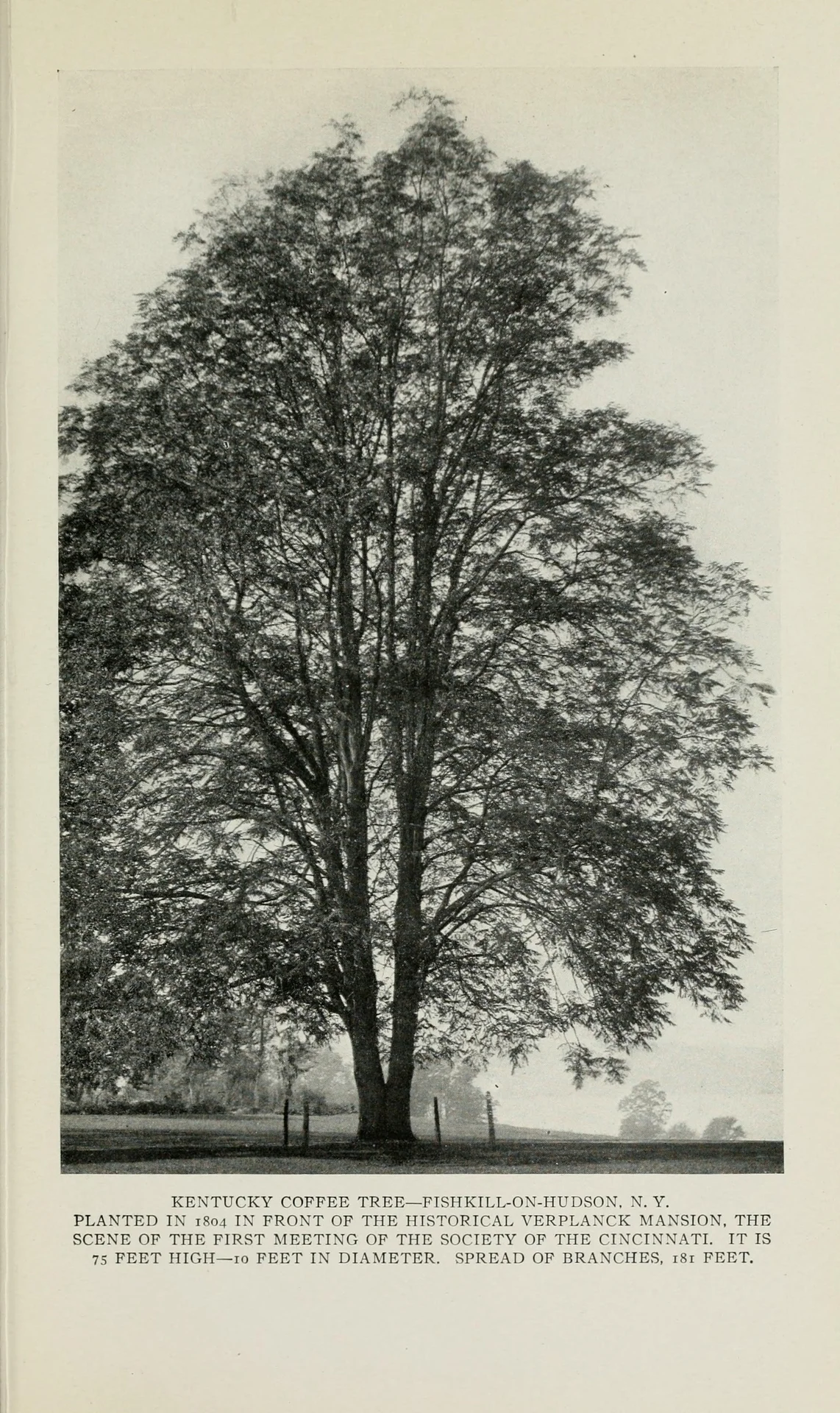
Botanical illustration
Фото: BioDivLibrary / Лицензия: Public Domain Mark
Morphology
Crown and Trunk Architecture
In full sun, the tree reaches 18 to 30 meters in height, dividing a few meters above the ground into three or four ascending limbs that build a narrow, dome-like crown. In dense forest stands, it instead sends up a tall, straight, unbranched central shaft.
The trunk is clad in ash-gray to dark brown periderm (outer bark) that splits into deep furrows and curls outward in rigid, scaly ridges resembling black cherry bark. Beneath this armor, the wood is heavy, coarse-grained, and reddish-brown with a very thin layer of pale yellow sapwood.
Winter Shoots and Giant Leaves
Because the tree produces no fine spray of small twigs, its stout shoots look starkly bare from autumn until late spring, with tiny bronze buds tucked deep inside downy cavities of the stem. The bark of these robust twigs is marked by large, heart-shaped leaf scars — distinct seals left behind where the previous season's heavy leaf stalks detached — and encloses a wide, salmon-pink central pith.
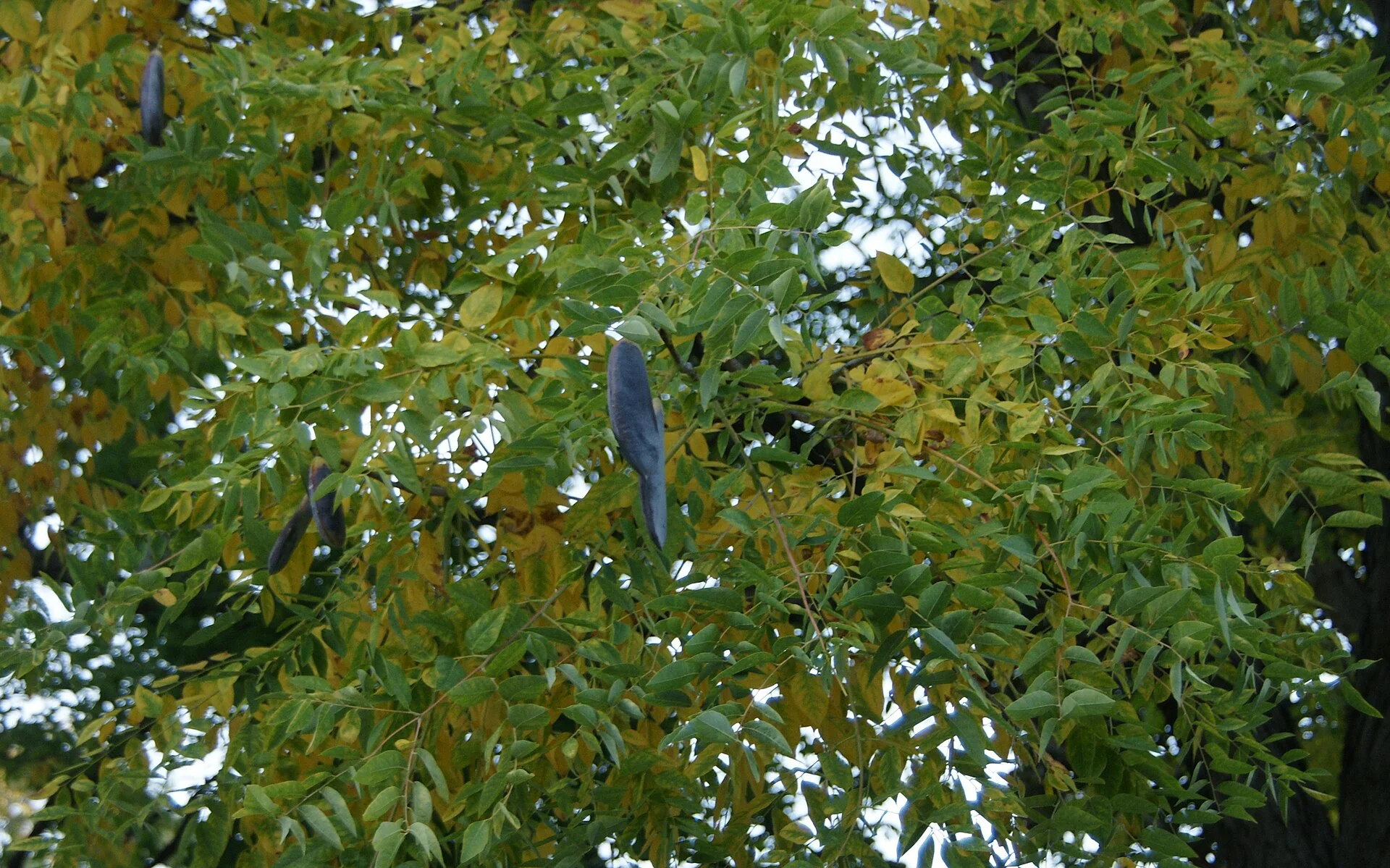
When foliage finally emerges in late spring, the alternate, bipinnately compound leaves (feathery structures divided twice along a central axis) stretch 30 to 90 centimeters long and up to 60 centimeters wide. Each leaf carries 5 to 14 pairs of side branches, with the lowest pair reduced to single ovate leaflets and the upper pairs bearing dozens of smooth-edged leaflets that shimmer bright pink in spring and turn clear golden yellow in early autumn.
Flowers, Pods, and Root System
Inflorescences: In early summer, greenish-white, star-shaped flowers with a crisp lemon fragrance open in terminal clusters; male blooms form compact raceme-like corymbs 7 to 10 centimeters long, whereas female blooms hang in looser clusters up to 30 centimeters long.
Woody legumes: Pollinated female flowers mature into hard, dark reddish-brown, thick-walled pods 15 to 25 centimeters long that hang on the bare branches through winter, enclosing 4 to 9 stony, dark brown seeds cushioned in a sweet, sticky, dark pulp.
Root network: Seedlings drive down a thick, carrot-like taproot (a deep primary vertical root) that later branches into fibrous lateral roots capable of sending up clonal root suckers to form small, interconnected groves.
Flowering season
Blooms in late spring and early summer, typically in May and June, concurrently with or shortly after the new leaves expand.
Jan
Feb
Mar
Apr
May
Jun
Jul
Aug
Sep
Oct
Name
Dec
Applications
Urban Forestry and Landscape Design
Thanks to its tolerance for drought, de-icing salts, alkaline soils, and urban air pollution, Gymnocladus dioicus is widely planted along city streets and in spacious parks across North America and Europe. Landscape architects often select male clones to avoid the litter of heavy fallen pods along sidewalks.
Its habit of leafing out late in spring and dropping foliage early in autumn makes it an effective passive solar shade tree. It blocks intense summer heat while allowing low winter sunlight to warm buildings and pavements for six months of the year.
Woodworking and Historical Uses
Cabinetry and carpentry: The heavy, strong, reddish-brown heartwood resists decay in contact with the ground and takes a high polish, making it prized by cabinetmakers, turners, and carpenters for furniture and interior woodwork.
Historical beverage substitute: Indigenous peoples — including the Meskwaki, Ho-Chunk, and Pawnee — as well as early European settlers in the Ohio and Kentucky river valleys, roasted the hard seeds thoroughly to neutralize the toxic alkaloid cytisine and brewed them into a bitter coffee substitute or ate them like roasted chestnuts.
Traditional crafts and games: Eastern Native American tribes polished and carved the smooth, stony seeds for use as jewelry beads and as dice in traditional ceremonial games of chance, while the saponin-rich pod pulp saw use in folk medicine and soap-making.
Interesting facts
An Evolutionary Anachronism Built for Ice Age Giants
Botanists regard Gymnocladus dioicus as a classic evolutionary anachronism — a plant whose fruit structure is finely tuned to partner with animals that vanished thousands of years ago. Its leathery, thick-walled pods are too tough for modern deer or rodents to chew open, too heavy to ride the wind, and laced with cytisine (a potent quinolizidine alkaloid that deters small mammals from eating the raw seeds).
During the Pleistocene, however, North American megafauna such as mastodons and giant ground sloths were drawn to the sweet, sticky pulp inside the pods and swallowed the fruits whole. Their massive molars nicked the rock-hard seed coats without crushing the embryos, and their digestive tracts deposited the seeds in nutrient-rich dung far from the parent tree.
Engineering Survival After the Megafauna
Impermeable seed armor: The seed coat is so dense and water-tight that in modern times germination in the wild mainly occurs along wet floodplains, where standing water and freeze-thaw cycles slowly rot the tough outer shell.
Human-assisted dispersal: After the extinction of large Ice Age browsers, Indigenous communities became key dispersers by carrying the prized gaming seeds between camps and nicking their surfaces with decorative carvings, inadvertently performing scarification (breaching the hard seed coat so water can enter and wake the embryo).
Frost-proof spring timing: By keeping its winter buds sunken inside insulated stem cavities and waiting to unfurl its giant leaves until late May or June, the tree completely bypasses late spring freezes that damage earlier-leafing neighbors.