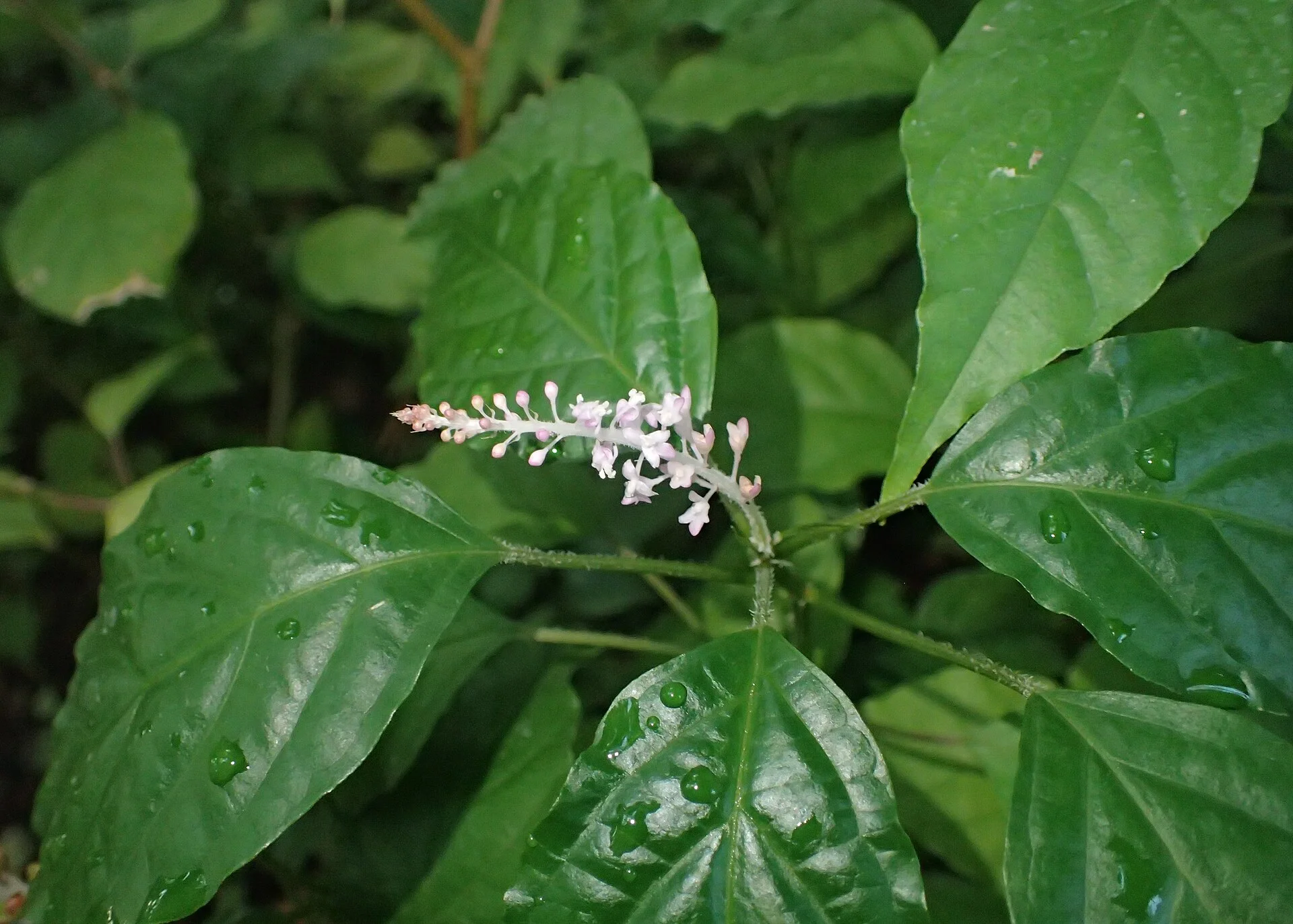
Native to the tropical regions of South America and Africa, Hilleria latifolia thrives in a variety of diverse habitats. Recognized for its exceptionally broad geographical distribution, this species spans from Colombia and Brazil across the Atlantic to Madagascar and Sri Lanka.
Historically, local populations have interacted with the plant in various ways, identifying it as a valuable resource in regional traditions. Taxonomically, it is classified within the Petiveriaceae family, though older records occasionally group it under Phytolaccaceae.
The specific epithet latifolia translates to "broad-leaved", directly referencing the notably wide foliage characteristic of this species. Like other members of its genus, it typically features simple, alternate leaves along its stems.
The plant develops a herbaceous to slightly woody structure as it matures. It produces inflorescences typical of the family, which play a crucial role in its reproductive cycle across its extensive natural range.
Applications
In various regions of tropical Africa, Hilleria latifolia is documented for its use as a medicinal plant. Local communities utilize different parts of the plant in traditional remedies and preparations.
Despite its historical usage in folk practices, comprehensive scientific and pharmacological studies evaluating its specific active compounds remain relatively scarce.
Interesting facts
The species possesses an exceptionally vast natural range, occurring naturally on both the South American and African continents. This transatlantic distribution highlights the remarkable adaptability and resilience of the plant.
Throughout its botanical history, it has been known by numerous synonyms, including Mohlana latifolia and Rivina elastica. Furthermore, the species has successfully naturalized in parts of Asia, such as Sri Lanka.