Iochroma arborescens: Description, Habitat, Chemistry and Traditional Uses
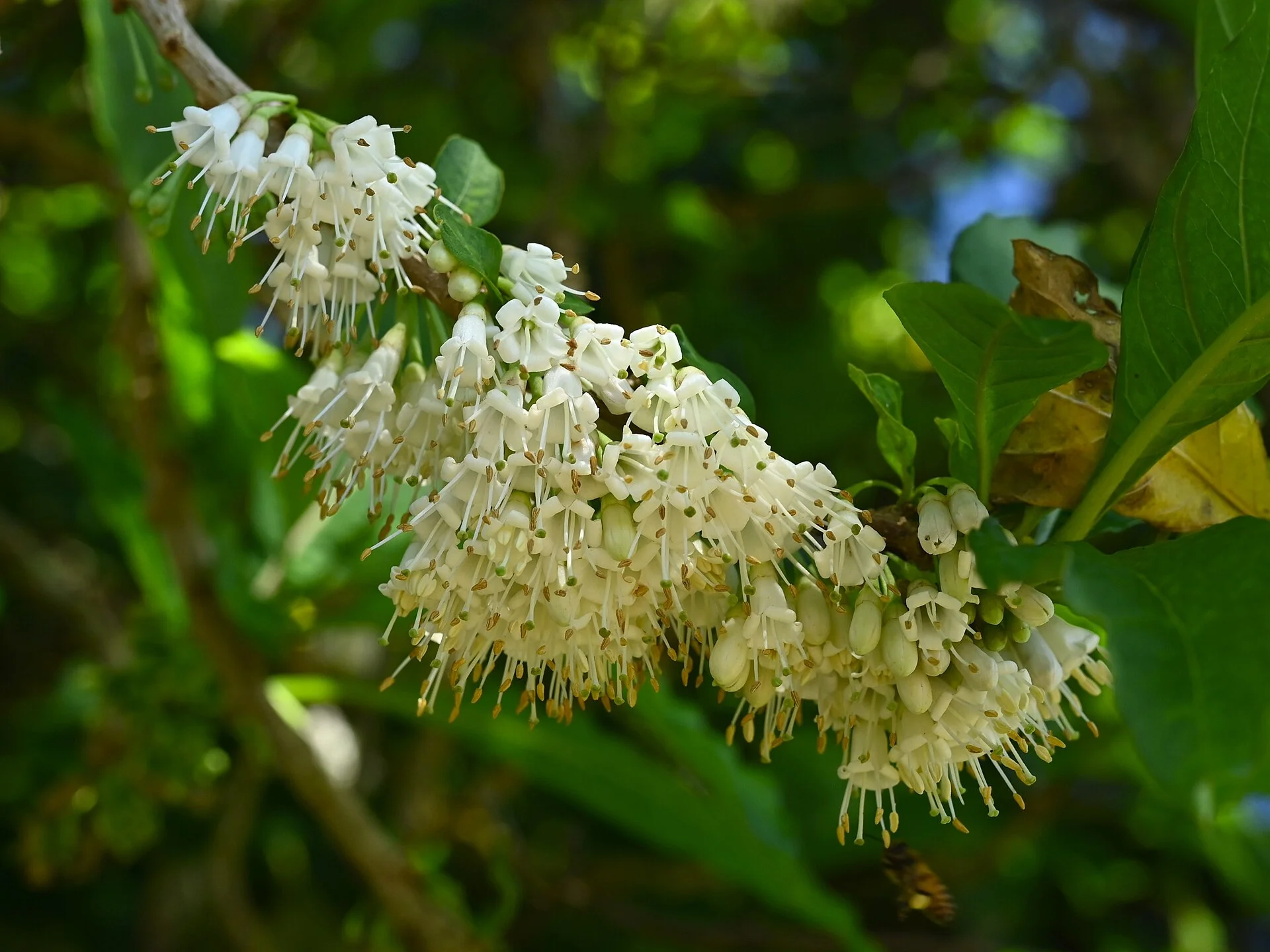
Iochroma arborescens is a sprawling shrub or small tree up to 10 meters tall that thrives in the montane cloud forests and sun-lit clearings of Central America, South America, and the Caribbean. Its specific epithet arborescens translates from Latin as "becoming tree-like," highlighting its sturdy woody trunk, which bears dense clusters of fragrant white-and-green flowers directly on the bare bark below the leafy canopy.
Belonging to the nightshade family (Solanaceae), the species was first scientifically described by Carl Linnaeus in 1756 as Atropa arborescens and spent nearly two centuries in the monotypic genus Acnistus before Julian M. H. Shaw transferred it to Iochroma in 2018.
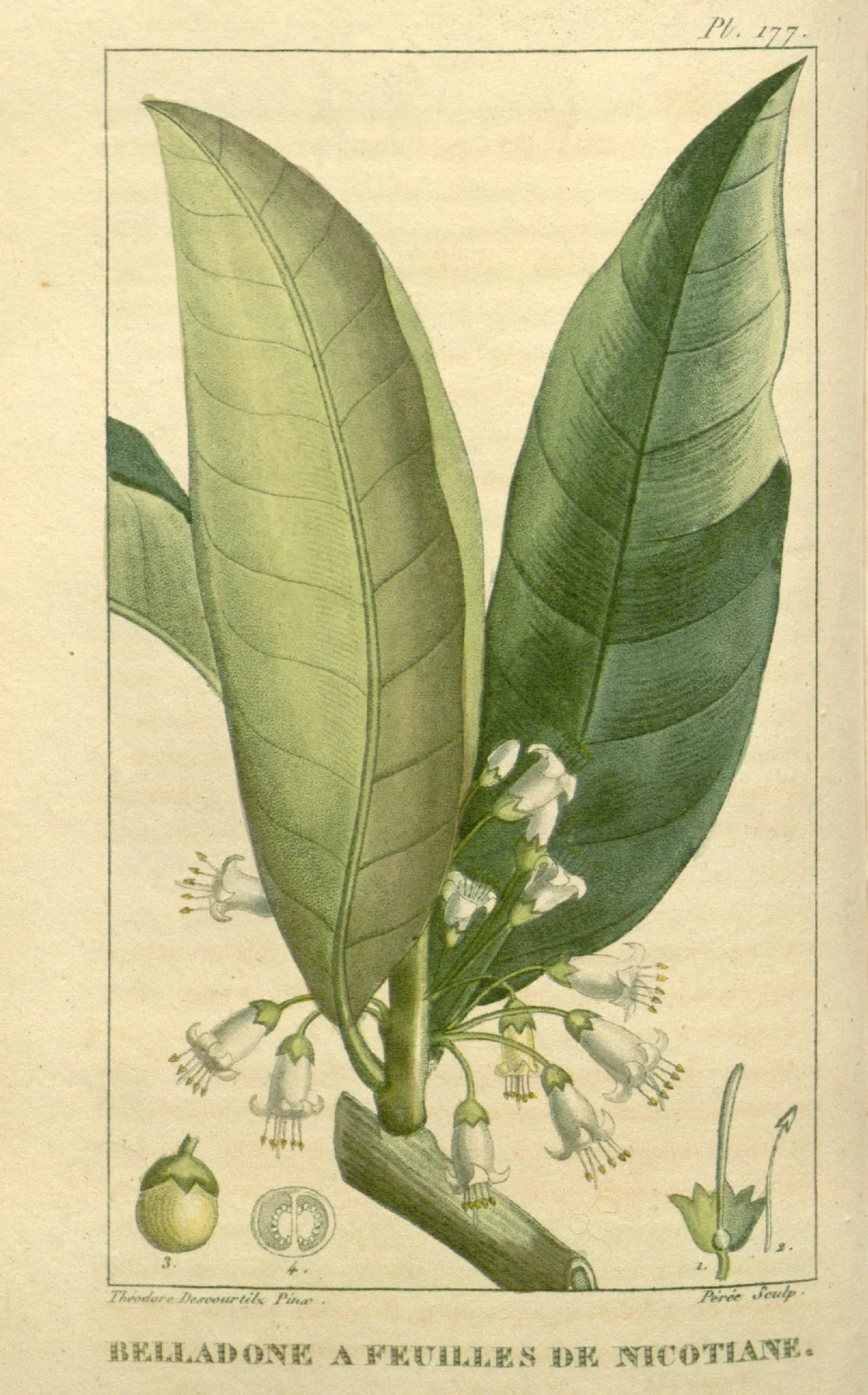
The plant develops into a multi-branched woody shrub or small tree reaching up to 10 meters in height with a soft, pithy core that inspired the common name hollowheart. Young stems and unfolding leaves are covered in a fine coat of rusty trichomes—microscopic protective hairs that gradually shed as the tissues mature.
The simple leaves are arranged alternately along the upper branches and have an elliptical blade measuring 15 to 30 cm long and 5 to 15 cm wide. Each leaf tapers into a long, wedge-shaped base and a pointed tip, with smooth or slightly wavy margins.
Flowers and fruits
Blooming occurs on the leafless, woody portions of the branches, where 30 or more fragrant flowers emerge together in dense fascicles:
The corolla forms a broad, funnel-shaped tube about 1.2 cm long with recurving lobes marked on the inside by a green patch that matures to yellow.
Five prominent stamens—the pollen-producing filaments—extend outward from the throat, bearing small cream to greenish-white anthers measuring 1.4 to 2.1 mm in length.
The fruit is a globose, glossy orange berry measuring 1 to 1.5 cm in diameter and packed with numerous small seeds.
Flowering season
Flowers sporadically throughout the year in tropical climates, with main fruiting occurring from March to July.
Jan
Feb
Mar
Apr
May
Jun
Jul
Aug
Sep
Oct
Name
Dec
Applications
In tropical landscaping and ecological restoration projects across Central and South America, Iochroma arborescens is planted as an ornamental tree and living fence. Gardeners value its year-round floral display and heavy crops of golden-orange berries, which attract dozens of native frugivorous birds—a trait reflected in its Brazilian name fruta-de-sabiá (thrush-fruit).
Although the plant contains bioactive compounds that vary widely across regional populations, people have utilized its parts in several traditional ways:
Traditional medicine: Hot infusions of the crushed leaves and bark are applied externally in the Caribbean and Latin America as poultices for bruises, sprains, neuralgia, and skin irritations.
Phytochemical research: Leaf extracts rich in withanolides—naturally occurring steroidal lactones—and specialized withaphysalins are studied in laboratory settings for their in vitro cytotoxic activity against human cancer cell lines.
Local culinary use: In regions where non-bitter chemical races grow, the ripe orange berries are occasionally cooked into local fruit jellies and preserves, though raw consumption in excess can cause digestive upset.
Interesting facts
An invisible chemical beacon for honeybees
To ensure pollination amid the dense, competing vegetation of montane cloud forests, the flowers of Iochroma arborescens synthesize a rare volatile compound called 3,5-dimethoxytoluene (orcinol dimethyl ether). While this aromatic molecule is nearly odorless to the human nose, the olfactory receptors of honeybees are tuned to detect it at minute concentrations, turning the pale floral clusters into high-contrast scent beacons.
Coordinated architecture for bird dispersal
The positioning of the flowers and fruits demonstrates a finely tuned mechanical coordination between plant architecture and animal behavior:
By producing blossoms directly on the sturdy, leafless lower branches—a phenomenon near ramiflory—the tree keeps its flowers and ripening berries clear of dense foliage that would otherwise block approaching visitors.
As the corolla ages, the green nectar guides inside the petals shift to yellow, signaling to pollinators which flowers have already been visited while directing perching birds toward the developing orange berries.
The species also exhibits distinct chemical races across its range: while leaves contain protective alkaloids like acnistine and volatile aldehydes such as (Z)-hex-2-enal to deter leaf-eating insects, the ripe pulp of bird-dispersed populations softens to allow safe seed transport by thrushes and tanagers.