
Creeping False Holly
Jaltomata procumbens
A sprawling herbaceous to semi-woody perennial in the nightshade family, native from the southwestern United …
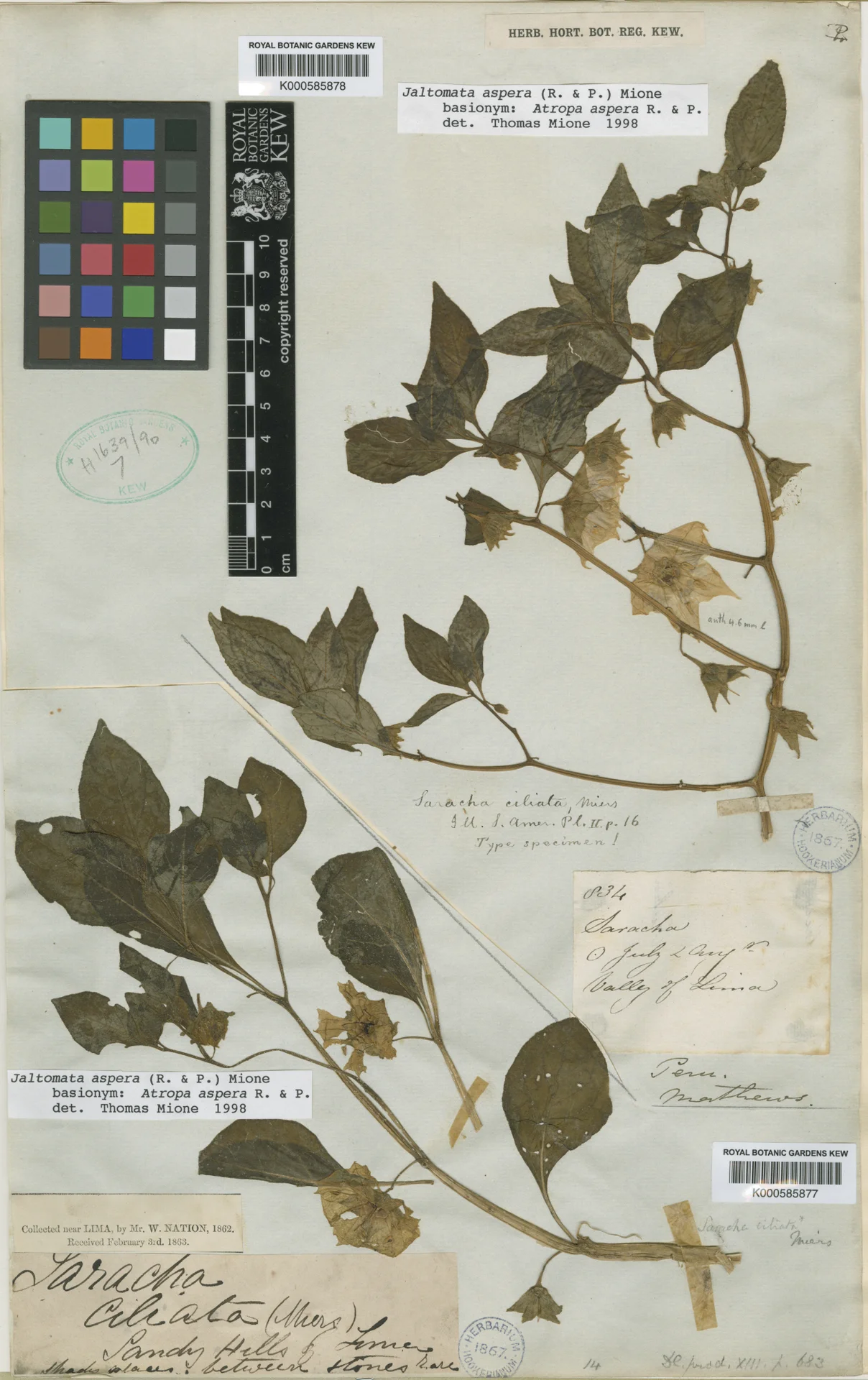
Jaltomata aspera is a branched shrub up to two meters tall that grows on rocky hillsides in Peru at elevations below 1,800 meters. Its specific epithet aspera means "rough" in Latin, referring to the textured pubescence of its stems and leaves, while its hanging greenish-yellow flowers stand out for producing striking blood-red nectar.
This species belongs to the nightshade family (Solanaceae) and was originally described in 1799 by the Spanish botanists Hipólito Ruiz López and José Antonio Pavón under the name Atropa aspera. In 1992, researchers Thomas Mione and Felix G. Coe transferred the taxon to its current placement in the genus Jaltomata.
Jaltomata aspera grows as a woody-based shrub reaching up to 2 meters in height. Its young stems and leaf surfaces are covered with rough trichomes—microscopic plant hairs that protect the tissues from intense mountain sunlight and moisture loss.
Unlike many of its relatives that bear multi-flowered clusters, this shrub typically produces solitary, nodding flowers that hang downward like miniature bells. Its floral and fruiting structures display several distinct traits:
In rural communities of Peru, the ripe berries of Jaltomata aspera are occasionally gathered from the wild and eaten fresh as a sweet snack. Beyond local foraging, the species is grown in university research greenhouses as a model organism for studying floral evolution and colored nectar chemistry within the family Solanaceae.
Most flowering plants produce transparent, colorless nectar and rely entirely on brightly pigmented petals to attract pollinators from a distance. Jaltomata aspera reverses this classic design by pairing a muted greenish-yellow corolla with vivid blood-red nectar that pools inside the hanging floral cup.
On the sun-baked, rocky slopes of western Peru, this liquid pigment acts as an unmistakable visual bullseye for daytime flower visitors hovering below the nodding blooms. The coordination between the downward-facing flower angle, the pale background of the petals, and the dark red sugar reward demonstrates how precisely the plant's optical signaling and floral geometry are tuned to its arid mountain habitat:
Taxon Synonyms: Atropa aspera, Saracha urbaniana, Saracha ciliata, Saracha lacrima-virginis, Witheringia ciliata
Jaltomata procumbens
A sprawling herbaceous to semi-woody perennial in the nightshade family, native from the southwestern United …

Jaltomata dentata
A wild Andean shrub in the nightshade family native to the high mountain slopes of …

Jaltomata viridiflora
A high-Andean herb or scrambling shrub with velvety leaves, tubular pale green flowers, and flattened …

Jaltomata umbellata
A low Peruvian shrub native to coastal fog deserts, bearing umbel-like clusters of cream to …