
Creeping False Holly
Jaltomata procumbens
A sprawling herbaceous to semi-woody perennial in the nightshade family, native from the southwestern United …
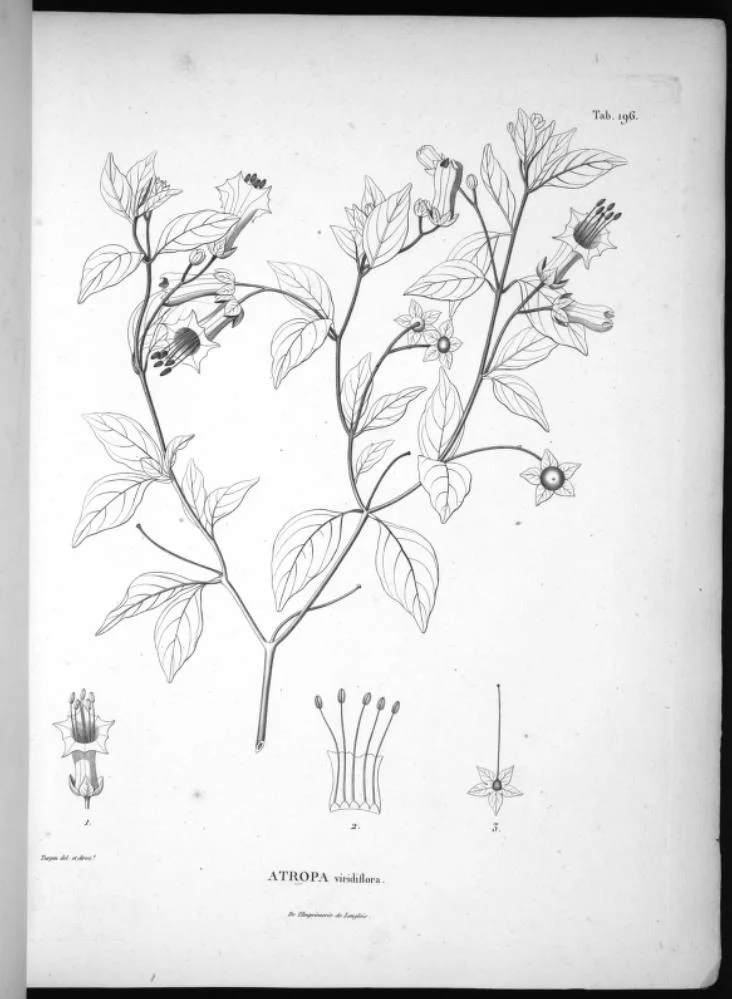
Jaltomata viridiflora is a velvety-leaved herbaceous plant or scrambling shrub up to two meters tall that grows across the high Andes of Venezuela, Colombia, Ecuador, and Peru at elevations between 2,500 and 3,400 meters. Its specific epithet viridiflora translates from Latin as "green-flowered," highlighting its tubular pale green blossoms that later give way to flattened orange-red berries.
Belonging to the nightshade family (Solanaceae), the species was first described in 1818 by the German botanist Carl Sigismund Kunth as Atropa viridiflora from collections made during Alexander von Humboldt and Aimé Bonpland's South American expedition. In 1993, Michael Nee and Thomas Mione transferred the taxon to the genus Jaltomata.
Jaltomata viridiflora develops as an erect or occasionally scrambling shrub reaching up to 2 meters in height. Its young shoots and ovate to ovate-lanceolate leaf blades are densely covered in a velvety to felt-like coat of multicellular, unbranched trichomes (plant hairs), some of which terminate in microscopic glandular heads.
The inflorescences typically carry pairs of flowers—or occasionally between one and four blooms—that hang from the leaf axils. Their reproductive and perianth organs exhibit several characteristic features:
Once fertilized, the ovary swells into a slightly flattened, spherical berry (oblate in shape) measuring 10 to 12 mm in length and 13 to 19 mm in diameter. As the fruit ripens, its skin turns bright orange to reddish.
Across the high Andean valleys of Ecuador, Colombia, and Peru, the sweet, juicy orange-red berries of Jaltomata viridiflora are harvested from wild plants by local residents and consumed fresh. The species is also maintained in living botanical collections to study high-altitude pollination syndromes in the family Solanaceae.
Living at elevations between 2,500 and 3,400 meters in the Andean subpáramo, Jaltomata viridiflora faces intense ultraviolet radiation by day and near-freezing temperatures by night, where cold winds restrict the activity of insect pollinators. In response, the plant combines a high-mountain thermal coat with a tubular floral architecture tailored for high-elevation hummingbirds.
The structural details of its foliage and blossoms work together to maintain tissue warmth and ensure reliable pollen transfer in thin mountain air:
Taxon Synonyms: Hebecladus viridiflorus, Hebecladus lanceolatus, Atropa viridiflora, Hebecladus mollis, Atropa flexuosa, Ulticona viridiflora
Jaltomata procumbens
A sprawling herbaceous to semi-woody perennial in the nightshade family, native from the southwestern United …

Jaltomata dentata
A wild Andean shrub in the nightshade family native to the high mountain slopes of …

Jaltomata umbellata
A low Peruvian shrub native to coastal fog deserts, bearing umbel-like clusters of cream to …

Jaltomata aspera
A wild Peruvian shrub of the nightshade family featuring solitary nodding greenish-yellow flowers filled with …