
Creeping False Holly
Jaltomata procumbens
A sprawling herbaceous to semi-woody perennial in the nightshade family, native from the southwestern United …
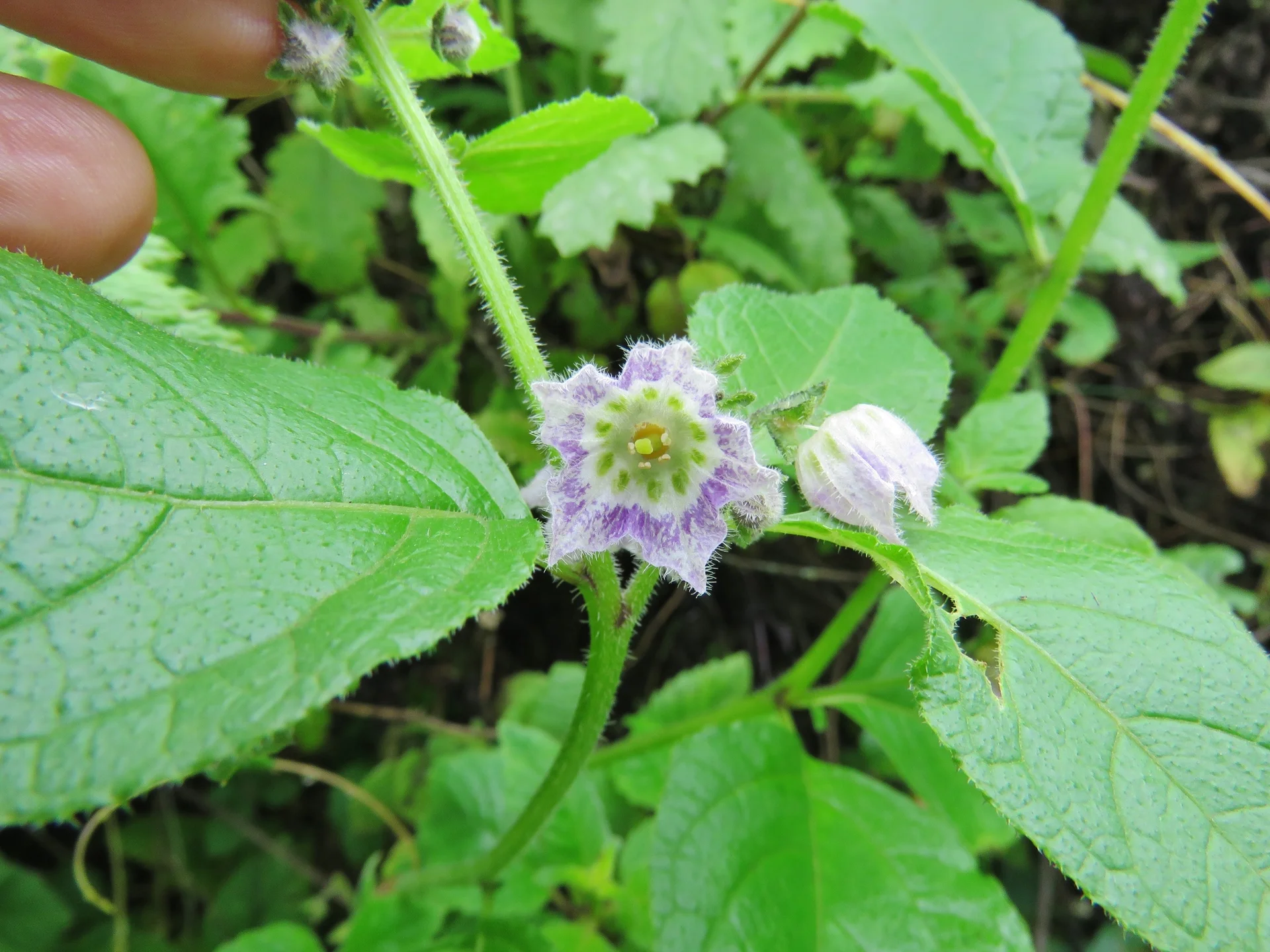
Jaltomata dentata is a branched, woody shrub native to the high mountain slopes and rocky ravines of the Peruvian and Bolivian Andes. Its specific epithet dentata means "toothed" in Latin, pointing directly to the jagged, sinuate-dentate margins of its leaves, while its branches bear nodding bell-shaped flowers and bright orange berries.
This species belongs to the nightshade family (Solanaceae) and was first described in 1799 by the Spanish botanists Hipólito Ruiz López and José Antonio Pavón as Saracha dentata. In 1976, the Venezuelan botanist Carmen Benítez de Rojas transferred the species to its current placement in the genus Jaltomata.
Growing up to 1–2.5 meters tall, this perennial shrub develops woody, terete stems covered in a fine coat of glandular and simple hairs (trichomes). The young shoots often display a slight purplish tint and sticky texture that helps trap small insects and reduce moisture loss in windy mountain habitats.
The inflorescences arise as small umbel-like clusters of 2 to 5 nodding flowers on slender peduncles. Each flower shows a tubular-campanulate to broadly flared corolla (the fused ring of petals) that is pale greenish-yellow to creamy white, often accented by a violet or purplish ring inside the throat.
Flowers primarily during the Andean rainy and transitional seasons from December to May.
In rural Andean communities of Peru, the fully ripe orange berries are occasionally gathered from the wild by local inhabitants and shepherds as a sweet, refreshing trail snack. Outside its native mountain valleys, the plant is maintained in specialized botanical gardens and university research collections to study floral evolution and breeding systems within the family Solanaceae.
Unlike the vast majority of flowering plants that produce clear, colorless nectar hidden deep inside the blossom, Jaltomata dentata secretes conspicuous droplets of yellow-orange to reddish nectar at the base of its pale corolla. Against the greenish-cream background of the petals, these colored droplets act as an honest visual gauge, allowing high-altitude bees and hummingbirds to see from a distance whether a flower holds a fresh energy reward before expending effort in the thin, chilly mountain air.
To prevent automatic self-fertilization, the flowers operate on a coordinated two-stage schedule known as protogyny—the maturation of female organs before male ones.
Taxon Synonyms: Bellinia dentata, Saracha sordideviolacea, Saracha dentata, Witheringia dentata, Atropa dentata
Jaltomata procumbens
A sprawling herbaceous to semi-woody perennial in the nightshade family, native from the southwestern United …

Jaltomata viridiflora
A high-Andean herb or scrambling shrub with velvety leaves, tubular pale green flowers, and flattened …

Jaltomata umbellata
A low Peruvian shrub native to coastal fog deserts, bearing umbel-like clusters of cream to …

Jaltomata aspera
A wild Peruvian shrub of the nightshade family featuring solitary nodding greenish-yellow flowers filled with …