
Creeping False Holly
Jaltomata procumbens
A sprawling herbaceous to semi-woody perennial in the nightshade family, native from the southwestern United …
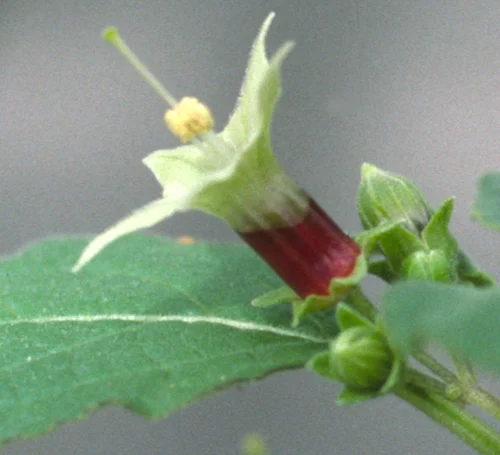
Jaltomata umbellata is a compact shrub reaching up to one meter in height that inhabits the coastal fog deserts (known locally as lomas) of the Lima Department in Peru at elevations between 300 and 500 meters. Its specific epithet umbellata refers to its umbrella-like clusters of four to nine flowers, which feature cream or pale green flaring rims and tubes filled with red nectar.
A member of the nightshade family (Solanaceae), the plant was first described in 1799 by Hipólito Ruiz López and José Antonio Pavón as Atropa umbellata in their monumental work Flora Peruviana, et Chilensis. In 1993, botanists Thomas Mione and Michael Nee transferred the species to the genus Jaltomata.
Jaltomata umbellata forms a branched shrub up to 1 meter tall with young shoots and outer calyx surfaces covered in a dual layer of trichomes—both straight glandular hairs that secrete sticky compounds and shorter, branched non-glandular hairs. The leaf blades are ovate with a pointed apex and smooth, entire margins, measuring up to 11 cm long and 8 cm wide.
The flowers are borne in umbel-like clusters of four to nine blooms supported by a main peduncle (inflorescence stalk) 4.5 to 11 mm long and densely glandular individual flower stalks (pedicels) measuring 6 to 9 mm. Each blossom displays a specialized architecture:
Following pollination, the flower develops into a spherical orange berry enclosed at the base by an accrescent calyx whose radius expands to 6–8 mm as the fruit matures. Inside the pulp lie numerous small seeds measuring 1.36 to 1.48 mm across.
Jaltomata umbellata is cultivated in specialized botanical collections and academic research facilities studying the evolutionary biology of South American Solanaceae. Its ripe orange berries are also sporadically eaten fresh by locals visiting the seasonal lomas formations of coastal Peru.
Jaltomata umbellata thrives in the coastal lomas of Lima—isolated islands of vegetation surrounded by hyper-arid desert that receive almost no rainfall and depend entirely on dense winter ocean fog (garúa). To survive in this narrow elevational belt between 300 and 500 meters, the shrub coordinates its surface vestiture, floral timing, and reproductive geometry into a unified survival system.
Every microscopic and macroscopic detail of the plant works in concert to harvest moisture, deter herbivores, and guarantee cross-pollination during brief windows of coastal bloom:
Taxon Synonyms: Witheringia villosa, Kokabus umbellatus, Saracha villosa, Saracha zuccagniana, Atropa villosa, Atropa revoluta, Saracha lobata, Witheringia zuccagniana, Hebecladus turneri, Atropa rothii
Jaltomata procumbens
A sprawling herbaceous to semi-woody perennial in the nightshade family, native from the southwestern United …

Jaltomata dentata
A wild Andean shrub in the nightshade family native to the high mountain slopes of …

Jaltomata viridiflora
A high-Andean herb or scrambling shrub with velvety leaves, tubular pale green flowers, and flattened …

Jaltomata aspera
A wild Peruvian shrub of the nightshade family featuring solitary nodding greenish-yellow flowers filled with …