
Creeping False Holly
Jaltomata procumbens
A sprawling herbaceous to semi-woody perennial in the nightshade family, native from the southwestern United …
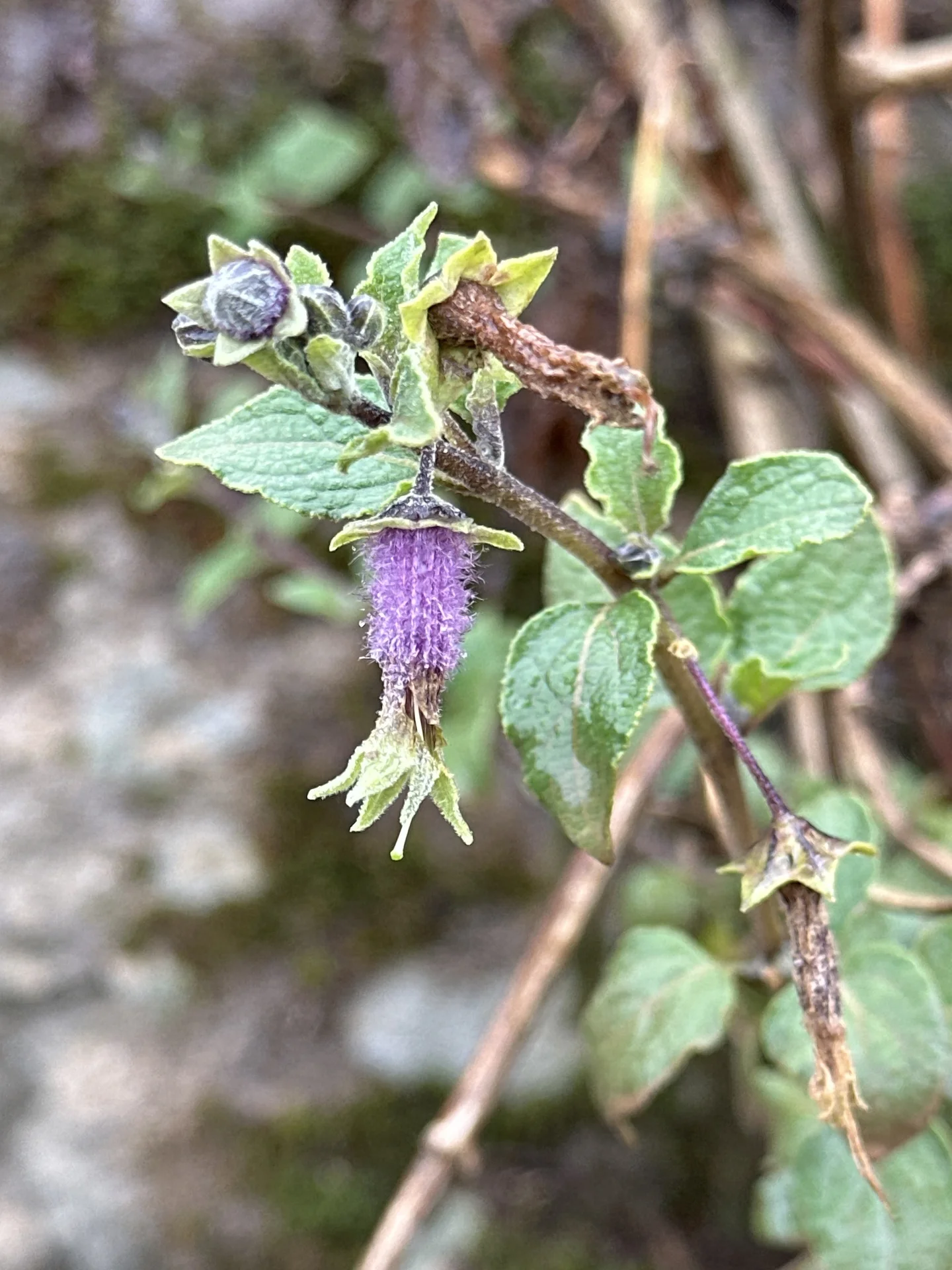
Jaltomata bicolor is a compact woody shrub growing up to one meter tall in the high-altitude rocky ravines, stone walls, and grassy slopes of the central Peruvian Andes between 3,000 and 5,000 meters above sea level. Its specific epithet, bicolor, refers to its striking tubular blossoms, whose lower two-thirds are painted in deep violet while the upper third contrasts in pale yellow or cream.
A member of the nightshade family (Solanaceae), the species was originally collected during the historic Royal Botanical Expedition to Peru and described in 1799 by Spanish botanists Hipólito Ruiz López and José Antonio Pavón as Atropa bicolor. In 1993, American botanist Thomas Mione transferred the species to its modern home in the genus Jaltomata.
The plant forms a resilient, branched woody shrub reaching up to 1 meter in height, often anchoring itself in narrow crevices of Andean stone walls and rocky talus slopes. Young shoots are sparsely to densely clothed in dendritic trichomes — microscopic, tree-like branched hairs that insulate the growing tips against cold mountain winds.
The smooth, hairless leaves are arranged singly, in pairs, or occasionally in whorls along the woody branches. The leaf blades are predominantly ovate, though they vary considerably in size and margin outline depending on altitude and exposure, ranging from entire to slightly wavy-toothed.
The inflorescences arise as umbel-like clusters bearing two to four (rarely five) pendulous flowers. Each flower features a straight, tubular corolla measuring 2 to 3 centimeters in length, crowned by five narrow, triangular, fleshy lobes that are 3 to 5 millimeters long.
Andean rainy and early dry season (December to May)
Living at elevations up to 5,000 meters in the Peruvian puna zone, where freezing nights and gale-force winds deter most flying insects, Jaltomata bicolor relies on a highly coordinated pollination partnership with high-Andean hummingbirds. While most lowland species in the genus Jaltomata have flat, wheel-shaped flowers pollinated by bees, this mountain shrub evolved a long, straight floral tube (2 to 3 centimeters long) that acts as an insulated nectar reservoir tailored to a hummingbird's bill.
Taxon Synonyms: Witheringia biflora, Ulticona biflora, Atropa bicolor, Hebecladus biflorus, Hebecladus intermedius
Jaltomata procumbens
A sprawling herbaceous to semi-woody perennial in the nightshade family, native from the southwestern United …

Jaltomata dentata
A wild Andean shrub in the nightshade family native to the high mountain slopes of …

Jaltomata viridiflora
A high-Andean herb or scrambling shrub with velvety leaves, tubular pale green flowers, and flattened …

Jaltomata umbellata
A low Peruvian shrub native to coastal fog deserts, bearing umbel-like clusters of cream to …