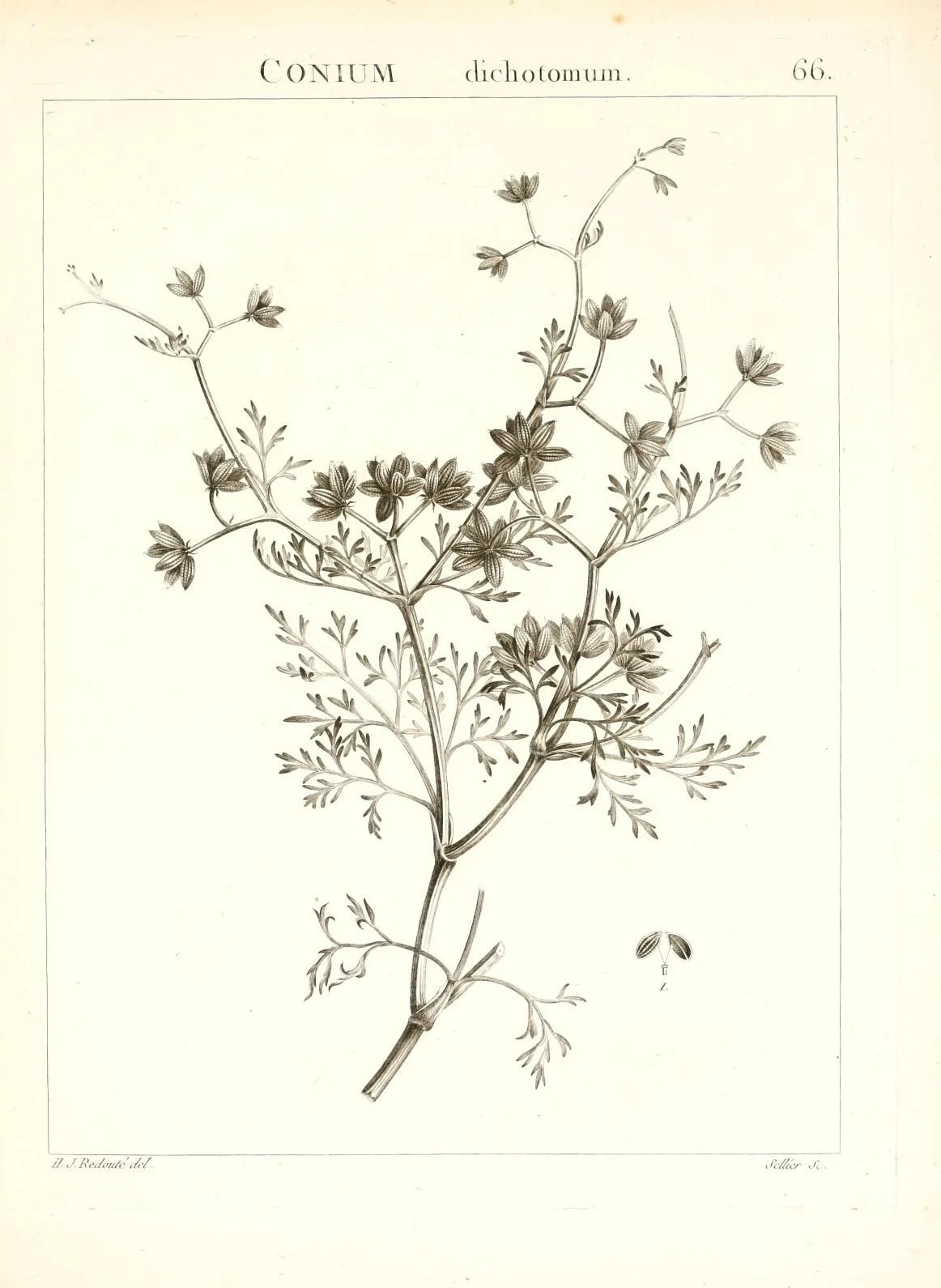
Krubera peregrina: morphology, Mediterranean distribution, and botany
Krubera peregrina is a low-growing, completely hairless annual herb native to sunny slopes, coastal plains, and cultivated fields across the Mediterranean basin and Macaronesia. It stands out for its delicate, fern-like foliage and compact umbels of tiny white flowers that mature into deeply sculpted, thick-walled fruits; its specific epithet peregrina comes from the Latin word for a traveler or wanderer, reflecting its widespread presence along ancient coastal and agricultural trade routes.
It is the sole member of the monospecific genus Krubera within the family Apiaceae (tribe Coriandreae). Originally described by Carl Linnaeus in 1753 as Tordylium peregrinum, it was transferred to its own genus in 1814 by the botanist Georg Franz Hoffmann, who named it in honor of the Moscow physician and botanist Johann Julius Kruber.
As a winter-spring annual (therophyte), Krubera peregrina completes its life cycle rapidly before the onset of summer drought. The entire plant is completely glabrous (smooth and hairless), with a sturdy, often branched stem that grows from 10 to 50 centimeters tall and features noticeable longitudinal ridges and a hollow or solid pith depending on age.
Leaves and vegetative structure
The leaves are arranged alternately along the stem and become progressively smaller and less divided toward the top. They are 2- to 3-pinnatisect, meaning the leaf blade is divided multiple times into narrow, linear-lanceolate segments that minimize water loss under intense Mediterranean sun.
Basal and lower stem leaves: Supported by slender petioles with broadened, membranous margins at the base that clasp the stem.
Upper stem leaves: Nearly sessile (attached directly without a stalk) and divided into fine, thread-like lobes that reduce wind resistance and heat buildup.
Inflorescences and flowers
The flowers are borne in compound umbels—umbrella-shaped clusters typical of the carrot family—located both at the ends of branches and opposite the leaves. Each umbel is compact, consisting of only 2 to 8 stout, unequal rays that thicken noticeably as the fruits develop.
Bracts and bracteoles: The primary umbel has 1 to 5 small, linear-lanceolate involucral bracts (or occasionally none), while the secondary umbellules are subtended by 4 to 6 short bracteoles.
Corolla: The tiny flowers are hermaphroditic with five white or faintly pinkish-white petals whose tips curve inward.
Fruits and seeds
The most diagnostic feature of the species is its fruit, a dry schizocarp that splits at maturity into two single-seeded units called mericarps. Measuring 4 to 7 millimeters long, the fruit is ovoid to oblong and dorsally compressed (flattened from back to front).
Corky ribs: Each mericarp bears five prominent, thick, wavy, and corky ridges—three along the back and two broadened lateral wings along the margins.
Vittae: Embedded within the fruit wall are slender microscopic resin canals (vittae) that contain aromatic compounds, though they are solitary and inconspicuous in mature fruits.
Flowering season
Spring to early summer (March to June)
Jan
Feb
Mar
Apr
May
Jun
Jul
Aug
Sep
Oct
Name
Dec
Interesting facts
While many members of the carrot family rely on hooks, bristles, or paper-thin wings to catch the wind or animal fur, Krubera peregrina uses a specialized architectural approach built around spongy, cork-like tissue. Its Latin epithet peregrina—meaning traveler or pilgrim—aptly reflects how effectively this coastal and lowland plant moves across the Mediterranean and Macaronesian islands.
Hydro-mechanical fruit armor and dispersal
As the plant finishes flowering in late spring, the slender flower stalks (rays) and the walls of the developing fruits undergo a coordinated structural transformation. Instead of remaining thin, the rays thicken and stiffen, while the five ribs on each half-fruit swell into dense, corrugated ridges of suberized (corky) cells filled with microscopic air pockets.
Buoyancy and water transport: The air-filled corky ribs make the mature mericarps buoyant, allowing heavy autumn rains and coastal runoff to float the seeds intact into new alluvial deposits without waterlogging the embryo inside.
Delayed germination control: The thick, woody-corky pericarp acts as a mechanical and chemical barrier that prevents premature sprouting during brief summer showers, ensuring the seed only germinates when prolonged autumn moisture softens the protective casing.
Historical travel with crops: Because the size, density, and shape of the corky mericarps closely mimic cereal grains and large legume seeds, ancient agricultural sorting methods often failed to separate them, allowing this botanical traveler to spread alongside human cultivation across Mediterranean islands.