
Osage Orange
Maclura pomifera
The Osage orange (Maclura pomifera) is a resilient, thorny tree famous for its heavy rot-resistant …
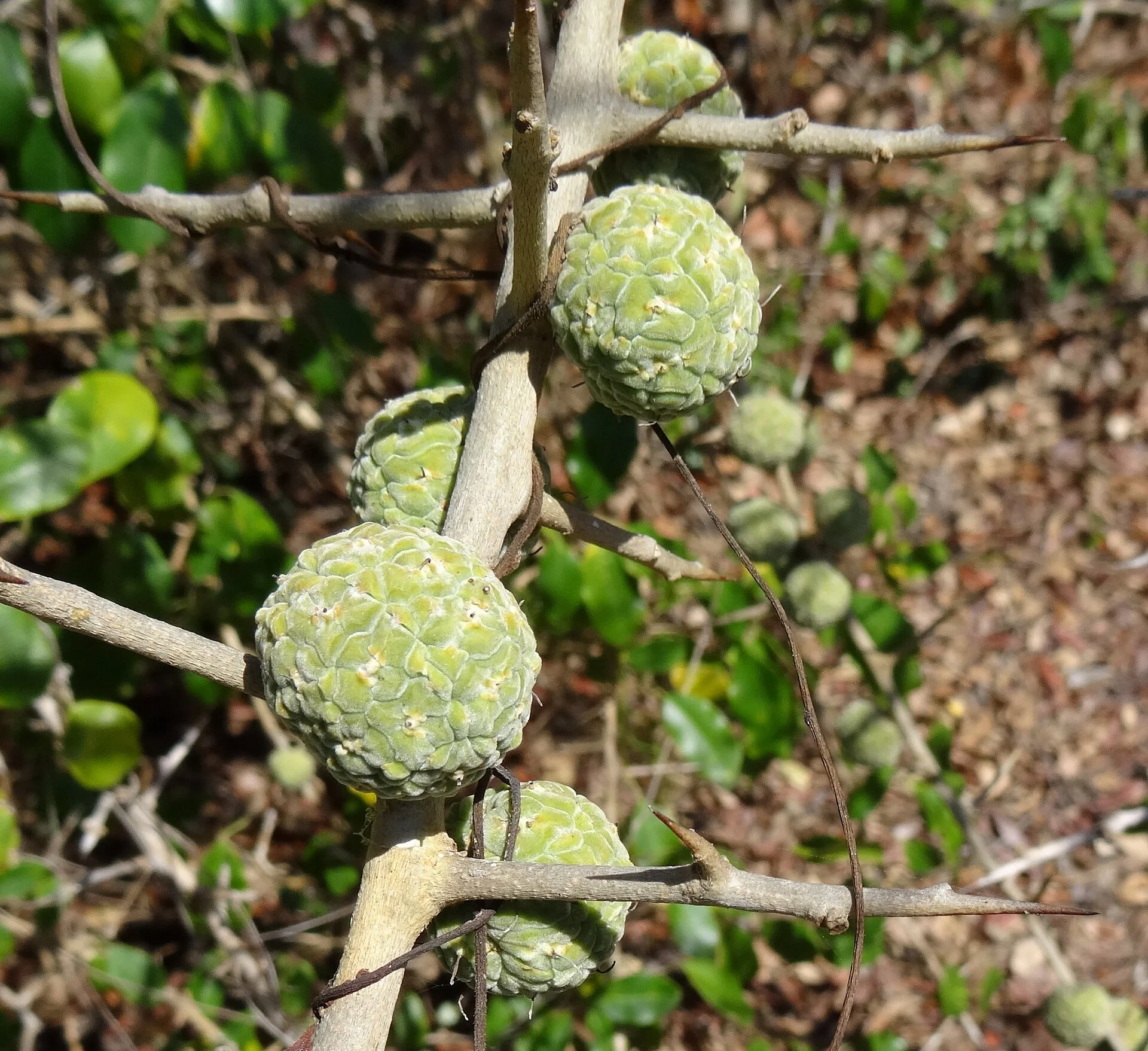
Inhabiting the riverine fringes and low-altitude woodlands of southeastern Africa, Maclura africana grows as a thorny scrambler or small tree. Its long, arching branches climb over surrounding vegetation to reach sunlight. The species plays a key role in local ecosystems by providing cover and food for fauna.
Local communities occasionally harvest the plant from the wild to extract natural pigments. Its formidable spines also make it suitable as a protective barrier. Despite its ecological value, it remains relatively underutilized in modern landscaping.
The growth habit of this species ranges from a heavily armed, multi-stemmed shrub to a small tree reaching up to 7 meters. Its slender branches are equipped with sharp, solitary spines that assist in climbing. The leaves are simple, alternate, and coriaceous, exhibiting an elliptic or obovate shape.
This dioecious plant produces small, unisexual flowers clustered in dense, globose heads. The female flowers develop into globose, green fruits that mature into yellow-orange syncarps. These aggregate fruits contain small seeds embedded within a fleshy pulp.
October to January
The heartwood and roots of this species yield natural yellow pigments used locally to color fabrics. In some African regions, it is planted along field borders to form impenetrable, protective hedges. The dense wood is also gathered for fuel or carved into small household implements.
Maclura pomifera
The Osage orange (Maclura pomifera) is a resilient, thorny tree famous for its heavy rot-resistant …

Maclura tricuspidata
A deciduous tree native to East Asia, Maclura tricuspidata is known for its sweet, melon-flavored …

Maclura tinctoria
A medium to large neotropical tree famed for producing fustic, a natural yellow dye historically …

Maclura cochinchinensis
A thorny scrambling shrub or climber native to East Asia and Australia, known for its …