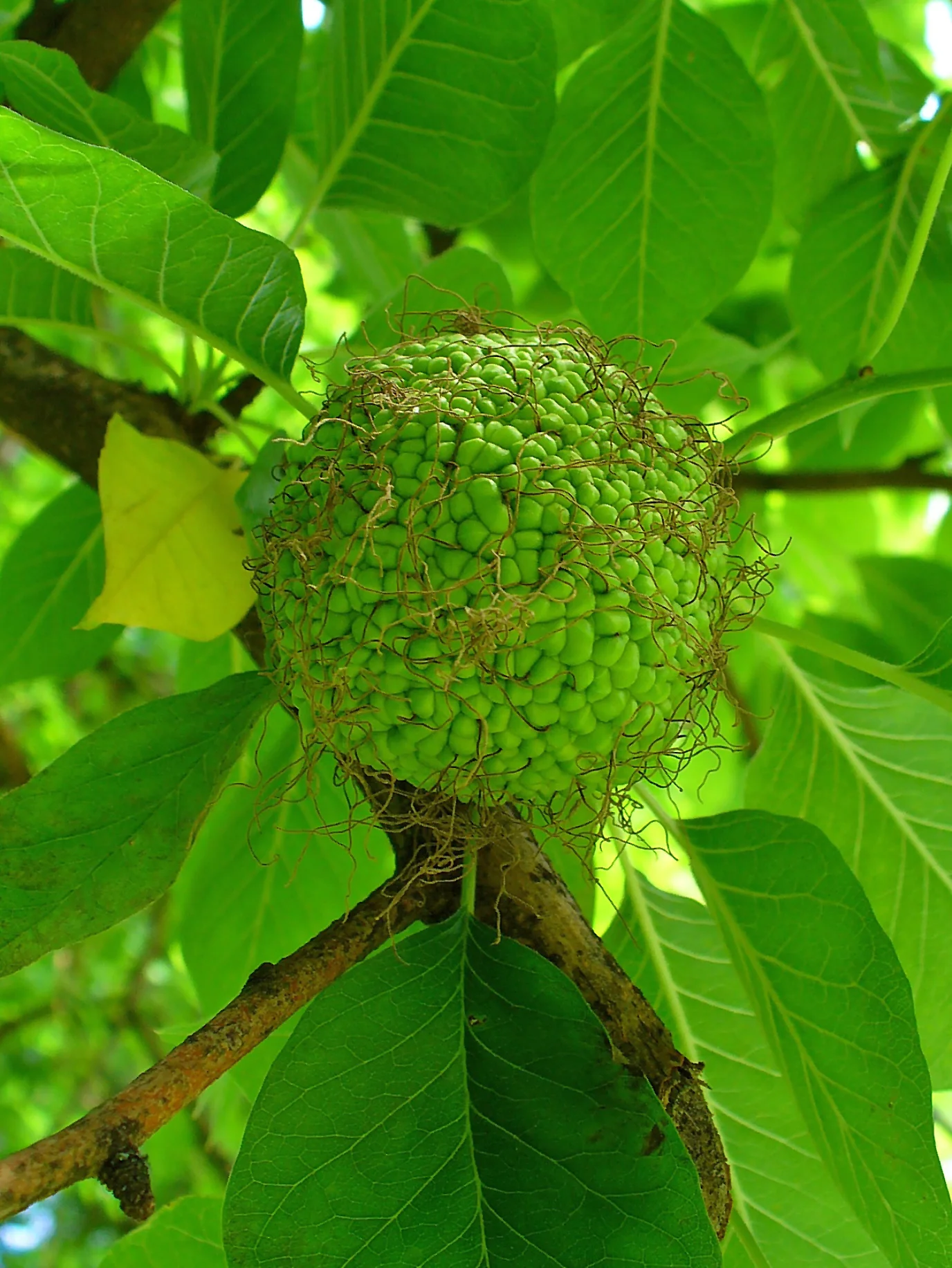
Maclura: Genus of Thorny Trees and Shrubs in the Moraceae Family
Spanning multiple continents, the genus Maclura comprises deciduous trees, shrubs, and climbing vines within the mulberry family, Moraceae. These plants are widely recognized for their durable wood, milky latex, and distinct spherical fruits. Historically, they have played vital roles in both indigenous crafts and modern agroforestry.
Members of the Maclura genus exhibit diverse growth habits, ranging from upright trees to scandent shrubs. Their branches are frequently armed with sharp axillary spines, and all parts of the plant secrete a thick, milky latex when injured. The leaves are simple, alternate, and can be entire or slightly lobed depending on the species.
These plants are dioecious, meaning male and female flowers develop on separate individuals. Female flowers form dense, globose heads that mature into large, fleshy composite fruits called syncarps, which often have a wrinkled, brain-like surface.
Applications
The genus Maclura has significant economic and practical value. The heavy, decay-resistant wood of Maclura pomifera is famously used for making fence posts, tool handles, and traditional bows. Additionally, Maclura tinctoria yields a valuable yellow dye known as fustic, which has been used in the textile industry for centuries.
Several species are planted as living fences due to their thorny branches, which effectively deter livestock. Some members of the genus also produce edible fruits or serve as ornamental plants in landscaping.
Interesting facts
The genus was named in honor of William Maclure, a pioneering Scottish-American geologist. The large, heavy fruits of the Osage orange are considered an evolutionary anachronism. Scientists believe they were once dispersed by extinct Pleistocene megafauna, such as mammoths and giant ground sloths, which could ingest them whole.