Monococcus echinophorus: Botany, Morphology, and Native Habitat
Monococcus echinophorus, commonly known in Australia as the broomberry, is a straggling shrub native to coastal subtropical rainforests and riverbanks of eastern Australia and southwestern Pacific islands. Its specific epithet, echinophorus, translates from Greek as "hedgehog-bearing," a vivid nod to its miniature, burr-like fruits covered in tiny hooked bristles.
First described in July 1858 by the German-Australian botanist Ferdinand von Mueller in his work Fragmenta Phytographiae Australiae, this species is the sole member of the monotypic genus Monococcus. Historically grouped within the broader pokeweed family (Phytolaccaceae), modern botanical classifications such as Plants of the World Online place it in the closely allied family Petiveriaceae.
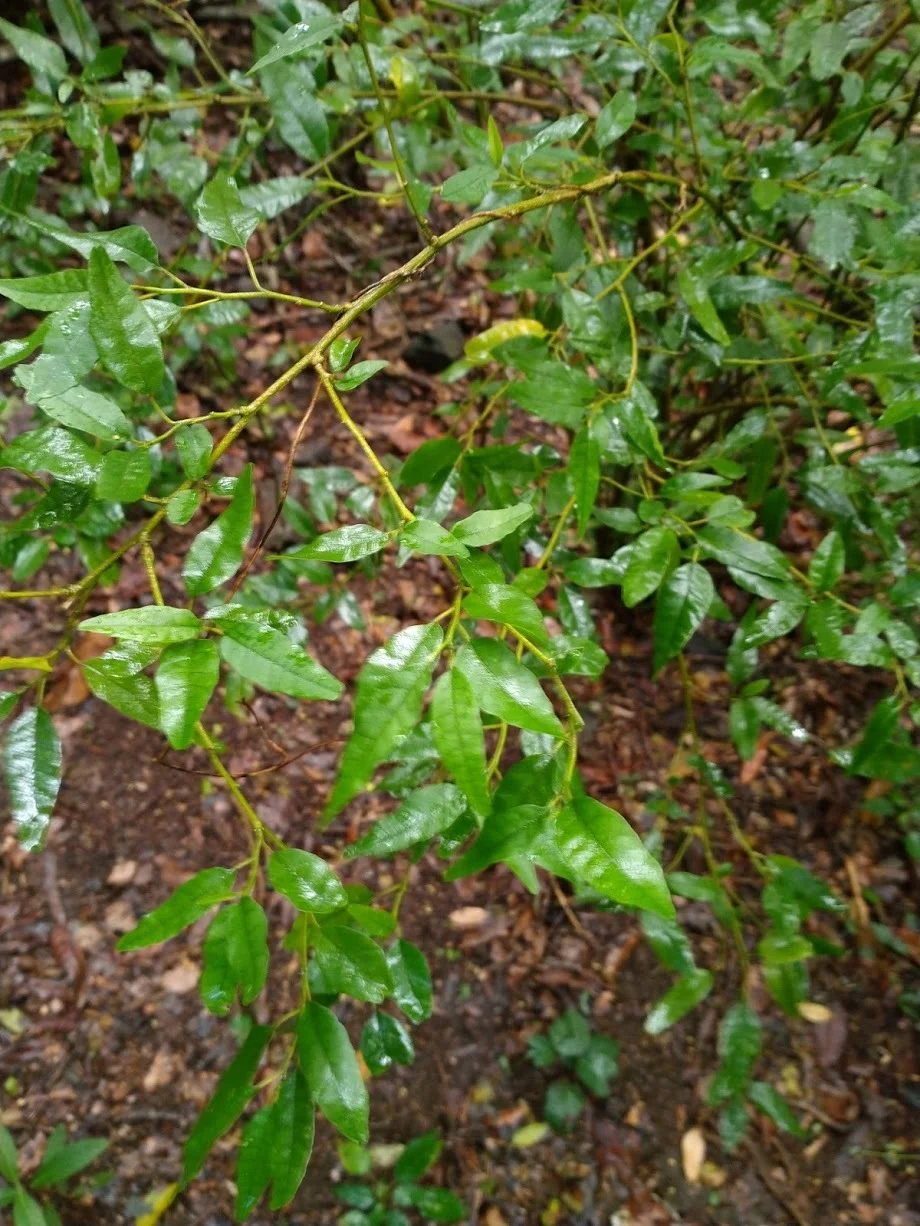
Monococcus echinophorus grows as an upright or scrambling shrub reaching between 1 and 3 meters in height. The bark on young branchlets is covered in a fine, soft pubescence that gradually wears away as the wood matures.
The alternate leaves are supported by slender petioles — leaf stalks that position the blade toward filtered forest light — measuring 5 to 15 millimeters long. Each leaf blade is ovate to lanceolate, spanning 3 to 10 centimeters in length and 1 to 3 centimeters in width, with a margin that is smooth or irregularly crenate and gently wavy.
Flowers and Reproductive Structure
Plants may be either monoecious (bearing separate male and female flowers on the same individual) or dioecious (with male and female flowers on distinct plants). The tiny, unisexual flowers measure only 2 to 3 millimeters across and are arranged in slender, pendulous racemes — unbranched, hanging flower clusters — that elongate up to 25 centimeters as fruits mature.
Bracts and perianth: Each flower sits on a short pedicel in the axil of two small bracts and features four white tepals, which are outer floral segments not differentiated into petals and sepals.
Male flowers: Staminate blossoms contain between 10 and 20 stamens that release pollen into the understory air currents.
Female flowers: Pistillate blossoms lack functional stamens and house a single carpel — the female ovule-bearing organ — that gives the genus Monococcus ("single-seeded berry" or "single kernel") its name.
Fruits
Following pollination, the female flower develops into a dry, single-seeded achene measuring 4 to 6 millimeters long. The fruit begins green and ripens to dark brown, densely armed with microscopic hooks that turn the entire seed case into a natural burr.
Flowering season
Flowers primarily during the Southern Hemisphere winter, from June to August.
Jan
Feb
Mar
Apr
May
Jun
Jul
Aug
Sep
Oct
Name
Dec
Applications
Because of its rarity and specialized ecological niche, Monococcus echinophorus is not widely cultivated in commercial horticulture, though it is occasionally grown in Australian botanical gardens and native rainforest restoration projects.
For conservation collections and specialized coastal reserves in New South Wales and Queensland, it serves as an authentic understory shrub for rehabilitating endangered littoral and lowland subtropical rainforest remnants.
Interesting facts
Hitchhiking Through the Rainforest Understory
In the dense, humid interior of a coastal subtropical rainforest, wind barely stirs the air near the forest floor, making wind-borne seed dispersal ineffective for a low-growing shrub. Monococcus echinophorus solves this limitation through epizoochory — the transport of seeds on the outside of animal bodies — using a finely tuned mechanical latching system.
Every detail of the plant's reproductive architecture works together to ensure the seed catches a passing host:
Pendulous presentation: As the flowers transition into fruit, the raceme stretches up to 25 centimeters and hangs downward at the exact height of ground-dwelling mammals and forest birds moving along riverbanks.
Micro-hooked armor: The surface of the 4 to 6 millimeter achene is studded with stiff, curved spines that act like natural hook-and-loop fasteners, instantly snagging onto fur or feathers at the slightest brush.
Lightweight single-carpel payload: By reducing its gynoecium to a single carpel containing just one seed, the plant keeps each burr light enough to remain attached to an animal across long distances without dropping off prematurely.
This precise coordination between the hanging fruiting stalks, the miniature hooked pericarp, and the streamlined single-seeded weight demonstrates how seamlessly the plant's anatomy is calibrated to its calm rainforest environment.