
Narrow-leaved montia
Montia angustifolia
A low-growing, mat-forming perennial herb endemic to the damp montane and alpine habitats of New …
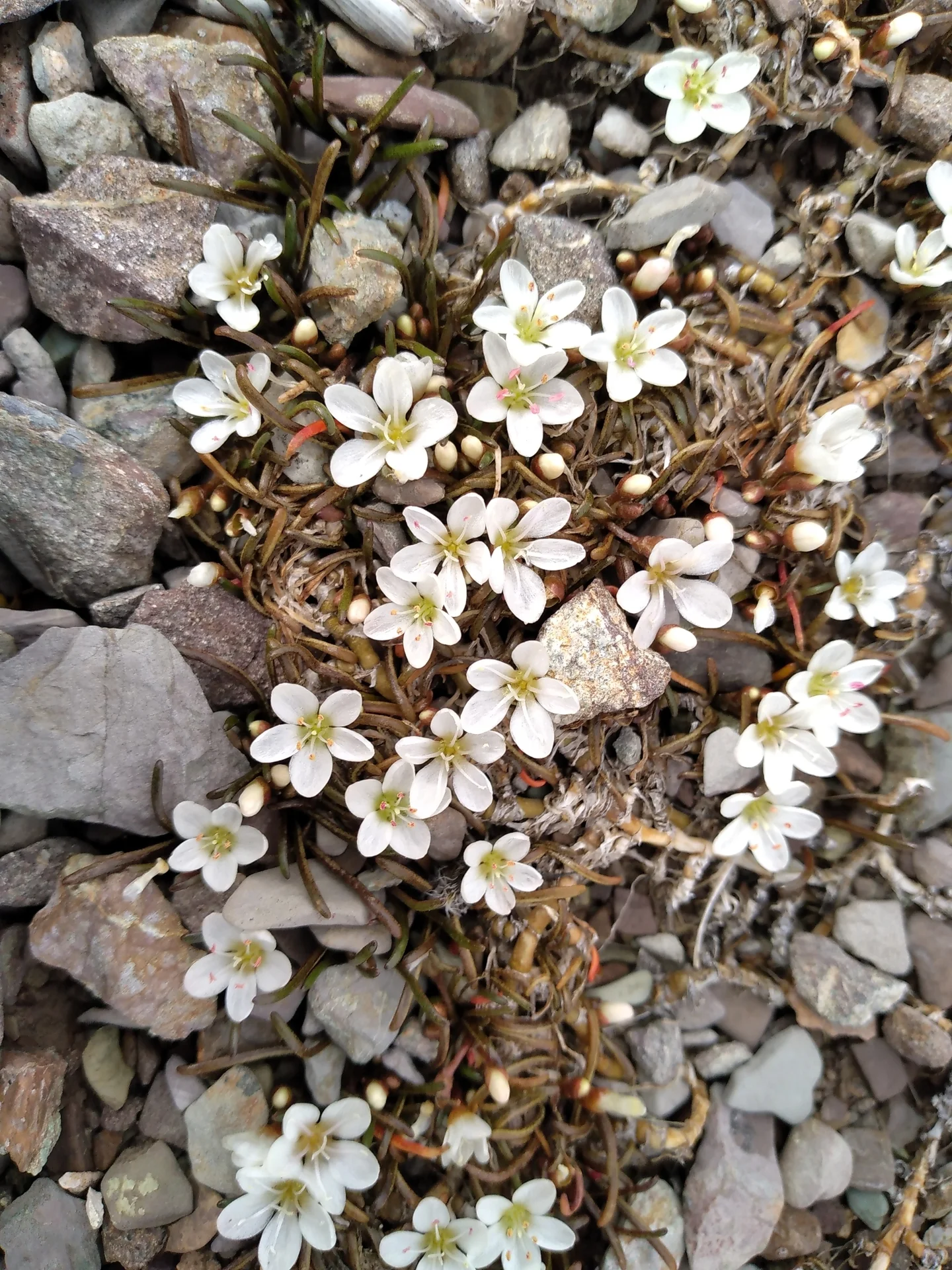
Montia calycina is a low-growing, mat-forming perennial herb endemic to the North and South Islands of New Zealand, thriving across mobile alpine scree slopes, tussock grasslands, and occasional coastal lowlands. Its specific epithet calycina comes from the Greek kalyx and refers to the prominent outer whorl of sepals—the protective cup that encloses its developing petals and low-set flowers.
First described by Sven Berggren as Claytonia calycina and later transferred to its current genus by Ferdinand Albin Pax and Käthe Hoffmann, this species was long grouped under the broader name Neopaxia australasica before taxonomic revision by Peter Heenan confirmed its distinct New Zealand identity.
Montia calycina grows as a compact, prostrate perennial that spreads via creeping stems to weave dense, springy mats close to the ground. This low profile helps the plant hug stony substrates and resist drying mountain winds.
Late spring to summer (November to February in the Southern Hemisphere)
Although not grown in mainstream commercial horticulture, Montia calycina holds value in specialized conservation and botanical collections focused on New Zealand's native alpine flora.
Botanical gardens and research nurseries cultivate this species in alpine houses and gravel beds to study high-altitude plant evolution and demonstrate scree-slope adaptations to visitors.
The architecture of Montia calycina reflects a finely tuned mechanical response to New Zealand's unstable mountain scree fields and wind-swept basins. Rather than fighting sliding stones with rigid woody stems, the plant relies on flexible, node-rooting runners and a deeply recessed floral structure.
Montia angustifolia
A low-growing, mat-forming perennial herb endemic to the damp montane and alpine habitats of New …

Montia sessiliflora
A compact, cushion-forming alpine perennial endemic to New Zealand, named for its sessile flowers that …

Montia racemosa
A fleshy, creeping perennial herb endemic to the South Island of New Zealand, notable for …

Montia campylostigma
A prostrate, mat-forming perennial herb endemic to the high-altitude habitats of New Zealand's South Island, …