
Narrow-leaved montia
Montia angustifolia
A low-growing, mat-forming perennial herb endemic to the damp montane and alpine habitats of New …
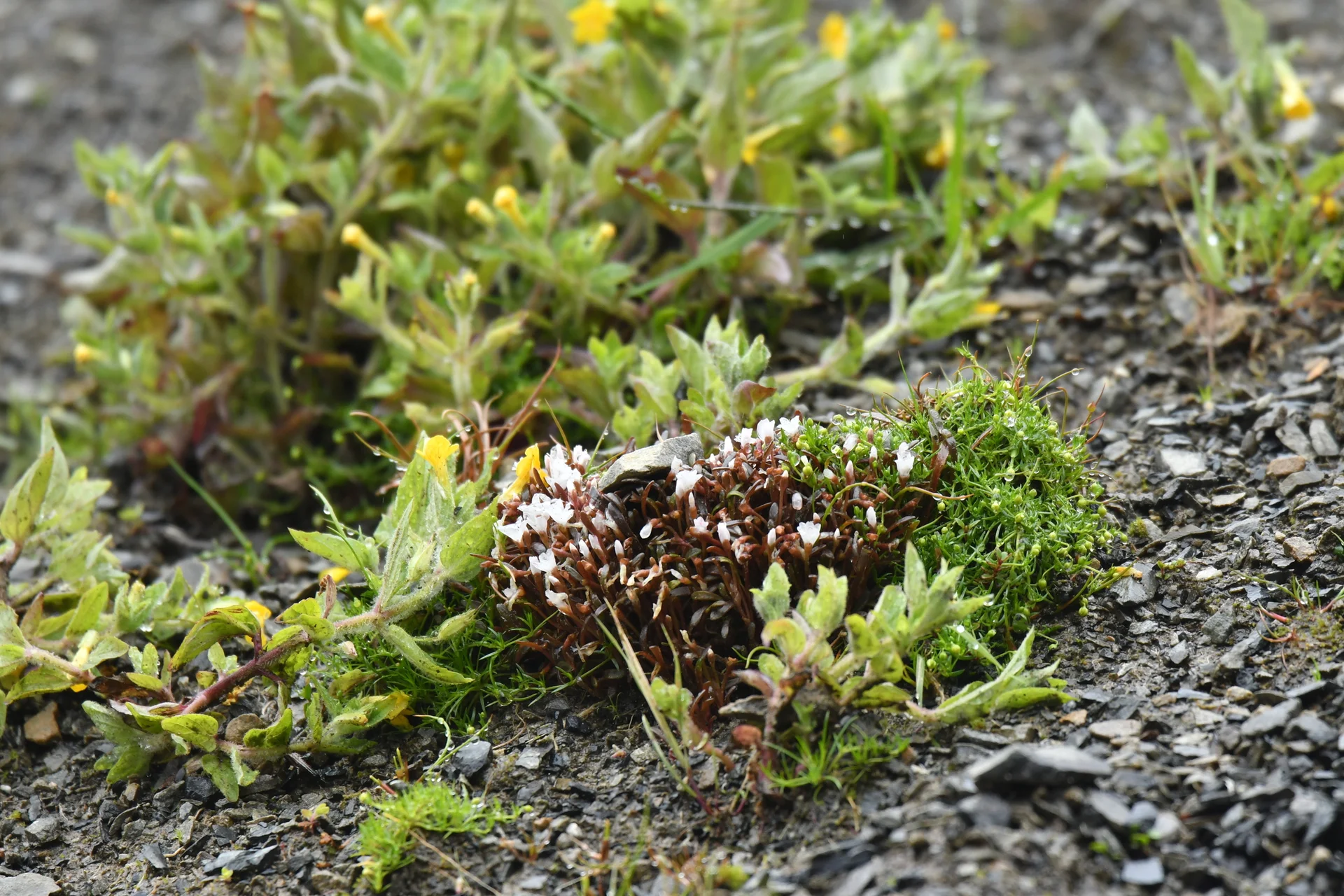
Montia erythrophylla is a low-growing, perennial alpine herb native to the high mountain ranges of New Zealand's South Island, where it forms compact, fleshy patches among cold rocky debris. Its specific epithet, erythrophylla, comes from the Greek words for "red" and "leaf," referring to the deep reddish-purple to bronze pigmentation that colors its succulent foliage under intense mountain sunlight.
This species belongs to the family Montiaceae and the genus Montia. It was formally described as a distinct species by the New Zealand botanist Peter B. Heenan in 2007 (originally under the name Neopaxia erythrophylla) before being transferred to Montia.
This diminutive alpine perennial grows as a tight, prostrate mat or small cushion up to several centimeters across. Beneath the surface, a stout, fleshy taproot and branching rootstock anchor the plant firmly into shifting gravel and rocky crevices.
The short, densely leafy stems remain pressed against the ground to escape freezing mountain winds. Its leaves are simple, alternate, and distinctly succulent, storing water inside specialized internal tissues.
During the brief southern alpine summer, small, solitary flowers appear on short stalks nestled among the upper leaves. Each flower has five delicate, white to pale pink petals surrounding a cluster of stamens.
Flowers during the Austral summer in high-altitude habitats, typically from December to February.
Surviving above the treeline in the Southern Alps of New Zealand requires coping with extreme ultraviolet radiation, freezing nights, and unstable rocky slopes. Montia erythrophylla meets these challenges through a tightly coordinated combination of leaf chemistry and compact architecture.
Taxon Synonyms: Neopaxia erythrophylla
Montia angustifolia
A low-growing, mat-forming perennial herb endemic to the damp montane and alpine habitats of New …

Montia sessiliflora
A compact, cushion-forming alpine perennial endemic to New Zealand, named for its sessile flowers that …

Montia racemosa
A fleshy, creeping perennial herb endemic to the South Island of New Zealand, notable for …

Montia campylostigma
A prostrate, mat-forming perennial herb endemic to the high-altitude habitats of New Zealand's South Island, …