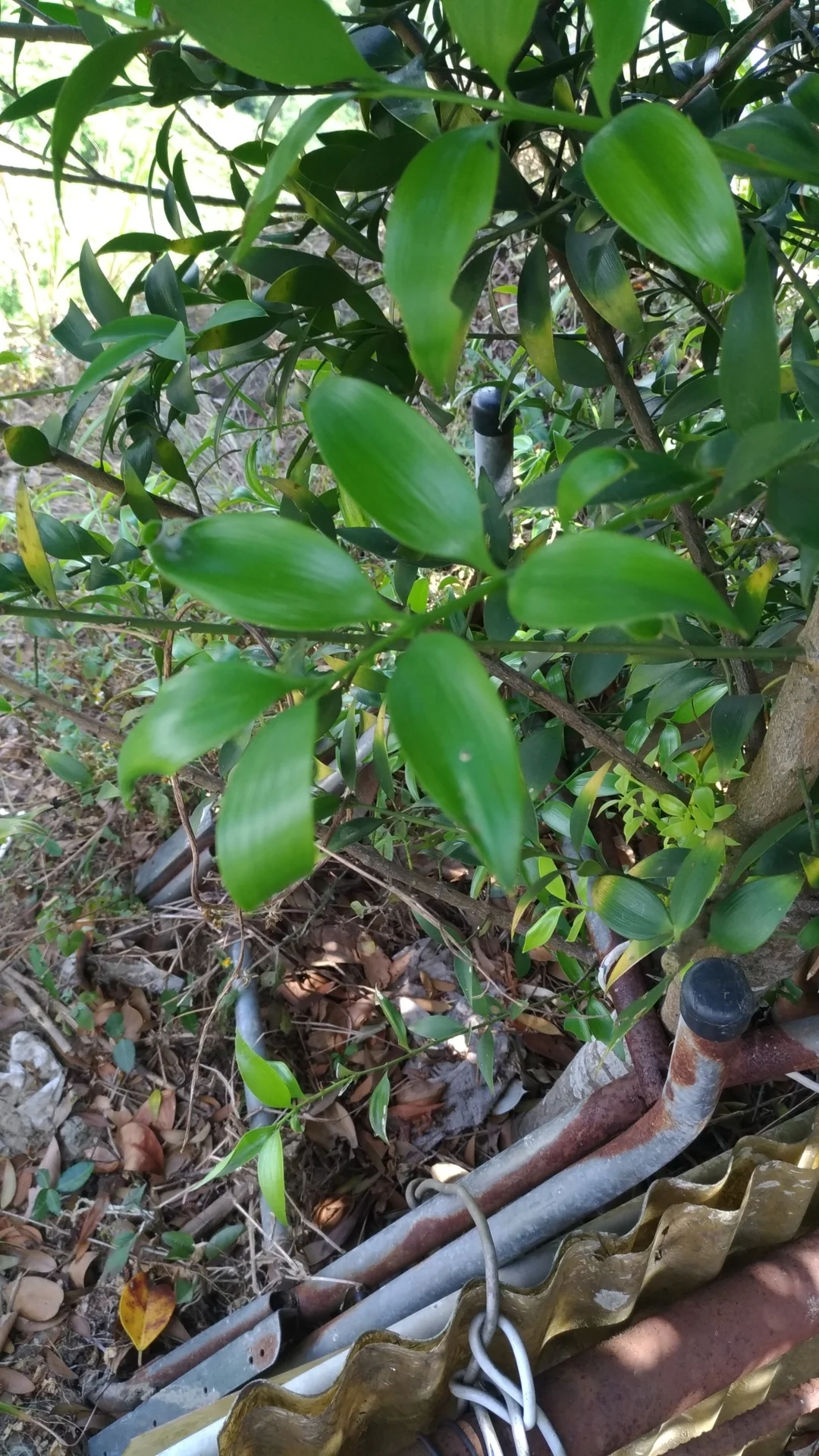
Nageia nagi (Asian bayberry): morphology, care, and uses
Nageia nagi is a graceful evergreen tree native to the warm, humid forests of China, Japan, and Taiwan that defies the typical image of a conifer by bearing broad, glossy, lance-shaped leaves instead of needles. Its specific epithet nagi comes directly from its traditional Japanese name, which alludes to the calm, smooth surface of its foliage and its resemblance to aquatic herbs of the genus Monochoria.
This species belongs to the family Podocarpaceae and was first scientifically described in 1784 by the Swedish botanist Carl Peter Thunberg, before Carl Ernst Otto Kuntze transferred it to the genus Nageia in 1891.
Taxonomy
∟царствоPlantae
∟divisionTracheophytes(Vascular Plants)
∟subdivisionSpermatophytes(Seed plants)
∟superclassGymnospermae(Gymnosperms)
∟divisionPinophyta(Conifers)
∟subclassCupressidae
∟orderAraucariales(Southern pines and monkey-puzzles)
In its natural forest habitat, Nageia nagi grows as a straight-trunked evergreen tree reaching 15 to 30 meters in height, crowned by a dense, rounded canopy. Its bark is smooth and reddish-brown to purplish-brown, gradually peeling away in thin, flaky layers that leave behind warm buff-colored patches.
Foliage and shoots
Unlike almost all other conifers, this species develops wide, leathery leaves that look remarkably like those of a broadleaf flowering tree or a stalk of bamboo. Although the buds are arranged in opposite pairs along the green, slightly flattened twigs, the leaf bases twist as they grow so the blades lie in two flat, light-catching rows.
Leaf shape and size: The blades are ovate-lanceolate to elliptic, measuring 2 to 9 cm long and 0.7 to 3 cm wide, with a wedge-shaped base and a pointed or slightly blunt tip.
Venation and texture: Instead of a single central midrib, each thick, hairless leaf is traversed by numerous fine, parallel veins that branch near the base and converge toward the tip.
Aromatic compounds: The upper surface is deep, polished green while the underside is paler, and crushing a fresh leaf releases a distinct, fruity aroma reminiscent of guava.
Cones and seeds
As a dioecious gymnosperm—meaning male and female reproductive structures grow on separate individual trees—this species relies entirely on the wind to carry pollen between plants from spring into early summer.
Pollen cones: Male trees produce slender, catkin-like cylindrical cones measuring 0.5 to 2.5 cm long, which emerge singly or in small clusters of three to five from the leaf axils.
Seed structures: Female trees bear solitary axillary stalks tipped with a single inverted ovule; unlike true Podocarpus species, the supporting receptacle does not swell into a bright, fleshy pedestal.
Mature seeds: By autumn, the seed is enclosed in a fleshy, drupe-like outer coat called an epimatium, forming a spherical structure 10 to 15 mm across that ripens from pale bluish-green to deep purplish-black dusted with a fine white bloom.
Flowering season
Pollen cones release pollen and pollination occurs from spring to early summer (March to June), while the plum-like seeds mature from late summer to autumn (August to November).
Jan
Feb
Mar
Apr
May
Jun
Jul
Aug
Sep
Oct
Name
Dec
Care parameters
Light
Thrives in bright, indirect light or partial shade when young, while established trees tolerate full sun to light woodland shade.
Watering
Water regularly to keep the substrate evenly moist during active growth, ensuring excess water drains freely to prevent root rot.
Temperature
Prefers warm temperate to subtropical conditions between 15 °C and 28 °C; protect young plants from frost and freezing winter winds.
Humidity
Adapts well to average household or garden humidity, though occasional misting benefits indoor potted specimens in dry winter air.
Toxicity
Safe to handle, though the seeds and leaves contain bioactive lactones and should not be ingested by pets.
Applications
Across East Asia, Nageia nagi is deeply woven into both daily craftsmanship and landscape architecture. Because its young seedlings tolerate deep shade and clean indoor air, it is widely cultivated as a desktop foliage plant, an elegant subject for bonsai, and a resilient street or garden tree in warm climates.
Sacred and ornamental plantings: In Japan, it has been planted for centuries around Shinto shrines—most famously at Kumano Hayatama Taisha and Kasuga Taisha—where its evergreen branches are used in ceremonial offerings, while cut stems are prized in floral arrangements for staying fresh in water for months.
Timber and woodworking: The wood is straight-grained, moderately hard, water-resistant, and slow to catch fire, making it a choice material for house construction, decorative alcove pillars, bridges, furniture, and fine woodcarving.
Oils, dyes, and folk remedies: The seeds yield a clear oil used both in cooking and in industrial applications (and historically burned in shrine lamps), the tannin-rich bark is harvested for leather tanning and natural dyes, and decoctions of the bark and leaves are applied externally in traditional medicine to soothe joint pain and staunch bleeding.
Interesting facts
Looking closely at Nageia nagi reveals a series of finely coordinated structural and chemical solutions that allow a slow-growing conifer to thrive inside dense, competitive broadleaf forests.
Engineering a broad leaf without a midrib
When early conifers evolved in ancient forests, most lineages settled on narrow needles to conserve water, leaving them at a disadvantage in shady understories where broad-leaved angiosperms capture diffuse light far more efficiently. Rather than relying on a single rigid central vein, the leaf of Nageia nagi distributes mechanical support across dozens of parallel vascular bundles running from base to tip, combined with a twisting petiole that aligns every blade horizontally toward the sky.
Longitudinal tensile strength: Because these tough vascular fibers run strictly in parallel without cross-veins, the leaf is almost impossible to tear across its width by hand, yet splits cleanly along its length.
Cultural symbolism: In Japan, this remarkable resistance to crosswise tearing earned the tree nicknames like Chikarashiba (strength-leaf) and inspired a tradition where women tucked a leaf behind their mirrors as a charm for unbreakable marital bonds.
Chemical defense in the forest floor
Growing slowly beneath faster canopy trees requires more than just efficient light capture; a young sapling also needs to keep aggressive neighbors from crowding its root zone.
Allelopathic lactones: The leaves, roots, and seed coats synthesize specialized diterpene dilactones known as nagilactones, which leach into the surrounding soil and gently inhibit the germination and root elongation of competing weed seeds.
Coordinated survival: By pairing shade-tolerant, broad-surface solar collectors above ground with a targeted chemical buffer in the soil below, the tree secures the space and time required to build its dense, decay-resistant timber over centuries.
Varieties and cultivars
Over centuries of cultivation in Japanese and Chinese gardens, horticulturists have selected several distinct forms of Nageia nagi that vary in leaf shape and variegation.
'Variegata' (Fuiri-nagi): A decorative form featuring creamy-white or pale yellow longitudinal stripes running parallel to the veins across the glossy green blades.
'Angustifolia' (Hosoba-nagi): Characterized by noticeably narrower, slender lance-shaped leaves that give the canopy a finer, bamboo-like texture.
'Rotundifolia' (Maruba-nagi): A compact selection bearing shorter, distinctly rounded to broadly oval leaves with blunt tips.