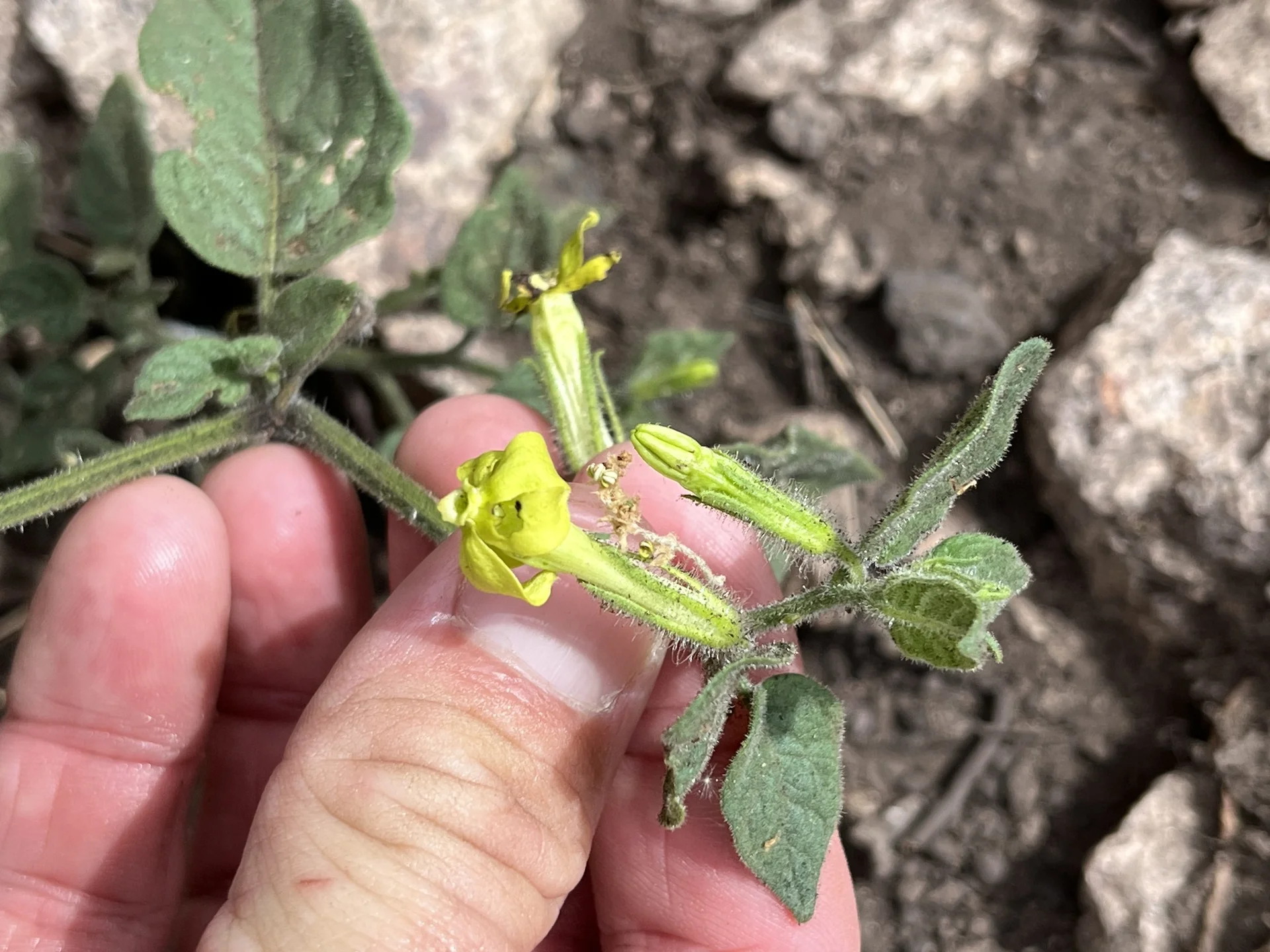
Nectouxia formosa (Trans-Pecos Stinkleaf): Rare Crowned Nightshade of Mexico
Nectouxia formosa, commonly known as the Trans-Pecos stinkleaf, is an erect perennial herb native to the cool pine-oak and fir forests of the Mexican mountains and the Chihuahuan Desert borderlands of western Texas. While its crushed glandular foliage gives off a noticeably pungent odor, the Latin epithet formosa—meaning finely formed or handsome—celebrates its striking, nodding yellowish-green flowers, each adorned with a distinct collar-like crown at the throat.
It is the sole member of the monotypic genus Nectouxia within the nightshade family (Solanaceae). The German botanist Carl Sigismund Kunth described both the genus and species in 1818 from specimens collected during Alexander von Humboldt and Aimé Bonpland's famous expedition, naming the genus in honor of the French botanist Hippolyte Nectoux (1759–1836); John Miers later published the synonym Nectouxia bella.
Rising from 20 to 60 centimeters tall, Nectouxia formosa is a cryptophyte—a perennial plant that survives unfavorable seasons via underground storage organs. Its fleshy subterranean rhizomes are clothed in delicate, scale-like cataphylls and send up fresh aerial shoots when mountain rains return.
Stems and hairs: The upright, simple or basally branched stems are covered in glandular hairs (trichomes) with unicellular or multicellular heads that release a sharp, musky scent and turn dark brown to nearly black when dried for herbarium specimens.
Foliage: The petiolate leaf blades are ovate to broadly ovate, measuring 4 to 7 centimeters (occasionally up to 10 centimeters) long, with a sharply pointed apex and a distinctly cordate (heart-shaped) base.
Crowned flowers and pointed berries
The flowers appear singly in the leaf axils, nodding or hanging downward on slender pedicels 1 to 2 centimeters long. Their architecture sets this species apart from almost all other members of the nightshade family.
Calyx: The radially symmetrical calyx is 11 to 24 millimeters long and divided nearly to the base into five narrow, linear segments covered in coarse, stiff hairs up to 2 millimeters long.
Corolla and corona: The hairless, yellowish-green corolla forms a salverform tube 18 to 43 millimeters long that flares into five reflexed lobes, while at the junction between tube and limb rises a continuous, ring-like outgrowth (annular corona) 2 to 4 millimeters high.
Stamens, pistil, and fruit: Five stamens sit inside the tube with flat dorsal outgrowths on their filaments, surrounding a conical ovary with prominent nectaries that matures into a pointed, fleshy berry 2 to 3 centimeters long containing about ten flat, kidney-shaped (reniform) seeds.
Interesting facts
A miniature daffodil-like crown in the nightshade family
At first glance, the nodding blossom of Nectouxia formosa looks as though a botanical engineer borrowed a blueprint from a daffodil and integrated it into a nightshade. At the throat of the yellowish-green floral tube, just above the পাঁচ curved-back petal lobes, projects a 2-to-4-millimeter cylindrical ring—a true floral corona—paired with plate-like dorsal shields on the stamen filaments inside.
Mechanical nectar guard: This raised collar narrows the entrance to the floral tube and reinforces its rim, guiding the proboscis of visiting pollinators along a precise track toward the prominent basal nectaries while blocking inefficient nectar thieves.
Seasonal underground retreat: In the high-altitude Abies (fir) and Quercus (oak) forests of central Mexico and the rugged Chihuahuan ranges between 2,000 and 3,000 meters, the plant pairs this intricate floral architecture with fleshy underground rhizomes that allow it to retreat completely beneath the soil during winter frosts and dry spells.
Even the plant's malodorous glandular hairs and rapid darkening upon drying reflect a specialized phytochemistry rich in defensive compounds. From its subterranean perennating buds to the protective plates over its anthers and the corona framing its throat, every anatomical feature works in tight coordination with its montane forest environment.