Nicandra physalodes (Apple of Peru): Botanical Profile, Chemistry, and Uses
Nicandra physalodes is a fast-growing annual herb native to the western slopes of the South American Andes, immediately recognizable by its nodding, pale violet bell-shaped flowers and papery, lantern-like fruiting husks. Its specific epithet, physalodes, translates to "resembling Physalis," a direct reference to how its inflated calyx mimics the bladder-like husks of groundcherries.
Belonging to the nightshade family (Solanaceae), the species was first scientifically described by Carl Linnaeus in 1753 as Atropa physalodes. In 1791, the German botanist Joseph Gaertner transferred it to the genus Nicandra, named in honor of the ancient Greek poet and physician Nicander of Colophon, who wrote extensively about plant toxins and their antidotes.
The plant develops a robust, upright, and vigorously branching habit, typically reaching heights between 0.5 and 1.5 meters, though vigorous specimens can occasionally grow up to 2 meters tall. Its stems are hairless, hollow, and distinctly angled with sharp ridges running along their length.
The leaves are arranged alternately on winged petioles measuring 1.5 to 9 centimeters long. Each leaf blade is ovate to elliptic, membranous in texture, and features deeply wavy, sinuate, or irregularly toothed margins that give the foliage a slightly crinkled appearance.
Flowers and Reproductive Organs
Solitary, bisexual flowers emerge from the leaf axils on slender stalks that start upright and gradually nod downward as the bloom matures. The radially symmetrical structure consists of several specialized parts:
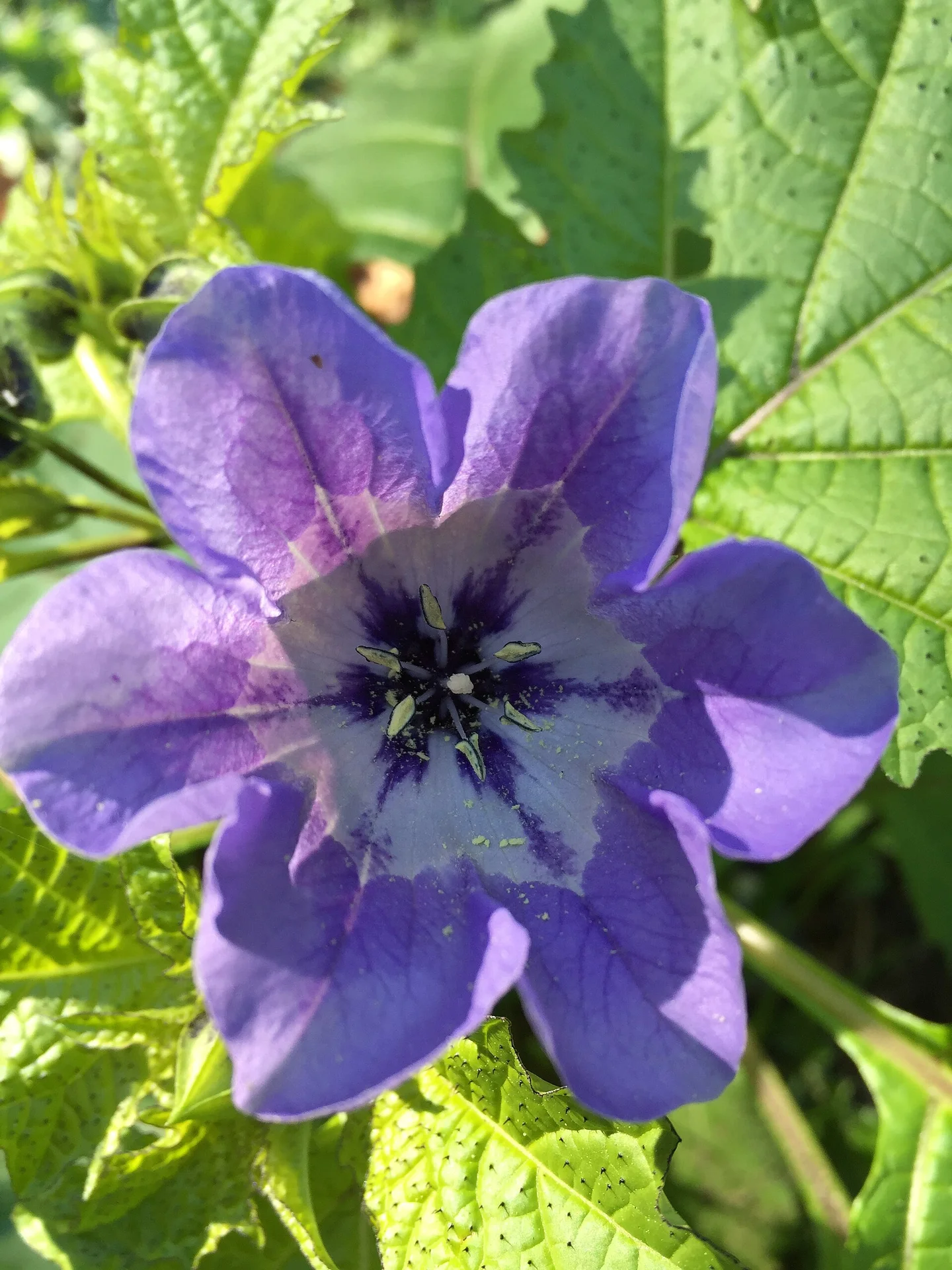
Corolla: The bell-shaped, shallowly five-lobed corolla measures 2 to 5 centimeters across and displays a pale violet or sky-blue rim that fades into a pure white throat, often marked with five dark purple spots at the base.
Androecium and Gynoecium: Five stamens of equal length are attached low inside the floral tube, featuring filaments densely covered in fine hairs (trichomes) at their bases that arch over the ovary to form a protective cone.
Calyx: Five heart-shaped (cordate) sepals with arrow-like basal lobes fuse along their lower halves, creating a sharply five-angled cup around the petals.
Fruits and Seeds
After pollination, the green calyx enlarges significantly to 3 or 4 centimeters, turning dry, papery, and strongly veined like a netted lantern while remaining deeply five-parted rather than forming a seamless bladder. Inside this protective husk sits a spherical, dryish brown berry measuring 1 to 2 centimeters in diameter, packed with numerous flat, kidney-shaped seeds covered in a thick, finely pitted seed coat (testa).
Flowering season
Blooms from mid-summer to mid-autumn, with individual flowers opening for only a few hours between late morning and mid-afternoon.
Jan
Feb
Mar
Apr
May
Jun
Jul
Aug
Sep
Oct
Name
Dec
Applications
Despite containing potent bioactive compounds throughout its tissues, Nicandra physalodes has a rich history of practical human use across several continents. Cultivated in European and North American gardens since the eighteenth century, it is grown both as an ornamental annual for its papery seed pods—which are frequently dried for autumn floral arrangements—and as a functional companion plant in greenhouses and vegetable plots to deter whiteflies.
Culinary Preparation (Bingfen): In Southwestern China, particularly in Sichuan province, the tiny brown seeds have been used since the Qing dynasty to make bingfen ("ice jelly"). Cooks place the seeds in cheesecloth and rub them vigorously in mineral water to release natural pectin—a structural plant polysaccharide—which is then set with slaked lime into a cooling, translucent summer dessert served with brown sugar syrup.
Traditional Medicine: Across the Himalayan regions of Nepal, Sikkim, and Tibet, the seeds and leaves are employed in folk remedies as a diuretic, sedative, and antipyretic to reduce fevers, relieve toothaches, and treat intestinal parasites. In Ecuadorian ethnobotany, the sterile fluid naturally secreted inside the closed flower bud is collected and applied as soothing eye drops for conjunctivitis.
Domestic Pest Control: In the southern United States, rural households historically crushed the fresh stems and leaves to mix the juice with milk, setting it out in saucers as a lethal bait for houseflies and blowflies. In parts of East Africa and India, leaf decoctions have similarly been applied externally to eliminate head lice.
Interesting facts
Chemical Defense and the Whitefly Trap
The common name "shoo-fly plant" hints at a sophisticated biochemical defense system rooted in the plant's specialized secondary metabolites. Its tissues synthesize nicandrenones—a specific group of steroidal lactones known as withanolides—alongside tropane and pyrrolidine alkaloids such as tropinone, hygrine, and calystegines.
Rather than merely repelling all insects from a distance, the foliage acts as a biochemical decoy for greenhouse whiteflies (Trialeurodes vaporariorum). Attracted to the broad, tender leaves, the insects pierce the epidermis to feed on the sap, ingesting the cytotoxic nicandrenones and alkaloids, which disrupt their development and halt reproduction before they can infest neighboring crops.
Hydraulic Engineering Inside the Flower Bud
Before the pale blue petals ever unfold, the developing flower relies on an internal liquid bath to survive dry mountain air and browsing insects. While still in the bud stage, the five heart-shaped sepals press tightly together along their winged edges, sealing the chamber completely.
Internal Water Glands: The inner lining of the calyx is studded with specialized microscopic water-secreting glands called hydathodes. These glands pump a clear, aqueous fluid directly into the sealed bud, submerging the developing stamens and pistil in a protective liquid cushion that prevents desiccation and deters nectar-robbing pests.
Precision Pollination Window: Once mature, the flower drains this fluid and opens for just a few hours between late morning and mid-afternoon, welcoming honeybees and other pollinators before wilting as soon as fertilization occurs—often within a single hour of self-pollination.
Long-Term Seed Dormancy: The mature seeds possess an exceptionally thick coat and exhibit strong physiological dormancy, allowing them to remain viable in undisturbed soil for up to 30 years until specific daily temperature fluctuations between 15 and 25 °C signal that an open, sunny gap has appeared at the surface.