Nolana humifusa (Trailing Chilean-bellflower): Habitat, Morphology, and Uses
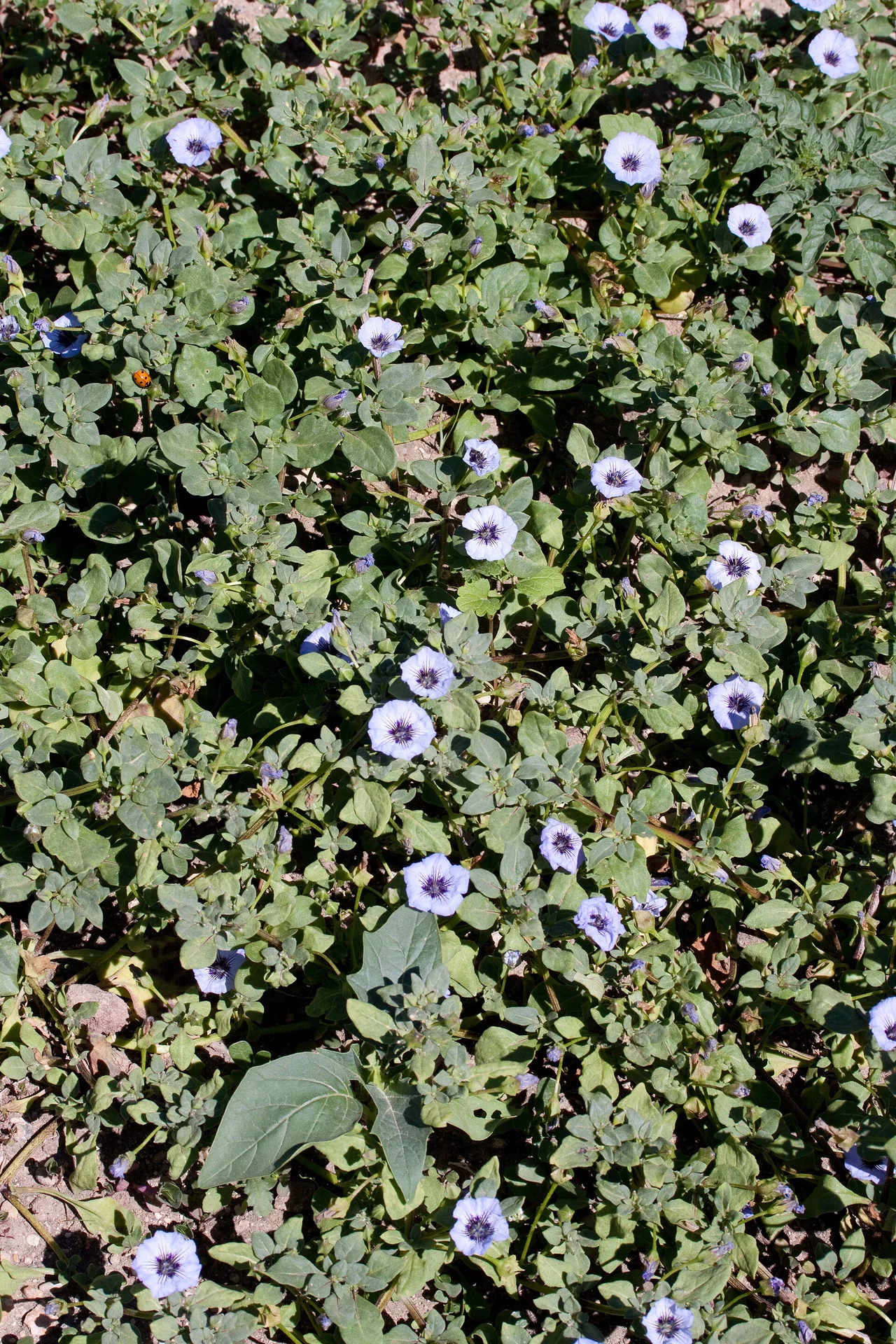
Nolana humifusa is a low-growing, sprawling herb native to the arid coastal hills of Peru, where its flexible stems weave dense carpets across sandy and rocky slopes. Its specific epithet humifusa translates from Latin as "spread out on the ground," capturing the way its fleshy leaves and bright blue funnel-shaped blossoms hug the soil surface.
Belonging to the nightshade family (Solanaceae), the species was first scientifically described in 1762 by Antoine Gouan as Atropa humifusa. In 1936, the American botanist Ivan Murray Johnston transferred it to the genus Nolana, establishing its currently accepted botanical name.
Nolana humifusa develops a prostrate or semi-trailing habit, sending out slender, sprawling branches several decimeters long from a sturdy, barely woody base. The stems and foliage are completely hairless or carry only a sparse dusting of fine hairs.
Foliage and stems
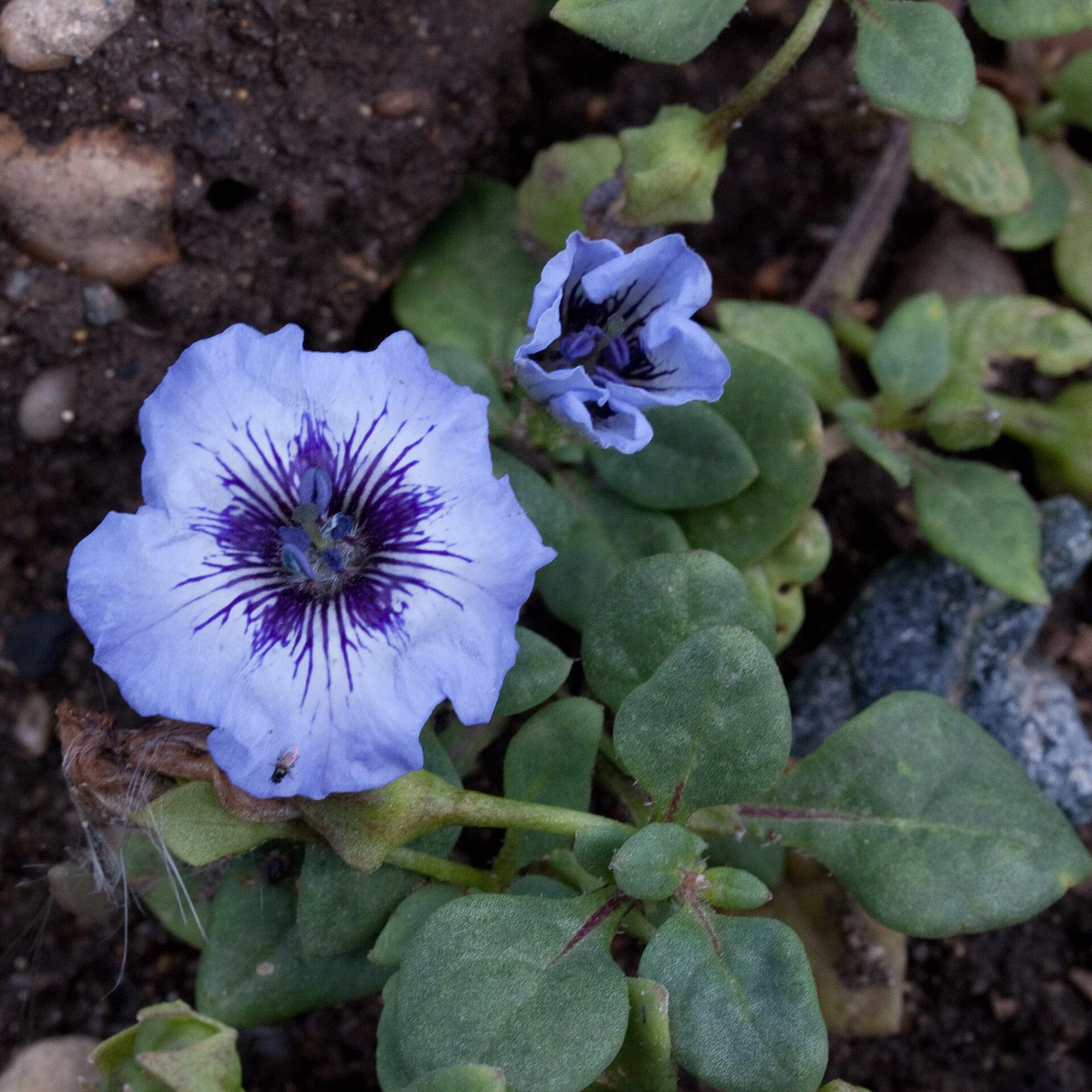
The leaves are arranged alternately and have a slightly succulent texture that stores moisture in dry coastal air. Each leaf blade measures 2 to 3 cm in length and transitions at its base into a slender petiole—a leaf stalk about 1 cm long.
Leaf shape: Obliquely ovate to nearly circular, with a gently blunted tip and a rounded or tapering base.
Surface texture: Smooth and fleshy, helping the plant reduce water loss under intense sunlight.
Flowers and fruits
Solitary flowers emerge on thin stalks called pedicels (around 1.5 cm long), which thicken, curve downward, and lengthen to 2 cm as the fruit matures. The calyx—the outer green cup of the flower—is about 1 cm long, broadly bell-shaped, and distinctly angled by a sharp fold above each notch between its pointed lobes.
Corolla structure: The fused petals form a funnel-shaped, violet-blue trumpet about 1.5 cm long, often etched with deep purplenectar lines inside the throat.
Schizocarp fruit: Instead of a fleshy berry, the flower produces five nut-like segments called mericarpids, each about 5 mm long with an angled, finely pitted surface.
Flowering season
Blooms from late spring through autumn in cultivation, and during the humid winter-spring fog season in its native Peruvian coast.
Jan
Feb
Mar
Apr
May
Jun
Jul
Aug
Sep
Oct
Name
Dec
Care parameters
Light
Full sun; requires bright, direct light to maintain compact trailing stems and abundant flowering.
Watering
Moderate to low; allow the topsoil to dry out between waterings to prevent root rot in its fleshy crown.
Temperature
Prefers warm daytime temperatures between 18°C and 26°C; sensitive to frost and cultivated as an annual in temperate climates.
Humidity
Tolerates dry air well, though it naturally thrives in coastal breezes with moderate moisture.
Toxicity
Contains tropane and other solanaceous alkaloids typical of the nightshade family; ornamental parts should not be ingested.
Applications
Introduced from Peru to European botanical gardens as early as 1760, Nolana humifusa is cultivated as an ornamental plant for sunny, well-drained landscapes. Although perennial in its frost-free native habitat, gardeners in temperate regions grow it as a warm-season annual.
Its trailing branches and drought-tolerant foliage make it well suited for rock gardens, stone walls, summer flower borders, and hanging baskets. In open beds, it functions as a vibrant groundcover that quickly fills gaps between paving stones.
Interesting facts
Unlike most familiar members of the nightshade family that form juicy berries or dry capsules, Nolana humifusa packages its seeds into hard, stone-like units called sclerocarps. These five angled nutlets sit openly at the base of the persistent calyx, waiting for specific moisture cues before germinating.
Engineered for coastal fog oases
This species is finely tuned to survive in the Peruvian lomas—isolated islands of vegetation surrounded by hyper-arid desert that rely almost entirely on dense winter ocean fog (garúa) rather than rainfall. Every structural detail of the plant works in concert to harvest and conserve this fleeting atmospheric water.
Pleated calyx architecture: The sharply folded, bell-shaped calyx acts as a miniature dew trap that channels condensed fog droplets directly toward the developing nutlets and root zone.
aerodynamic prostrate habit: By pressing its stems flat against sun-warmed stones and sandy loam, the plant stays within the calm boundary layer of air near the ground, shielding its fleshy leaves from drying coastal winds.
Delayed seed release: The pitted, bony walls of the five fruit segments protect the embryos through months of scorching drought, softening only when sustained moisture returns to the soil.