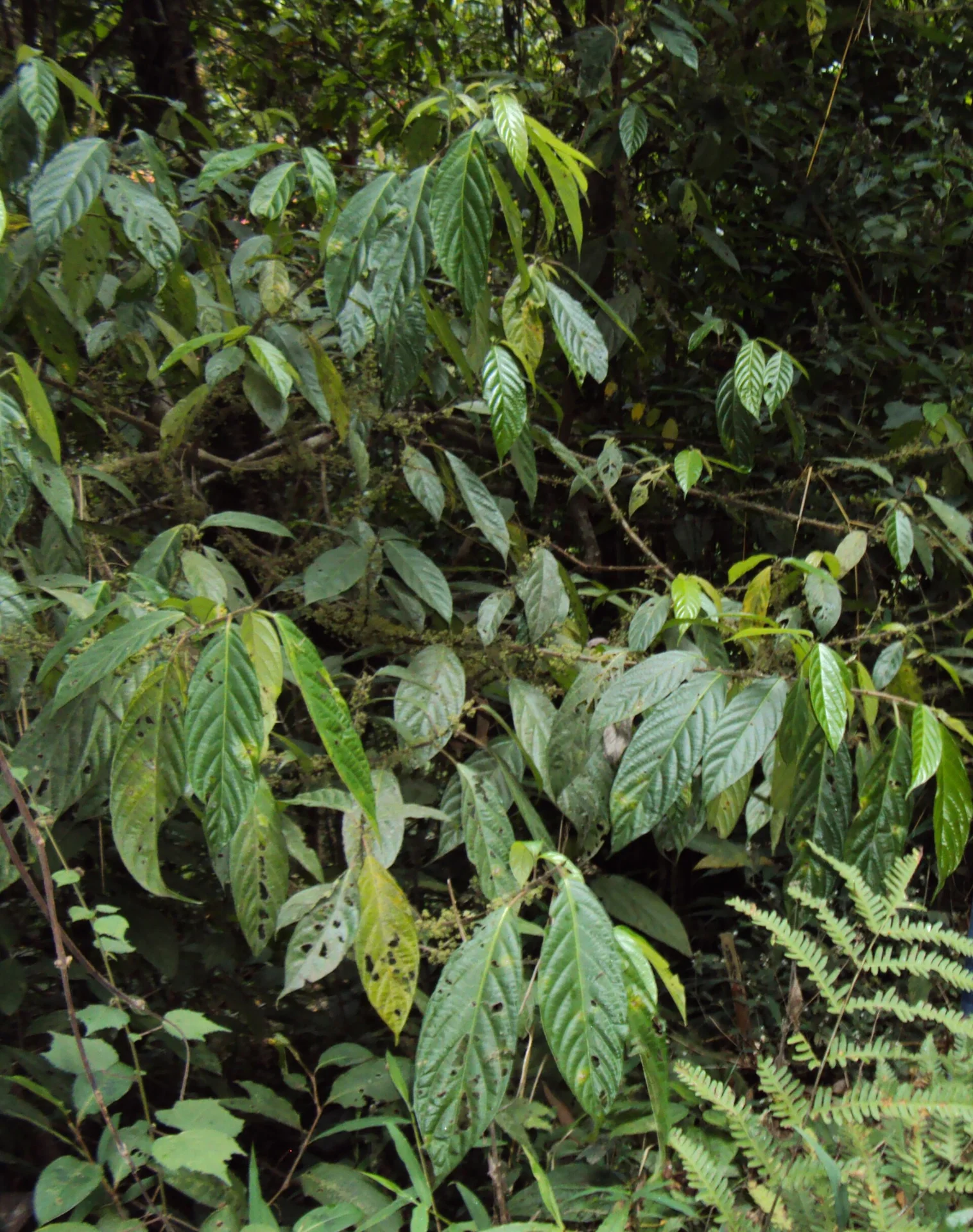
Oreocnide integrifolia (Wild rhea): botany, habitat and uses
Oreocnide integrifolia, commonly known as wild rhea, is an evergreen shrub or small tree that thrives along humid forest streams and shaded valleys across tropical and subtropical Asia. Unlike its famous stinging cousins, this peaceful woodland dweller has completely smooth-margined leaves—a feature directly reflected in its Latin specific epithet integrifolia, meaning entire-leaved.
The species belongs to the nettle family (Urticaceae). It was first described by the French botanist Charles Gaudichaud-Beaupré and later assigned its current name within the genus Oreocnide by Friedrich Anton Wilhelm Miquel in 1869.
In its native moist forests, Oreocnide integrifolia grows as a multi-branched shrub or a slender tree reaching 3 to 12 meters in height. Its young twigs are covered in fine, appressed hairs, while the mature bark is grayish-brown and conceals layers of remarkably tough bast fibers (flexible structural strands within the inner phloem).
Leaves and stipules
The leaves are arranged alternately along the branches and are supported by slender petioles measuring 1 to 5 centimeters long. Unlike the toothed foliage typical of most nettle relatives, these blades have smooth, untoothed margins and an oblong to lance-shaped outline ending in a long, drip-tip point (acuminate apex).
Venation pattern: Each leaf features three prominent main veins rising from the base (trinerved venation), which form a supportive framework visible on the paler, softly pubescent underside.
Protective stipules: At the base of each leaf stalk sits a pair of small, linear-lanceolate stipules (scale-like appendages that shield emerging buds before falling away).
Flowers and fruiting structures
Because the plant is dioecious (bearing male and female flowers on separate individuals), its tiny, greenish-white blossoms appear in dense, branching clusters tucked into the leaf axils. After pollination, the female flower's fleshy cup-like base swells into a translucent, white to pale yellowish receptacle that hugs the tiny dry seed-like fruit (achene).
Flowering season
Flowers from late winter to spring (February to May), with fruits ripening from summer through autumn.
Jan
Feb
Mar
Apr
May
Jun
Jul
Aug
Sep
Oct
Name
Dec
Applications
Throughout its native range in South and Southeast Asia, local communities harvest the inner bark of Oreocnide integrifolia for its resilient bast fibers. These water-resistant strands are twisted into durable cordage, fishing nets, and coarse textiles, earning the species its English trade name wild rhea.
In traditional folk medicine in Northeast India and neighboring regions, leaf and root extracts are prepared by herbalists to help manage skin irritations and metabolic ailments. The small, juicy fruiting receptacles are also occasionally gathered from wild trees as a mild woodland snack.
Interesting facts
Trading stinging hairs for fibrous armor and sweet lures
While ground-hugging nettles rely on hypodermic stinging hairs (urticating trichomes) to deter grazing mammals, growing into a woody tree allowed Oreocnide integrifolia to invest its energy into structural strength instead. Its stems are reinforced with long, interlocking cellulose chains that allow slender branches to bend without snapping under heavy monsoon downpours and rushing stream currents.
Engineering a drip-tip and bird-dispersed fruit
Every part of the foliage and fruit works in quiet coordination with the wet mountain climate of southern Asia.
Self-cleaning leaf tips: The smooth leaf margins and elongated, tail-like tip channel rainwater off the blade like a miniature gutter, preventing moisture-loving mosses and fungi from colonizing the photosynthetic surface.
A fleshy false berry: Instead of building a true berry from the ovary wall, the plant inflates the floral base into a sugary, translucent cushion around the hard achene, creating an eye-catching reward tailored for forest birds that scatter the seeds along riverbanks.
Geography of distribution
China
India
Bhutan
Bangladesh
Myanmar
Thailand
Vietnam
Laos
Indonesia
Malaysia
Sources
Plants of the World Online (POWO). Royal Botanic Gardens, Kew: Oreocnide integrifolia (Gaudich.) Miq.
World Flora Online (WFO): Oreocnide integrifolia (Gaudich.) Miq.
Flora of China, Vol. 5: Urticaceae, Oreocnide integrifolia.
Global Biodiversity Information Facility (GBIF): Oreocnide integrifolia (Gaudich.) Miq.