Pentaceras australe (bastard crow's ash): botany, habitat, and features
Pentaceras australe is a slender, medium-sized evergreen tree native to the coastal and dry subtropical rainforests of eastern Australia. Easily recognized by its lush, feathery canopy and large clouds of honey-scented white blossoms, this species takes its specific epithet australe—meaning 'southern' in Latin—as a direct nod to its Southern Hemisphere homeland.
It is the sole member of the monotypic genus Pentaceras within the citrus family, Rutaceae. First described as Cookia australis by Ferdinand von Mueller in 1863, it was transferred later that same year to its current accepted name by George Bentham in Flora Australiensis.
In forest settings, the tree reaches up to 25–27 meters in height with a trunk diameter of around 45 centimeters. Its bark is smooth and grey-fawn, patterned with fine horizontal lines and developing distinct flanges at the base of mature trunks.
Compound foliage
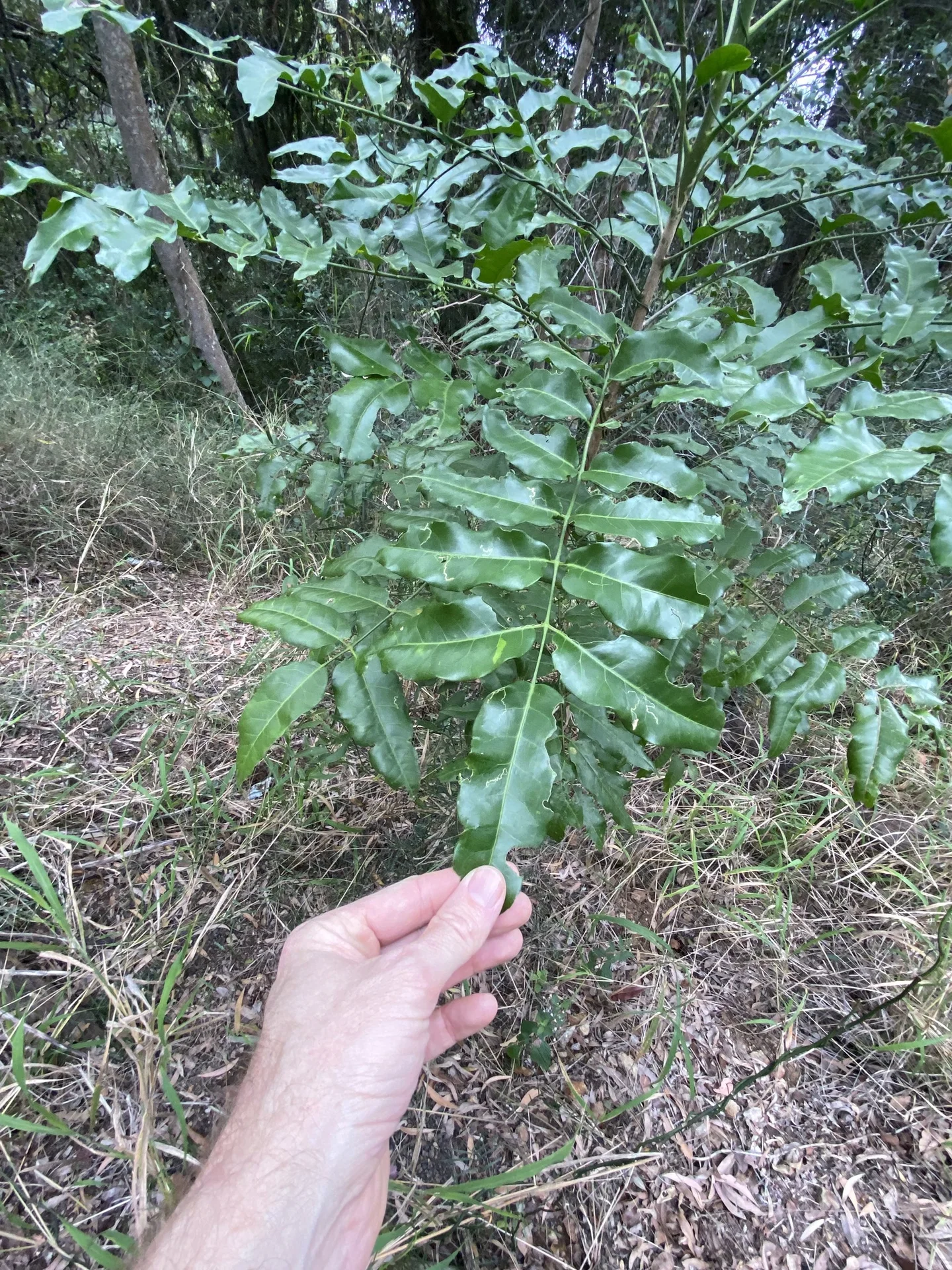
The leaves are imparipinnate (feather-formed with a single terminal leaflet) and measure between 15 and 50 centimeters long. They display several distinctive structural traits:
Each compound leaf carries 5 to 17 ovate to lance-shaped leaflets that measure 5 to 13 centimeters in length and have strongly asymmetrical bases.
When held against the light, the blades reveal numerous translucent pellucid glands—microscopic pockets filled with aromatic essential oils that release a citrusy scent when crushed.
Flowers and winged fruits
From winter through spring, the canopy produces heavily branched terminal panicles (loose, pyramid-shaped flower clusters) measuring 12 to 35 centimeters long. Individual flowers are about 6 millimeters across, featuring خمس tiny sepals and five white petals up to 3 millimeters long that emit a rich honey fragrance.
After pollination, the flower develops into one to five dry, light-brown samaras—specialized single-seeded fruits encircled by a papery wing 2 to 4.5 centimeters long. Inside each winged casing sits a compact seed roughly 3 millimeters in length.
Flowering season
June to October (Southern Hemisphere winter to spring)
Jan
Feb
Mar
Apr
May
Jun
Jul
Aug
Sep
Oct
Name
Dec
Applications
Timber and woodworking
Known in the timber trade as black teak or bastard crow's ash, this species yields a hard, close-grained, pale yellow-brown wood. Craftsmen have historically valued it for cabinetwork, interior joinery, and specialty turnery where a smooth finish is required.
Subtropical landscaping and reforestation
In eastern Australia, Pentaceras australe is cultivated as a feature shade tree in parks, large gardens, and streetscapes due to its neat form and profusion of fragrant blossoms. Ecological restoration projects also plant it as a hardy pioneer species to re-establish cleared subtropical and dry rainforest corridors.
Interesting facts
Five-horned aerodynamics in a dry rainforest
The generic name Pentaceras translates from Greek as 'five horns', referring to the five separate carpels (seed-bearing chambers) arranged at the center of each flower. Unlike familiar fleshy citrus fruits in the family Rutaceae, these chambers mature into dry, flat samaras wrapped in a wide, papery membrane.
This shift from heavy berry to lightweight wing is finely tuned to the tree's regeneration strategy along dry rainforest margins and sun-lit clearings. Because the wing is weighted slightly off-center by the 3-millimeter seed, the falling fruit automatically enters a stable, spinning autorotation—much like a miniature helicopter blade—that slows its descent.
By staying aloft longer in thermal updrafts, the seeds travel well beyond the dense shade of the parent canopy to colonize open gaps.
Even the timing of flowering from June to October aligns with the drier, breezier late-winter and spring months in Queensland and New South Wales, ensuring that mature samaras meet optimal wind currents right when they are ready to detach.