Amargo
Bitterwood
Surinam quassia
Bitter-ash
Hombre grande
Quassia wood
#1D3212
#636337
#2A2E11
#4C6938
#33511E
Plant palette
Quassia amara (Amargo): Botanical Guide and Uses
Deep within the humid, shaded understory of the Amazonian rainforest, a remarkably intense bitterness serves as a potent natural shield against hungry insects. This chemical defense belongs to Quassia amara, a slow-growing tropical shrub renowned for its striking crimson blossoms and therapeutic legacy.
Named in honor of Graman Quassi, a renowned 18th-century Surinamese healer who shared its fever-reducing secrets with European scholars, this plant occupies a celebrated chapter in ethnobotanical history. Today, modern researchers and organic farmers continue to study Quassia amara for its unique chemical compounds and ecological applications.
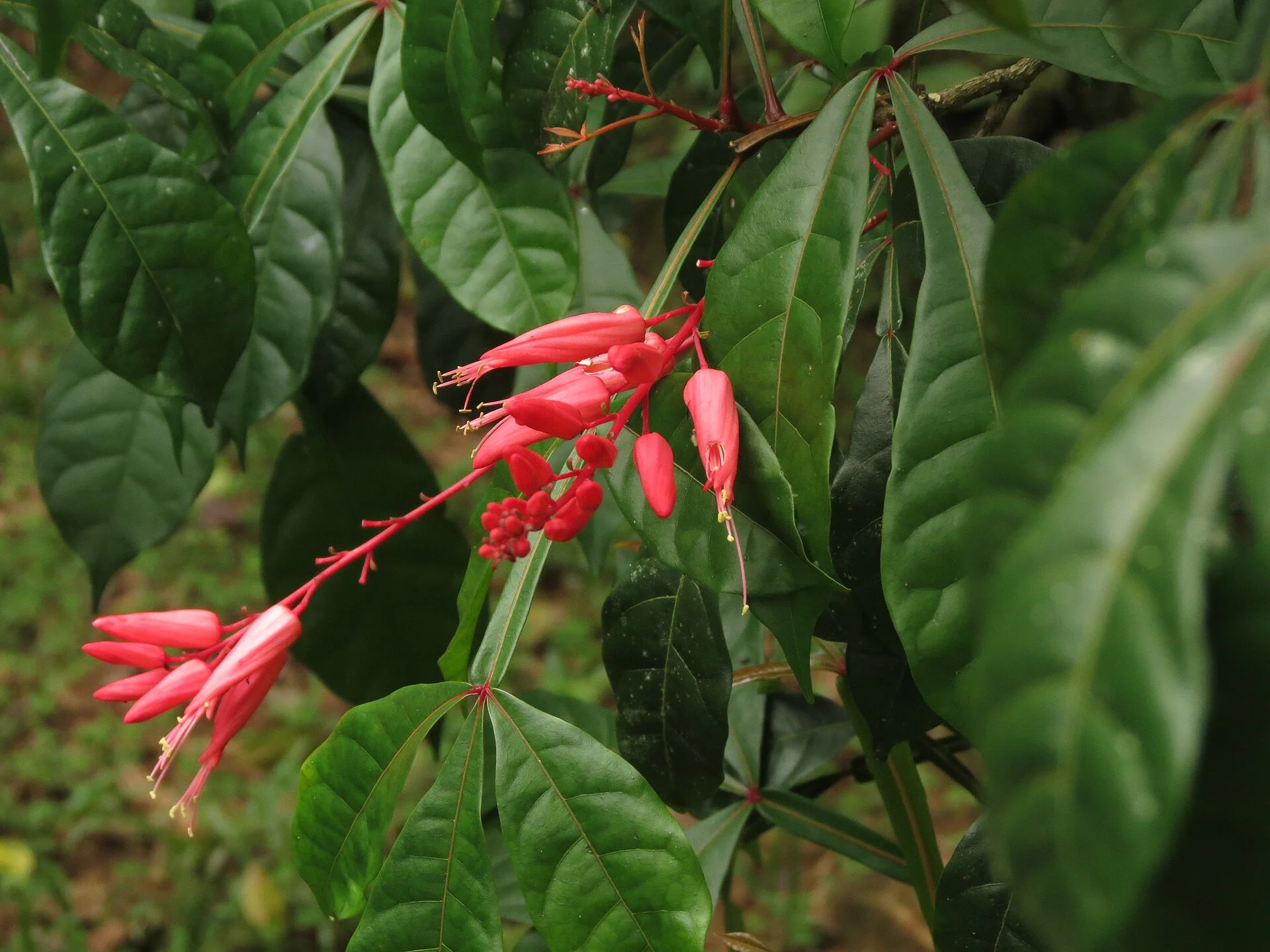
The species is easily distinguished by its compound leaves featuring distinctly winged, reddish petioles and showy terminal flower clusters. Its wood contains quassin, which is widely recognized as one of the most bitter substances ever discovered in the natural world.
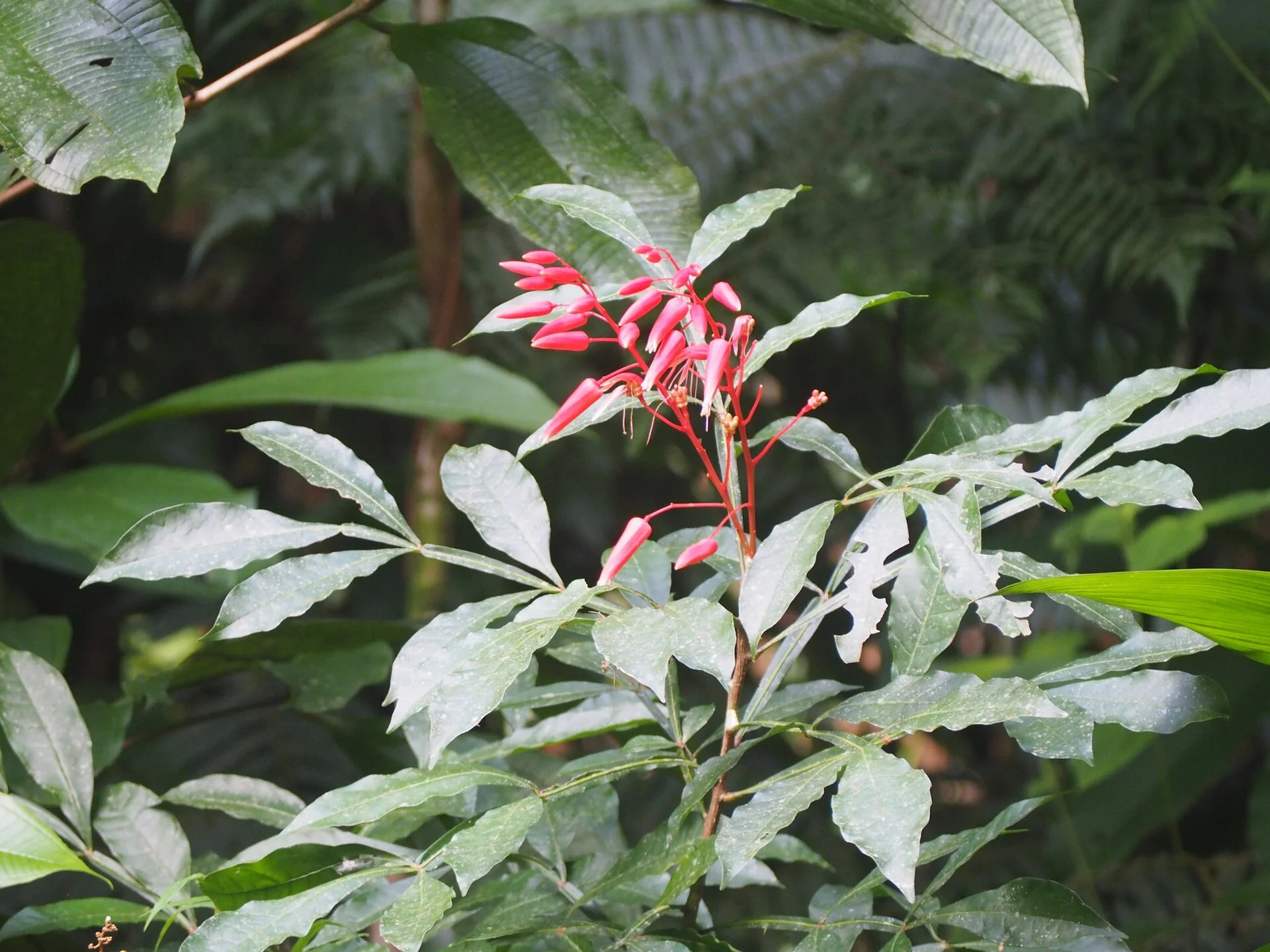
Quassia amara typically grows as a slow-growing shrub or a small, multi-stemmed tree, reaching a height of 2 to 6 meters, and occasionally up to 8 meters under optimal conditions. The plant features a somewhat disorderly, twiggy branching pattern with light gray, thin, and slightly rough bark.
The foliage is highly distinctive and organized as follows:
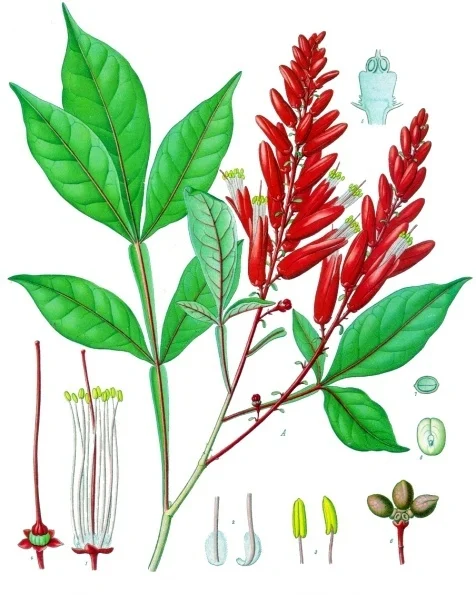
Leaves: The alternate, pinnately compound leaves measure 15 to 25 centimeters in length and consist of 3 to 5 (rarely 7) leaflets. The leaflets are dark green, deeply veined, polished, and have an obovate to elliptic shape with entire margins.
Winged Rachis: A key identifying feature is the leaf axis (rachis) and petiole, which are broadly winged and frequently display a reddish tint.
The reproductive organs exhibit striking color contrasts designed to attract pollinators, particularly hummingbirds:
Flowers: The narrow, tubular flowers are arranged in terminal racemes or panicles 10 to 30 centimeters long. Each flower measures 2.5 to 3.5 centimeters, boasting a brilliant crimson exterior and a clean white interior. The five lanceolate petals remain mostly closed, forming a tight cylinder around ten long, protruding stamens.
Fruits: Following successful pollination, the flowers are replaced by five small, elliptic drupes measuring 0.8 to 1.5 centimeters. These fleshy fruits are positioned on a red, swollen receptacle and transition from red to green, finally ripening to a deep purple-black color.
Flowering season
Flowering occurs from October through April in its Central American range, followed by fruit ripening that peaks in late winter and early spring.
Jan
Feb
Mar
Apr
May
Jun
Jul
Aug
Sep
Oct
Name
Dec
Applications
Quassia amara has a rich history of utility, particularly in organic farming, medicine, and the food industry, driven by its unique phytochemistry.
Natural Insecticide: Wood and bark extracts serve as highly effective, contact and stomach insecticides in organic agriculture. They are particularly successful at combating aphids, potato beetles, sawflies, and caterpillars without harming beneficial organisms.
Beverage and Food Industry: The intense bitter compounds extracted from the wood and bark form the flavor base for traditional Angostura Bitters, tonic waters, and various digestifs. They are also utilized as a hops substitute in beer brewing and as flavoring in baked goods.
Traditional and Modern Medicine: Infusions and teas made from the leaves and bark are widely used in South American folk medicine to treat malaria, reduce fevers, stimulate appetite, and aid digestion. Modern research has validated its anti-plasmodial, anti-hyperglycemic, and anti-ulcer properties.
Parasite Control: The bitter substances, such as quassin, target the chitin in lice larvae, making bark decoctions a popular hair rinse for treating dandruff and head lice.
Interesting facts
The history and ecology of Quassia amara are filled with intriguing details that highlight its cultural and natural significance.
Etymological Honor: The genus name was coined by Carl Linnaeus to honor Graman Quassi, an enslaved Surinamese man who gained his freedom and became a celebrated healer. He discovered the plant's ability to treat endemic fevers and shared it with Swedish botanist Daniel Rolander in 1756.
Extreme Bitterness: The specific epithet amara translates directly to "bitter" in Latin. The plant contains quassin, a compound estimated to be one of the most bitter substances occurring in nature.
Hummingbird Pollination: The plant's bright red, tubular flowers are specifically adapted for pollination by hummingbirds, which are drawn to the vivid crimson coloration and can easily access the nectar.
Linnaean Endorsement: In his 1764 dissertation, Carl Linnaeus praised the wood of this plant as a "divine medicine," noting its superior efficacy against fevers compared to the traditional Peruvian bark (quinine).
Traditional Cautions: Despite its healing properties, traditional South American medicine warns that excessive, long-term use can cause vomiting, muscle weakness, and even temporary or permanent vision loss.