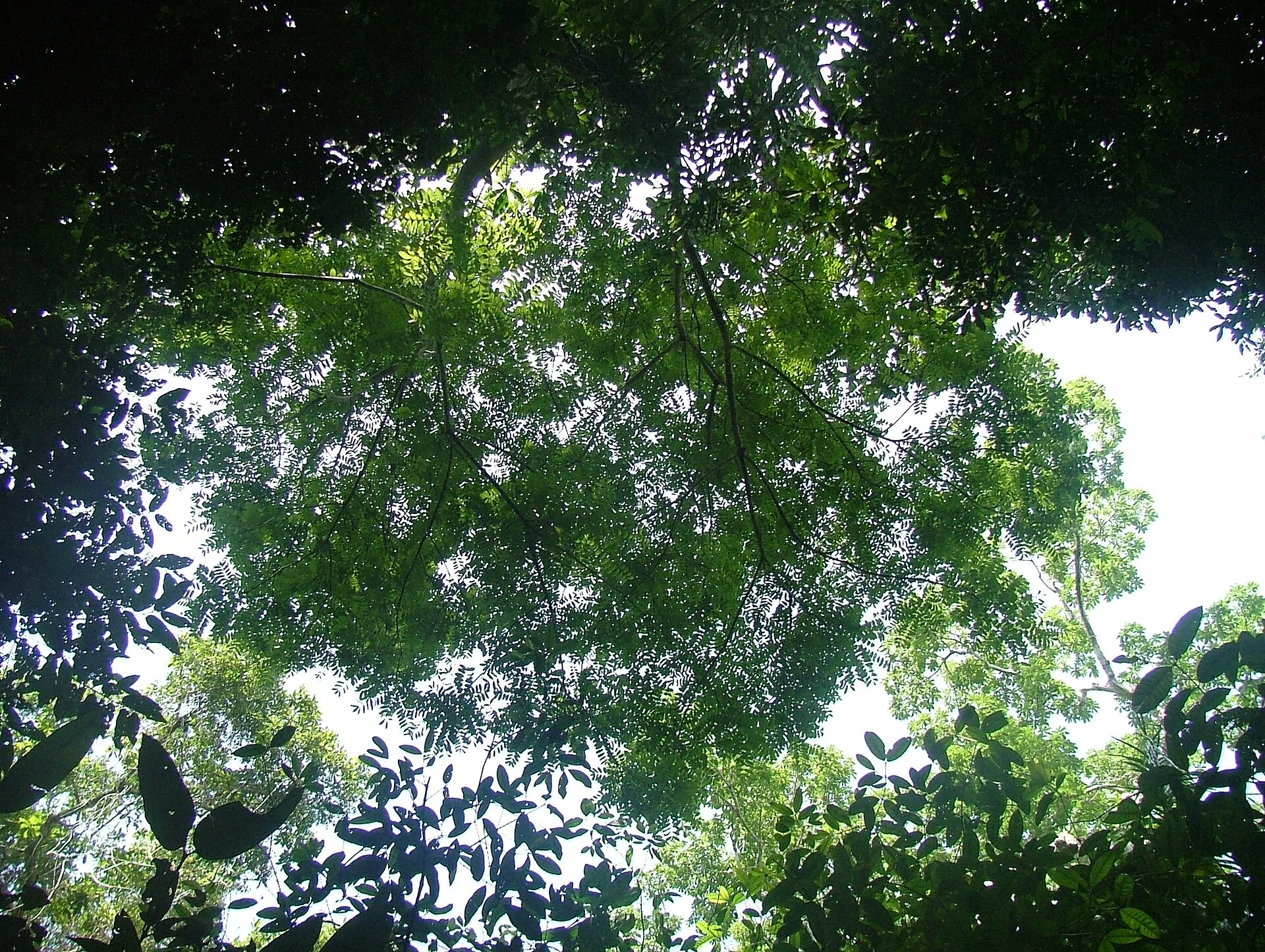
Paradise Tree
Bitter Ash
Bitterwood
Mountain Damson
Stave-wood
Damson
#162515
#4C654D
#90A68F
#314C2C
#DCEBDE
Plant palette
Simarouba amara: The Bitter Paradise Tree of the Rainforest
Towering above the dense canopy of the Neotropical rainforests, a remarkable tree makes its presence known through an intense, lingering bitterness in its bark. Known to science as Simarouba amara, this rapid grower plays a vital role in the ecological dynamics of Central and South American woodlands.
Locally referred to as the Paradise Tree, this evergreen giant is celebrated for its ability to quickly colonize sunlit gaps in the forest. Within these tropical ecosystems, Simarouba amara offers shelter and nourishment to various species of monkeys, birds, and insects.
Human communities have long recognized the tree's value, trading its light wood and potent medicinal bark across continents. Today, Simarouba amara remains a key subject of ecological research and sustainable forestry in the Amazon basin.
Simarouba amara is a large, fast-growing evergreen canopy tree that can reach heights of up to 35 to 40 meters. Its straight trunk can attain a maximum diameter of 125 centimeters, featuring a relatively smooth, grayish-brown bark that develops fine fissures as the tree matures.
The foliage consists of large, alternate compound leaves, which are typically imparipinnate and measure approximately 60 centimeters in length. Each leaf carries 9 to 16 leathery leaflets that are dark green and shiny on the upper surface, with a paler, sometimes glaucous underside.
The species is strictly dioecious, meaning individual trees produce either male or female flowers. The reproductive structure and fruit development are defined by the following characteristics:
Inflorescences: The small, pale yellow, unisexual flowers are less than 1 centimeter long and arranged in widely branched panicles about 30 centimeters in length.
Fruits: The fruit is a cluster of 3 to 5 compressed, oval drupes, which are about 1.5 to 2 centimeters long. They change color from green to red, and eventually turn a deep purplish-black when fully ripe.
Seeds: Each drupe contains a single, large seed measuring 10 to 14 millimeters in length. These seeds cannot undergo dormancy and rely on animal vectors for dispersal.
Flowering season
Flowering times vary by region, occurring from November to December in French Guiana, January to April in Panama, and March to July in Costa Rica.
Jan
Feb
Mar
Apr
May
Jun
Jul
Aug
Sep
Oct
Name
Dec
Applications
The lightweight and fine-grained wood of Simarouba amara is highly valued in both local and international markets. It is commonly utilized for manufacturing furniture, plywood, paper, matches, and interior veneers due to its ease of processing and rapid drying qualities.
In traditional medicine, the bitter bark and leaves are renowned for treating gastrointestinal ailments such as dysentery, diarrhea, and amoebiasis. Scientific evaluations have isolated active compounds called quassinoids, which exhibit powerful antimicrobial and antimalarial properties.
Beyond timber and medicine, the tree offers several other practical applications:
Edible Oil: The seeds yield a high-quality edible fat that can be utilized as a substitute for cocoa butter.
Activated Carbon: The hard shells of the seeds are processed to manufacture active charcoal for filtration purposes.
Cultural Uses: Indigenous communities, such as the Waika of the Amazon, extract a natural juice from the plant to use as black body paint.
Soil Conservation: Due to its robust root system, the tree is planted to control soil erosion and restore degraded lands.
Interesting facts
Ecological studies reveal that seedlings of Simarouba amara are far more likely to survive if they grow away from their parent trees. This phenomenon supports the Janzen-Connell hypothesis, which suggests that growing at a distance helps the young plants escape species-specific pests and pathogens.
Although the tree is highly beneficial, its wood shavings can be toxic to domestic animals. When used as bedding, the shavings have been documented to cause severe poisoning in horses and dogs.
Other fascinating biological and ecological facts about this species include:
Peculiar Phosphate Levels: The soil beneath female trees contains higher concentrations of bioavailable phosphate than that under male trees, likely due to rotting fruit and animal droppings.
Long-Distance Dispersal: While gravity drops seeds close to the mother tree, fruit-eating monkeys and birds transport them up to 1 kilometer away, enhancing genetic diversity.
Insect Relationships: The base of the trunk frequently serves as a nesting site for formidable bullet ants, while the caterpillars of the butterfly Bungalotis diophorus feed exclusively on its foliage.
Water Control: Instead of closing its stomata to prevent dehydration during dry periods, the tree regulates water loss structurally by adjusting its total leaf surface area.