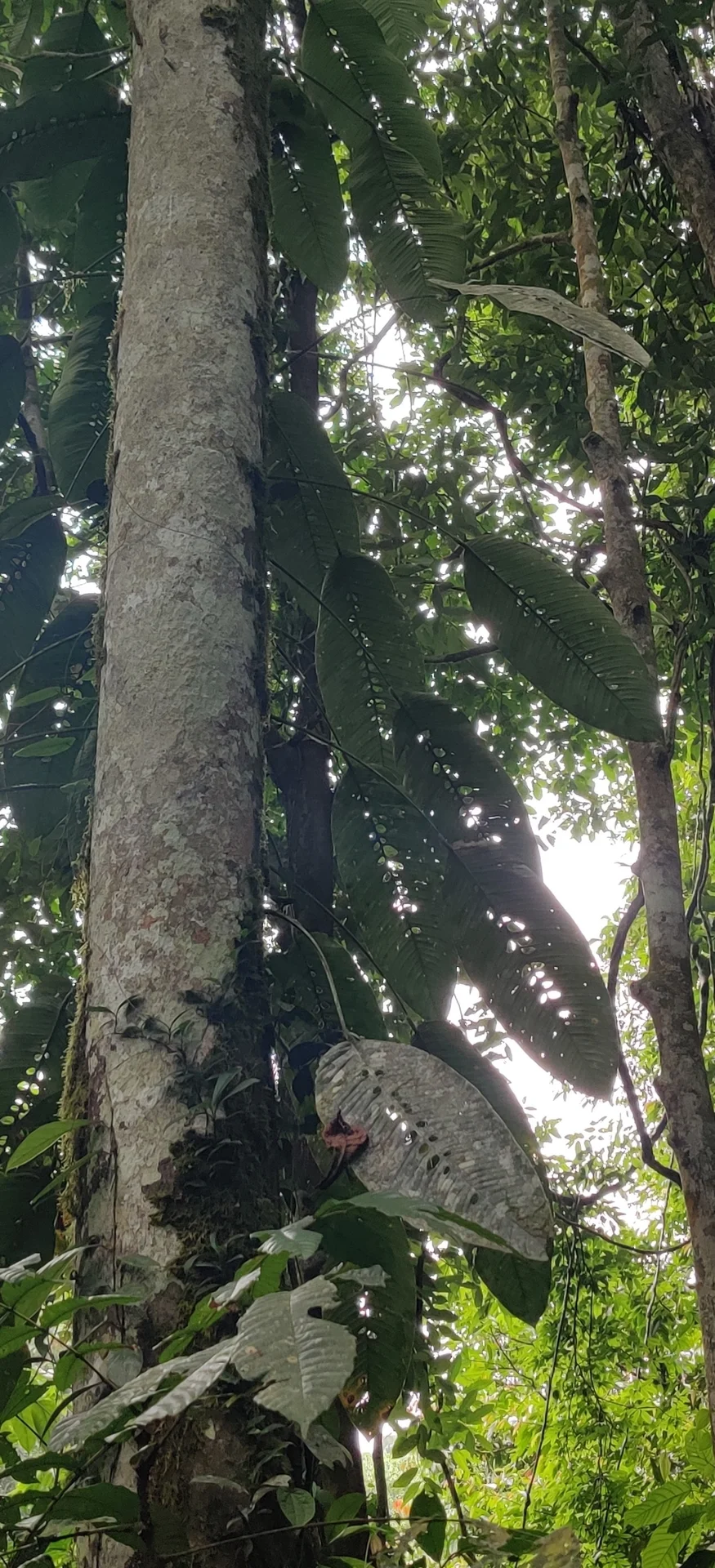
Rhaphidophora foraminifera — perforated aroid vine and indoor care
Rhaphidophora foraminifera is an evergreen climbing vine from the humid lowland and hill rainforests of Borneo, Sumatra, and Peninsular Malaysia. Its specific epithet, foraminifera, literally means 'hole-bearing' in Latin, pointing directly to the neat oval perforations that pierce its dark green leaf blades close to the central midrib as the vine climbs toward the canopy.
The species belongs to the arum family (Araceae) within the subfamily Monsteroideae. It was first described in 1898 by the German botanist Adolf Engler under the basionym Epipremnum foraminiferum, before Engler himself transferred it to the genus Rhaphidophora in 1908 based on the structure of its ovules and seeds.
Rhaphidophora foraminifera is a robust, perennial, evergreen liana that climbs up up to 15 meters along tree trunks in its native tropical forests. Its somatic cells carry a chromosome count of 2n = 60 (30 homologous pairs).
Dimorphic growth phases: In its juvenile and pre-adult stages, the plant grows as a shingling climber, pressing its stems and overlapping leaves flat against vertical tree bark with the help of clasping adhesive roots.
Petioles and geniculum: Each leaf is held on a channeled petiole measuring 22 to 52 centimeters long, topped by a prominent geniculum — a swollen, joint-like pulvinus just below the blade that acts like a hydraulic hinge to pivot the leaf toward incoming light.
Perforated leaf blades and inflorescences
As the vine matures and reaches brighter levels of the forest understory, its foliage transitions into large, hanging or spreading adult blades.
Fenestrated lamina: The adult leaf blades are oblong-elliptic to ovate-lanceolate, measuring 7 to 53 centimeters long and 6 to 19 centimeters wide, and are pierced by 1 to several round to elliptic perforations (fenestrations) positioned symmetrically alongside the midrib, while the outer leaf margins remain completely intact and unsplit.
Pubescent spadix and spathe: When mature, the vine produces solitary or clustered inflorescences at the shoot tips, consisting of a canoe-shaped greenish-yellow spathe (modified floral bract) up to 8–10 centimeters long that opens to reveal a cylindrical, densely hairy (pubescent) spadix (fleshy floral spike) packed with bisexual flowers containing tiny needle-like calcium oxalate crystals called raphides.
Care parameters
Light
Bright, indirect light; avoid harsh midday sun which can scorch the perforated leaf tissues.
Watering
Keep the potting mix evenly moist but never waterlogged, allowing the top few centimeters of substrate to dry slightly between waterings.
Temperature
Warm tropical conditions between 18 °C and 29 °C (65–85 °F); protect from cold drafts and temperatures below 15 °C.
Humidity
High relative humidity of 65–85% is ideal to help new perforated leaves unfurl cleanly without tearing.
Toxicity
Toxic if ingested; plant tissues contain needle-like calcium oxalate crystals (raphides) that cause oral irritation in humans and pets.
Applications
In indoor horticulture and botanical collections, Rhaphidophora foraminifera is cultivated as a prized foliage plant and terrarium climber. Collectors value it for its distinctive internal leaf holes and its striking contrast with more common split-leaf aroids like Monstera deliciosa or Rhaphidophora tetrasperma.
To replicate its natural climbing habit indoors, growers typically provide a moss pole, cedar plank, or cork bark mount. Giving the adhesive aerial roots a vertical, moisture-retentive surface to grip encourages the vine to transition from smaller juvenile leaves to large, heavily perforated adult foliage.
Interesting facts
Programmed cell death as an architectural tool
Unlike many climbing aroids whose leaves split all the way to the outer edge as they expand, Rhaphidophora foraminifera keeps its outer leaf margins solidly framed while opening neat oval windows right next to the midrib. These holes are not caused by wind tearing the leaf; instead, they are sculpted before the leaf even unfurls through programmed cell death (apoptosis), where specific patches of cells inside the microscopic leaf bud systematically stop dividing and dissolve.
Engineering for torrential rainforests
Living attached to tree trunks in the perhumid rainforests of Borneo, Sumatra, and Malaysia poses three simultaneous physical challenges: erratic sunflecks, violent tropical downpours, and stagnant boundary-layer air. The perforated blade and hinged petiole of Rhaphidophora foraminifera solve all three problems in a single coordinated design.
Hydraulic relief and light sharing: Placing perforations directly alongside the thick central midrib — where water naturally pools on an overarching leaf — allows heavy monsoon rain to drain straight through the blade without snapping the petiole, while simultaneously letting dappled sunlight pass through to feed the plant's own lower leaves.
Thermal convection and tracking: While the swollen geniculum at the top of the stalk adjusts the leaf angle to track shifting beams of forest light, the internal holes break up the insulating layer of still air clinging to the leaf surface, allowing rising warm air to pass through and cool the photosynthetic tissue.
The fact that tiny microscopic buds dissolve exact patches of cells in advance so the adult leaf can balance light capture, rain drainage, and cooling shows how precisely every stage of the plant's development is coordinated with the physics of the rainforest.
Geography of distribution
Malaysia
Indonesia
Brunei
Sources
Boyce, P. C. (1999). The Genus Rhaphidophora Hassk. (Araceae-Monsteroideae-Monstereae) in Peninsular Malaysia and Singapore. Gardens' Bulletin Singapore, 51: 183–256.
Boyce, P. C. (2001). The Genus Rhaphidophora Hassk. (Araceae-Monsteroideae-Monstereae) in Borneo. Gardens' Bulletin Singapore, 53: 19–74.
Plants of the World Online (POWO). Royal Botanic Gardens, Kew: Rhaphidophora foraminifera (Engl.) Engl.