
Lily of the Valley Vine
Salpichroa origanifolia
A sprawling perennial vine from South America bearing small, urn-shaped white blossoms and sweet, pale …
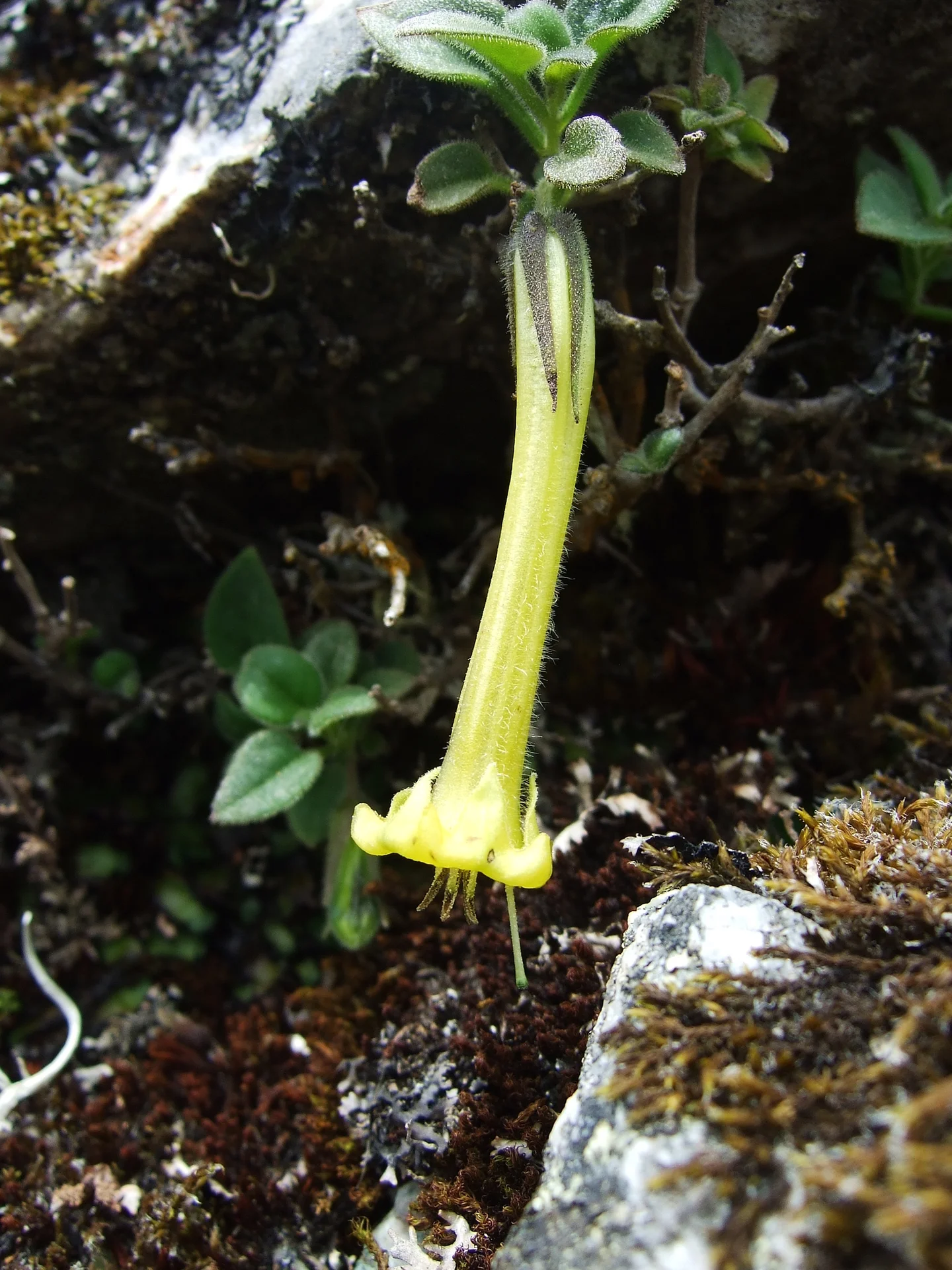
Salpichroa glandulosa is a sprawling, woody-based Andean subshrub that drapes over boulders and ravine walls across the high mountains of Peru, Bolivia, Chile, and northwestern Argentina. Its specific epithet glandulosa refers to the dense covering of microscopic, sticky-tipped glandular hairs across its stems, leaves, and calyces, which accompany its long, nodding, greenish-yellow trumpet flowers.
A member of the nightshade family (Solanaceae), the plant was originally described in 1837 by the eminent British botanist William Jackson Hooker as Atropa glandulosa. Eight years later, in 1845, John Miers moved it into the genus Salpichroa, where botanists today also recognize two distinct geographic subspecies: the nominate S. glandulosa subsp. glandulosa and S. glandulosa subsp. weddellii.
Growing in rocky ravines (quebradas) and high-elevation scree, Salpichroa glandulosa develops long, clambering woody stems that can trail over stones or lean against neighboring shrubs. The entire plant is coated in specialized glandular trichomes—fine hairs tipped with microscopic secretory cells that make the herbage slightly viscid to the touch.
The solitary flowers hang gracefully from the leaf axils on pendulous stalks, measuring several centimeters in length and standing out against the muted gray-green foliage. Their elongated proportions match the feeding apparatus of high-altitude pollinators.
While its close relative Salpichroa hirsuta relies on dry, stiff bristles for physical insulation, Salpichroa glandulosa employs a sophisticated chemical shield across the high Andean valleys of up to 4,000 meters. The plant's surface is studded with glandular trichomes—miniature biological factories raised on slender cellular stalks.
This dual strategy—repelling unwanted leaf-eaters through sticky epidermal chemistry while welcoming specialized avian pollinators with precision-engineered floral tubes—demonstrates a remarkably integrated design where defense and reproduction operate in seamless harmony.
Taxon Synonyms: Salpichroa amoena, Atropa glandulosa
Salpichroa origanifolia
A sprawling perennial vine from South America bearing small, urn-shaped white blossoms and sweet, pale …

Salpichroa hirsuta
A wild Andean scrambling subshrub in the nightshade family, distinguished by its shaggy coat of …

Picrasma
A genus of deciduous trees and shrubs known for their extremely bitter bark and medicinal …

Araucaria humboldtensis
A small, critically endangered coniferous tree native strictly to the high-altitude mountain peaks of southern …