
Glandular Lily of the Valley Vine
Salpichroa glandulosa
A high-Andean scrambling subshrub of the nightshade family, characterized by sticky glandular hairs and long, …
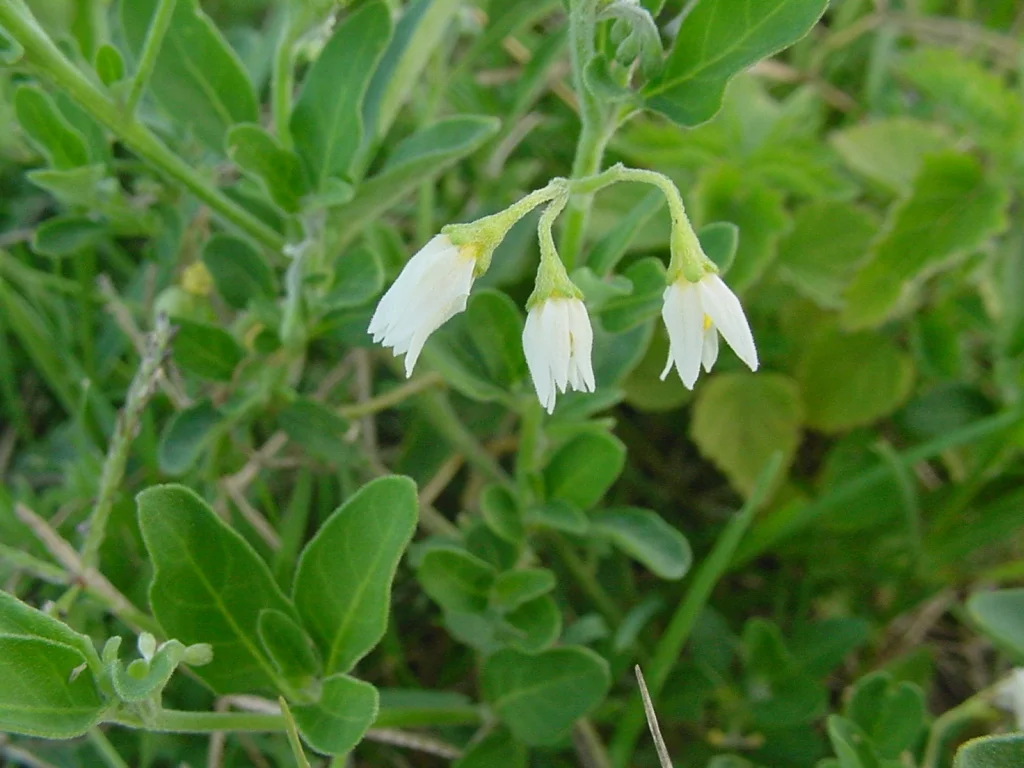
Salpichroa origanifolia is a sprawling, richly branched perennial vine native to the warm grasslands and open woodlands of South America, easily recognized by its dainty, nodding white flowers and pale, egg-shaped berries. Its specific epithet origanifolia means "oregano-leaved," pointing to the small, rounded leaf blades that closely resemble culinary oregano at a passing glance.
Belonging to the nightshade family (Solanaceae), the species was first scientifically described by Jean-Baptiste de Lamarck and later placed in its current genus by Louis Antoine François Baillon in 1888.
This herbaceous perennial develops a tough network of rhizomes—underground horizontal stems that store nutrients and send up new shoots—giving rise to flexible, four-angled aerial stems that trail across the ground or scramble up to 2–3 meters over neighboring shrubs. The zigzagging branches are clothed in fine hairs when young, gradually becoming woody toward the base.
After pollination, the flower develops into a smooth, ovoid berry measuring 10 to 20 millimeters long. As it ripens in autumn, the fruit turns waxy white or pale ivory-yellow and contains numerous flattened seeds suspended in a sweet, grape-scented pulp.
Blooms primarily from late spring through mid-autumn, with peak flowering in summer.
Despite its reputation as an aggressive colonizer in mild coastal climates outside its native range, Salpichroa origanifolia has several documented uses in its South American homeland and in traditional beekeeping.
While Salpichroa origanifolia is neither a true lily nor related to oregano, its survival strategy showcases a finely tuned coordination between floral geometry, stem mechanics, and seed dispersal.
The downward-facing, urn-shaped blossom acts as a miniature weatherproof chamber for its reproductive organs. By narrowing slightly at the mouth and hanging beneath the leafy canopy, the corolla shields both its nectar reserves and pollen-laden anthers from rain dilution and drying pampero winds.
Taxon Synonyms: Perizoma rhomboidea, Salpichroa rhomboidea var. pubescens, Atropa rhomboidea, Physalis origanifolia, Atropa origanifolia, Salpichroa rhomboidea var. divaricata, Salpichroa rhomboidea
Salpichroa glandulosa
A high-Andean scrambling subshrub of the nightshade family, characterized by sticky glandular hairs and long, …

Salpichroa hirsuta
A wild Andean scrambling subshrub in the nightshade family, distinguished by its shaggy coat of …

Picrasma
A genus of deciduous trees and shrubs known for their extremely bitter bark and medicinal …

Araucaria humboldtensis
A small, critically endangered coniferous tree native strictly to the high-altitude mountain peaks of southern …