
Lily of the Valley Vine
Salpichroa origanifolia
A sprawling perennial vine from South America bearing small, urn-shaped white blossoms and sweet, pale …
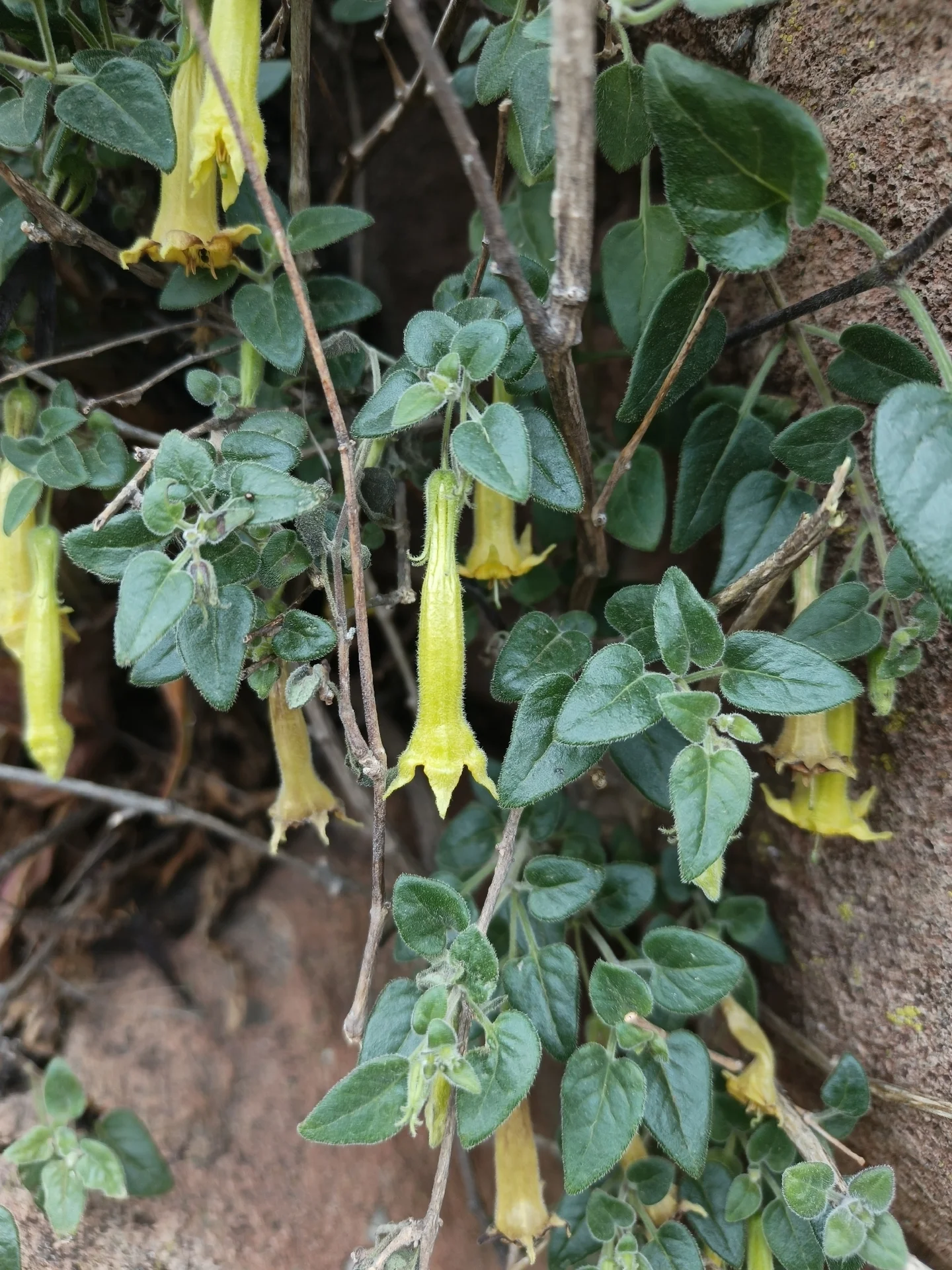
Salpichroa hirsuta is a wild, scrambling subshrub native to the high mountain slopes of Peru and Bolivia, where it weaves through rocky crevices and low alpine scrub. True to its Latin specific epithet hirsuta—meaning shaggy or covered in coarse hairs—the plant wears a dense coat of stiff bristles across its stems and small leaves, accompanied by solitary, nodding tubular flowers.
It belongs to the nightshade family (Solanaceae) and was first collected and described in 1834 by the Prussian physician and naturalist Franz Julius Ferdinand Meyen under the name Atropa hirsuta. In 1845, the British botanist and engineer John Miers transferred the species to his newly established genus Salpichroa, giving the plant its currently accepted scientific name.
In its rugged highland habitat, Salpichroa hirsuta grows as a woody-based, richly branched subshrub with flexuous, trailing or scrambling stems. These tough shoots use surrounding rocks and woody bushes for support, forming tangled mats that resist mountain winds.
The flowers emerge singly from the leaf axils, hanging downward on slender, hairy stalks (pedicels) like miniature trumpets. This pendulous posture shields the reproductive organs and nectar from cold mountain rain.
Living at high elevations in the tropical Andes means facing extreme daily temperature swings, where intense midday solar radiation is followed by freezing night air. The defining trait of Salpichroa hirsuta—its dense, shaggy coat of coarse trichomes—functions as a finely tuned microclimatic buffer rather than a mere decorative feature.
Every detail of this epidermal armor works in concert with the plant's compact, rock-hugging growth habit and downward-facing flowers. Together, these traits form a cohesive survival system tailored to the harsh physics of high-altitude life.
Taxon Synonyms: Salpichroma hirsutum, Atropa hirsuta
Salpichroa origanifolia
A sprawling perennial vine from South America bearing small, urn-shaped white blossoms and sweet, pale …

Salpichroa glandulosa
A high-Andean scrambling subshrub of the nightshade family, characterized by sticky glandular hairs and long, …

Picrasma
A genus of deciduous trees and shrubs known for their extremely bitter bark and medicinal …

Araucaria humboldtensis
A small, critically endangered coniferous tree native strictly to the high-altitude mountain peaks of southern …