Sapranthus campechianus — morphology, habitat, and botany
Sapranthus campechianus is an evergreen shrub or small understory tree that grows in the tropical forests of the Yucatán Peninsula, Chiapas, and northern Central America. Its specific epithet, campechianus, refers to the Mexican state of Campeche, where early botanical specimens were gathered, and the plant stands out in the shaded forest floor for its solitary flowers that gradually mature from pale green to dark reddish-maroon.
This species belongs to the custard apple family (Annonaceae). It was originally described by the German botanist Carl Sigismund Kunth as Asimina campechiana before the American botanist Paul Carpenter Standley transferred it to the genus Sapranthus in 1922.
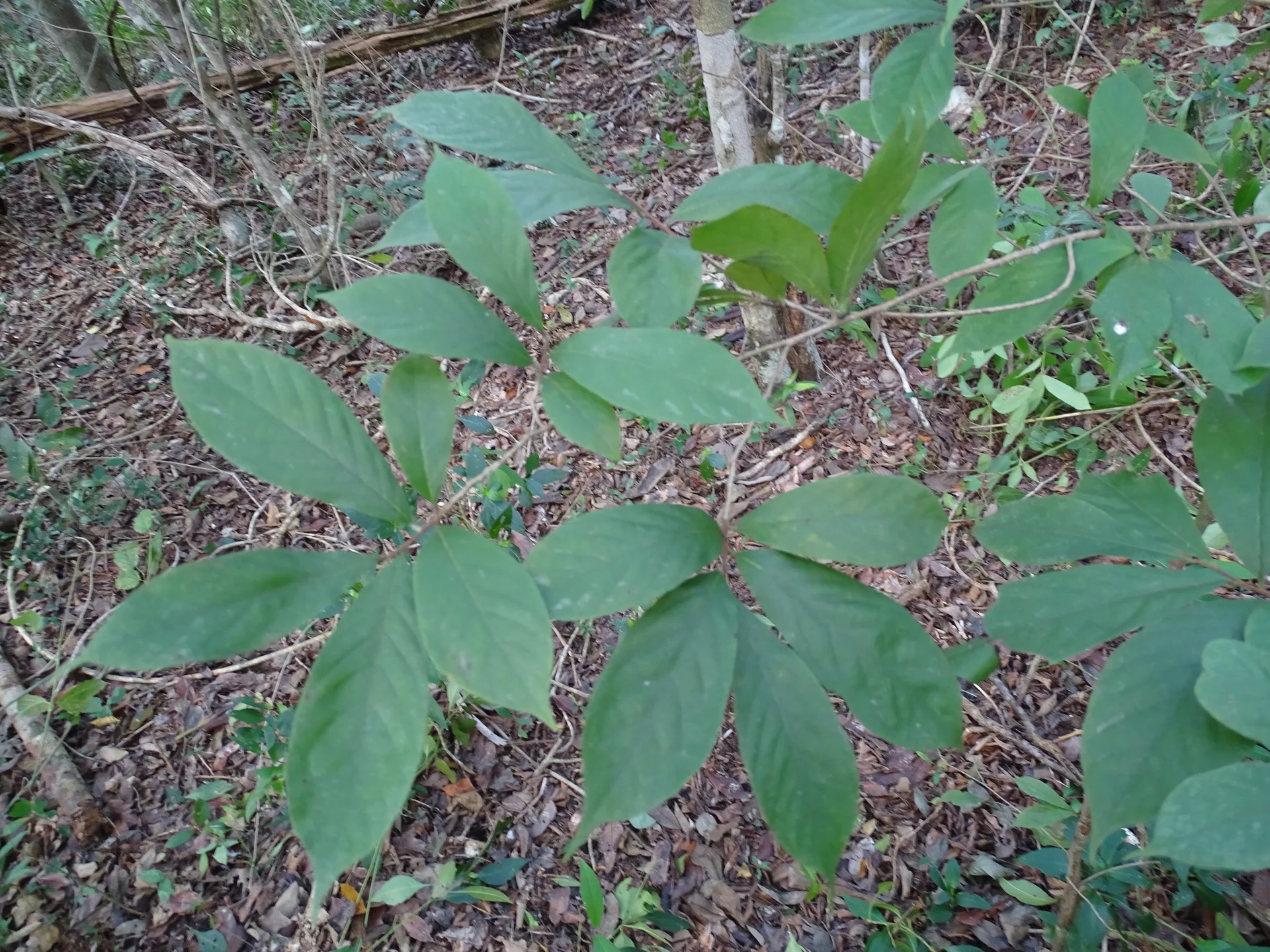
In its natural forest habitat, Sapranthus campechianus develops as a branching shrub or a slender evergreen tree reaching 2 to 10 meters in height. Its young twigs and short leaf stalks are covered in fine, soft hairs that protect emerging tissues.
Leaf blades: The leaves are arranged alternately along the branches and have an elliptic to obovate (teardrop-shaped with the wider end toward the tip) outline, measuring 2.8 to 21.2 centimeters long and 1.6 to 8.6 centimeters wide.
Margins and petioles: Each blade has an entire (smooth and untoothed) margin, a wedge-shaped or obtuse base, and a sharply pointed apex, supported by a hairy petiole (leaf stalk) just 2 to 9 millimeters long.
Flowers and fruits
The flowers emerge singly from the leaf axils or along older woody shoots. Like many members of its genus, the blossoms undergo a marked color transition as they mature.
Perianth structure: The calyx consists of three small triangular sepals measuring 4 to 8 millimeters long, surrounding six oval to elliptic petals arranged in two whorls that reach 25 to 33 millimeters in length and turn from green to deep red.
Reproductive organs and fruit: Inside the floral chamber sit roughly 100 tightly packed stamens surrounding 9 to 13 separate carpels (pistils), which develop after pollination into clusters of ellipsoid to obovoid fruitlets (monocarps — individual berry-like segments formed from a single flower) measuring 18 to 34 millimeters long.
Interesting facts
Sensory mimicry in the Mesoamerican understory
The generic name Sapranthus combines the Greek words sapros (rotten or putrid) and anthos (flower), directly pointing to the specialized pollination strategy refined by this Central American lineage. While many tropical trees rely on sweet nectar and bright colors to attract bees or butterflies in the sunlit canopy, Sapranthus campechianus operates in the dim understory below 1,200 meters, where wind is scarce and visual signals are muted.
Coordinated floral mechanics
To ensure cross-pollination in these shaded habitats, the flower coordinates its visual, chemical, and structural traits to match the sensory preferences of carrion-feeding and saprophagous beetles and flies.
Chromatographic shift: The petals open as an inconspicuous leafy green while the tissues expand, then accumulate dark anthocyanin pigments to turn dull red or liver-colored just as the reproductive organs reach maturity.
Structural floral chamber: The six membranaceous, prominently veined petals curve inward to form a sheltered space around the ~100 stamens and central carpels, retaining volatile scent compounds and offering visiting insects a protected microclimate where pollen transfer happens efficiently.
Every detail of this floral architecture — from the timing of pigment synthesis to the precise geometry of the petal chamber — works in concert to guide specific forest insects to the stamens without expending energy on sugar-rich nectar.
Geography of distribution
Mexico
Belize
Guatemala
Honduras
Sources
Plants of the World Online (POWO). Royal Botanic Gardens, Kew: Sapranthus campechianus (Kunth) Standl.
Schatz, G. E. et al. (2018). Taxonomic revision of the genus Sapranthus (Annonaceae). Blumea.
Global Biodiversity Information Facility (GBIF): Sapranthus campechianus occurrence and taxonomy records.