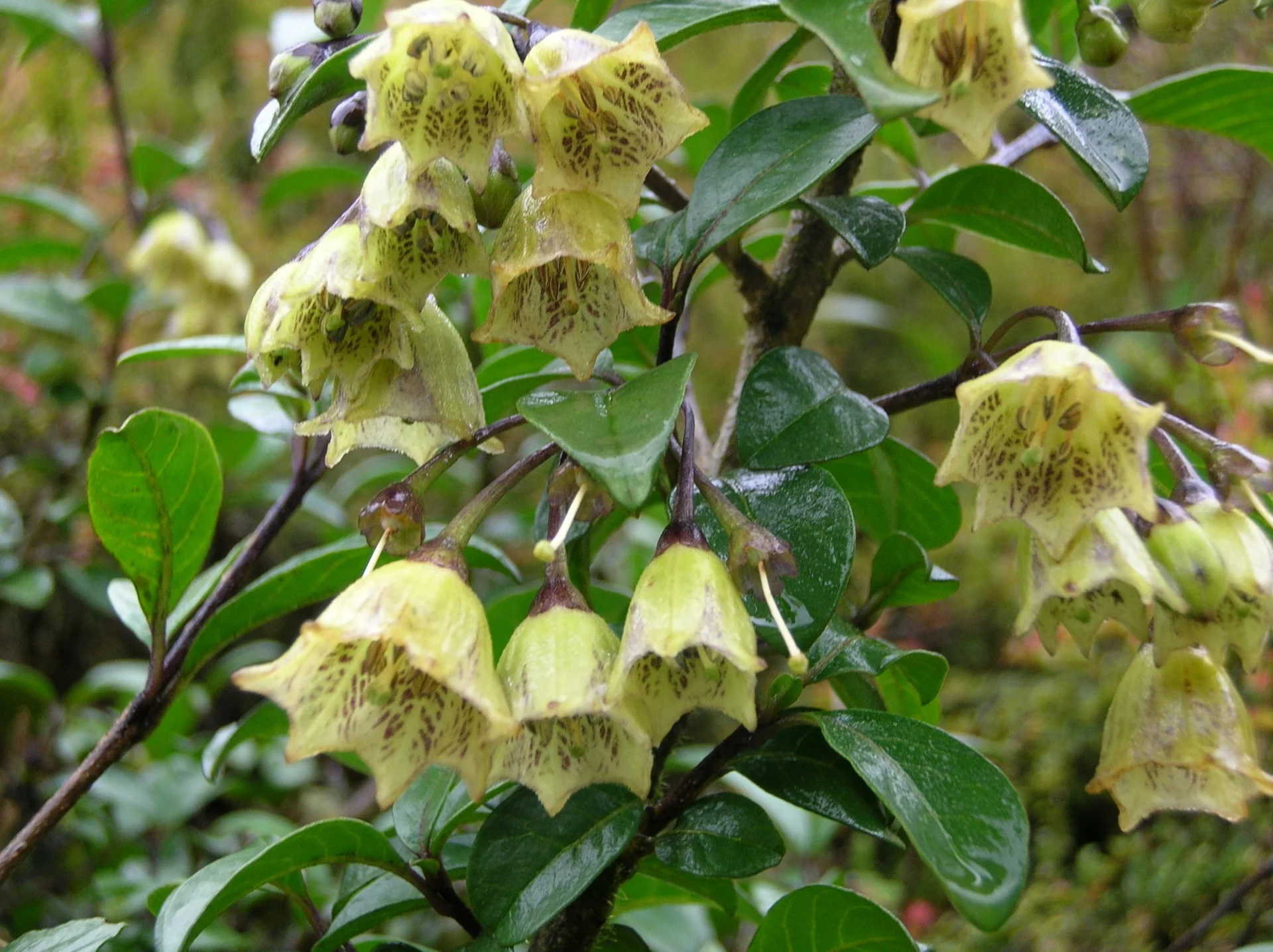
Saracha punctata: Andean bell-flowered shrub of the Solanaceae family
Saracha punctata is an evergreen shrub or small gnarled tree native to the cool, mist-shrouded cloud forests and high-elevation timberlines of the tropical Andes. Its Latin epithet punctata—meaning spotted or dotted—refers to the striking purple-brown or violet speckles painted across the inside of its nodding, bell-shaped yellow-green to violet flowers.
Belonging to the nightshade family (Solanaceae), the species was first scientifically described in 1799 by the Spanish botanists Hipólito Ruiz López and José Antonio Pavón following their famous botanical expedition to Peru and Chile. It serves as the type species of the genus Saracha, which honors the 18th-century Spanish Benedictine monk and botanist Isidoro Saracha.
Adapted to the cool, windy conditions of the high Andes between 2,500 and 4,000 meters above sea level, Saracha punctata grows as a densely branched shrub or a compact tree reaching 2 to 8 meters in height. Its young twigs are often angled and covered in fine, protective pubescence before maturing into rough, fissured bark.
Leaves: The thick, leathery leaves are elliptic to obovate, arranged alternately or clustered near the branch tips, with prominent veins on the underside.
Foliar protection: The tough leaf texture helps the plant withstand intense high-altitude ultraviolet radiation and sudden night frosts.
Flowers and fruits
The plant produces showy, pendulous flowers either singly or in small umbel-like clusters that hang down beneath the foliage. After pollination, the persistent calyx continues to grow slightly around the developing fruit.
Corolla: Each flower features a broadly campanulate (bell-shaped) to funnel-shaped corolla measuring 2 to 3.5 centimeters long, yellowish-green to cream on the outside and heavily dotted with dark purple inside.
Berries: The fruit is a juicy, spherical to ovoid berry enclosed at the base by the leathery calyx, containing numerous flattened, pitted seeds.
Flowering season
Flowers intermittently throughout the year in tropical montane climates, with a peak during the wetter months from October to April.
Jan
Feb
Mar
Apr
May
Jun
Jul
Aug
Sep
Oct
Name
Dec
Applications
In rural Andean communities of Peru, Bolivia, and Ecuador, the dense wood of Saracha punctata is occasionally used locally as fuelwood and for constructing living fences around high-mountain pastures. Due to the presence of tropane and other solanaceous alkaloids typical of its lineage, the plant is avoided as livestock fodder, though its striking pendulous blossoms make it a prized subject for high-elevation Andean botanical collections.
Interesting facts
Hanging umbrellas for mountain pollinators
Living in the upper montane cloud forests and sub-páramo zones of the Andes, Saracha punctata must flower and set seed in an environment where freezing rain, thick fog, and chilly mountain winds are everyday occurrences. An upward-facing flower in this climate would quickly fill with cold rainwater, diluting its nectar and washing away its pollen.
The architecture of its blossoms solves this meteorological challenge through several integrated features:
Pendulous orientation: By hanging its bell-shaped corollas upside down on curving pedicels, the plant keeps its five stamens and nectar reserves dry inside a sheltered air pocket, much like a diving bell.
Nectar guides in the gloom: The dense purple-brown spots (punctata) lining the pale interior of the bell act as high-contrast visual runway lights, guiding high-altitude bumblebees and hummingbirds directly to the nectar during dim, overcast days.