
Blessed Milk Thistle
Silybum marianum
A hardy annual or biennial thistle famous for its milk-white veined leaves, purple flower heads, …
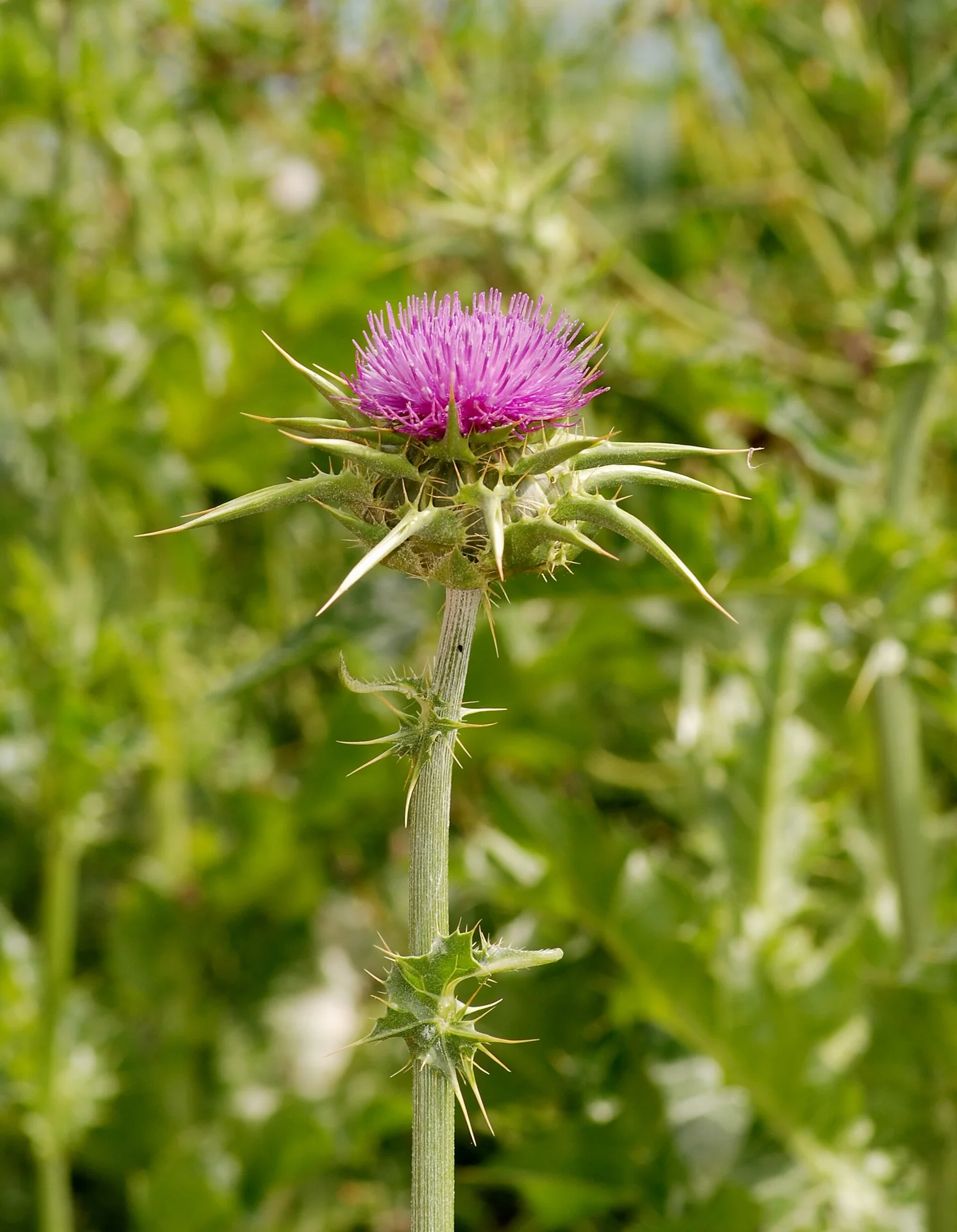
Forming spontaneously in regions where its parent populations meet, Silybum ×gonzaloi displays intermediate morphological traits.
This nothospecies is the result of cross-pollination between Silybum eburneum and Silybum marianum. It is primarily documented in areas where the geographical ranges of the two parents overlap, offering valuable insights into hybrid speciation within the aster family.
The morphology of Silybum ×gonzaloi combines elements of both parent plants in its vegetative and floral structures. It forms large rosettes of glossy, lobed leaves characterized by prominent white veins. The margins are armed with sharp, pale spines, reflecting the heavy armature of Silybum eburneum and the broad leaves of Silybum marianum.
Its inflorescences consist of large, globose flower heads surrounded by stout involucral bracts. These bracts terminate in stiff, sharp spines that are less spreading than those of Silybum eburneum but more robust than those of Silybum marianum. The tubular flowers exhibit a deep pinkish-purple hue.
Spring to early summer
This hybrid is not utilized in commercial agriculture or horticulture due to its wild nature and hybrid status. However, it holds significant value in botanical research, particularly in the study of hybridization events and genetic flow between thistle species. Its presence in wild populations helps botanists understand the evolutionary dynamics of the genus Silybum.
Silybum marianum
A hardy annual or biennial thistle famous for its milk-white veined leaves, purple flower heads, …

Silybum eburneum
A spiny annual or biennial thistle native to the Mediterranean basin, known for its distinct …

Picrasma
A genus of deciduous trees and shrubs known for their extremely bitter bark and medicinal …

Araucaria humboldtensis
A small, critically endangered coniferous tree native strictly to the high-altitude mountain peaks of southern …