Milk thistle
Blessed milkthistle
Marian thistle
Mary thistle
Saint Mary's thistle
Mediterranean milk thistle
Variegated thistle
Scotch thistle
IUCN: Вызывает наименьшие опасения
Silybum marianum: The Complete Guide to Milk Thistle
Under the blazing Mediterranean sun, where dry, disturbed meadows stretch toward ancient ruins, the striking silhouette of Silybum marianum stands out with its milk-white veins and sharp spines. Commonly known as milk thistle, this resilient annual or biennial herb is celebrated both as a stubborn wild weed and a highly valued medicinal crop.
According to medieval Christian folklore, the distinctive white patterns tracing the glossy leaves of this thistle were formed by drops of the Virgin Mary's milk. Beyond its rich mythological heritage, the plant has transitioned into modern pharmacology as a premier natural agent for liver protection.
Today, it is cultivated globally, from the historic fields of Europe to agricultural landscapes in China and Argentina. Its seeds serve as the primary source for silymarin, a powerful complex of active flavonolignans.
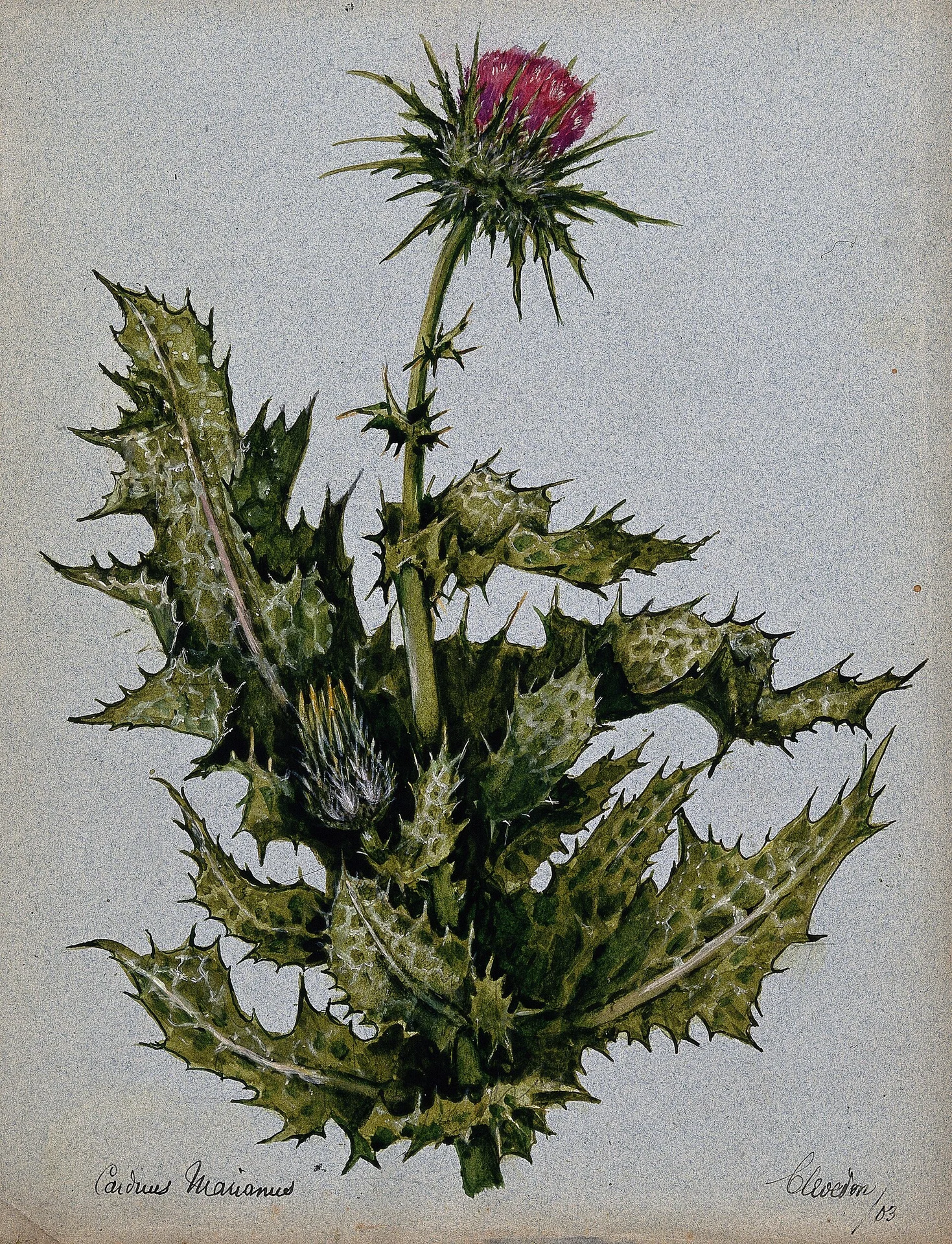
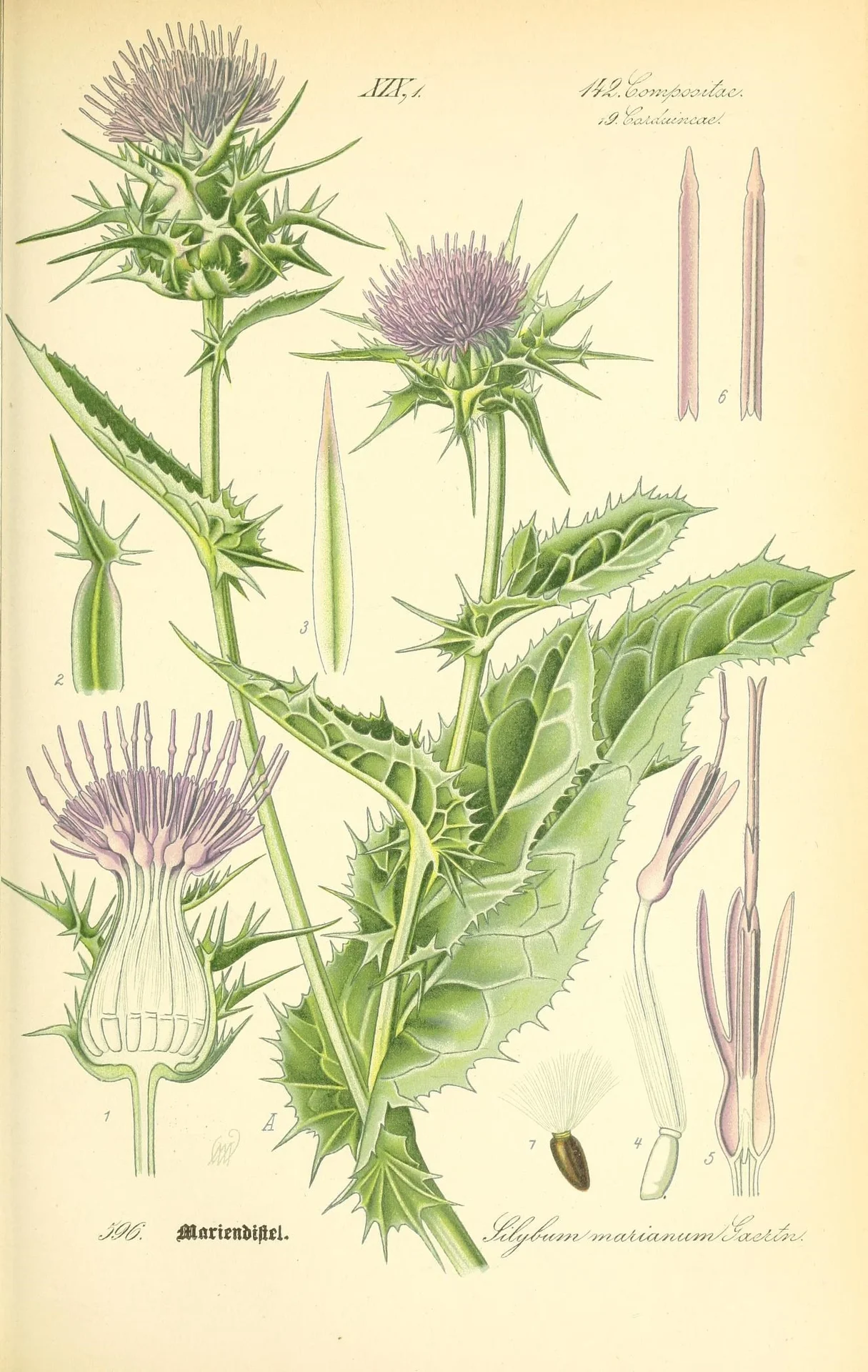
Botanical illustration
Фото: BioDivLibrary / Лицензия: Public Domain Mark
Morphology
Silybum marianum is a robust, upright herb that can grow between 30 and 200 cm in height, exhibiting a distinct conical shape. Its grooved stem is hollow in larger specimens and is often covered with a light, cottony fuzz.
The large, glossy green leaves are oblong to lanceolate, measuring 15 to 60 cm in length. They are characterized by spinose margins and a striking reticulate pattern of milk-white veins running across their hairless surface.
Its reproductive structures include:
Flower heads: Solitary, globose heads measuring 4 to 12 cm across, filled with tubular florets of a vibrant red-purple hue.
Bracts: A surrounding envelope of hairless bracts featuring triangular, spine-edged appendages that end in a stout yellow spine.
Achenes: Shiny, black to mottled grey-brown fruits about 6 to 8 mm long, topped with a deciduous white pappus that facilitates wind dispersal.
Flowering season
Flowers from June to August in the Northern Hemisphere and from December to February in the Southern Hemisphere.
Jan
Feb
Mar
Apr
May
Jun
Jul
Aug
Sep
Oct
Name
Dec
Applications
The primary value of Silybum marianum lies in its seeds, which contain silymarin, a powerful complex of flavonolignans. This natural compound is widely utilized in modern medicine for its hepatoprotective, anti-inflammatory, and antioxidant properties, helping to treat liver conditions such as cirrhosis, hepatitis, and fatty liver disease.
In emergency medicine, the active component silibinin is administered intravenously as an effective antidote for life-threatening poisoning caused by the death cap mushroom (Amanita phalloides). Research also points to the herb's potential in regulating blood sugar and protecting renal cells.
Historically and in various local traditions, this thistle has also served as a versatile food source:
Roots: Can be consumed raw, boiled, or roasted like salsify.
Leaves and Shoots: Young leaves, once stripped of their sharp spines and soaked to remove bitterness, make an excellent substitute for spinach or a fresh salad green.
Flower Heads: Can be cooked and eaten in a manner similar to globe artichokes.
Seeds: Can be roasted to create a caffeine-free coffee alternative.
Interesting facts
According to Christian legend, the white veins on the leaves of Silybum marianum arose when drops of the Virgin Mary's milk fell onto a thistle plant while she hid the infant Jesus from Herod's soldiers. This story led to the medieval practice of recommending the plant to nursing mothers to promote lactation.
The ancient Greek physician Dioscorides first named the plant in 100 BCE, and Pliny the Elder recommended its juice mixed with honey for carrying off bile. During the Middle Ages, it was widely prescribed to dispel "black bile," a condition associated with liver ailments and melancholy.
Fascinating regional facts include:
The Snake Shaker: In England, the plant was historically called "snake shaker" because of a belief that snakes would writhe against each other in its presence.
Sahara Delicacy: Nomadic Bedouins in the Sahara desert harvest the tender leaves and artichoke-like hearts as a valued raw salad ingredient.
Official Recognition: In 2021, Austria officially declared the milk thistle as the "Medicinal Plant of the Year" to celebrate its long-standing therapeutic contributions.