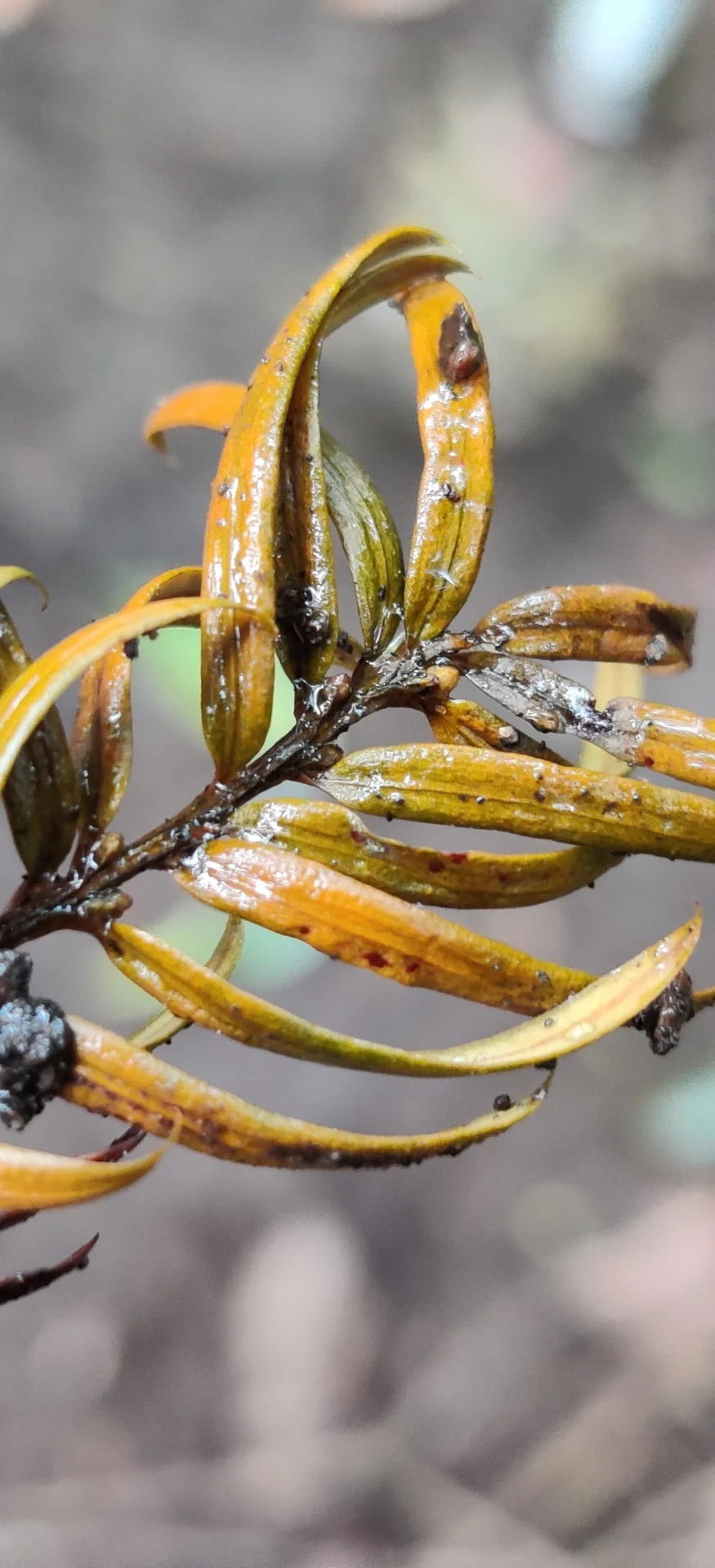
Taxus wallichiana (Himalayan Yew): Morphology, Uses, and Facts
Taxus wallichiana, widely known as the Himalayan yew, is a slow-growing evergreen coniferous tree or broad shrub native to the high mountain forests of the Himalayas, southwestern China, and parts of Southeast Asia. It stands out for its flaking reddish-purple bark, gracefully curved needles, and bright scarlet seed cups, while its specific epithet honors Nathaniel Wallich, the Danish surgeon and botanist who pioneered the study of Indian and Nepali flora.
This species belongs to the yew family (Taxaceae). It was formally described in 1843 by the German botanist Joseph Gerhard Zuccarini in the memoirs of the Royal Bavarian Academy of Sciences.
In sheltered mountain valleys, Taxus wallichiana grows as an understory tree reaching 10 to 30 meters in height with a trunk diameter of up to 1.3 meters. On exposed rocky ridges and high-altitude slopes, it adapts by forming a dense, broadly spreading shrub.
Bark and shoots
The trunk is wrapped in thin, scaly bark that shifts in color from grayish-brown to warm reddish-purple and peels away in vertical strips. Young shoots emerge bright green and flexible before maturing to a warm brown after three or four years.
Foliage and stomatal bands
The leaves are flat, thin needles measuring 1.5 to 3.5 centimeters long and 2 to 4 millimeters wide, with a noticeably falcate (sickle-shaped) curve and a softly pointed tip.
Although the needles grow spirally around the stem, their bases twist so they lie in two neat, flat horizontal rows on either side of the twig to capture dappled forest light.
The upper surface is glossy dark green with a slightly raised central vein, while the underside features two pale yellowish stomatal bands—specialized microscopic pore zones that regulate gas exchange and water vapor.
Cones and the scarlet aril
The Himalayan yew is dioecious, meaning male and female reproductive structures grow on separate individual trees.
Male pollen cones are tiny, pale yellowish-green spheres about 4 millimeters across that release wind-borne pollen from the undersides of the twigs.
Instead of a woody cone, female trees produce a single hard, olive-like seed Measuring 5 to 8 millimeters long, nestled inside a fleshy, cup-shaped aril—a modified cone scale that ripens into a juicy, bright red berry-like cloak in autumn.
Flowering season
Wind pollination takes place from autumn through early spring depending on elevation and local climate, while the red seed arils mature from August to December.
Jan
Feb
Mar
Apr
May
Jun
Jul
Aug
Sep
Oct
Name
Dec
Applications
For centuries, mountain communities across the Himalayas have valued Taxus wallichiana as a versatile resource in medicine, craftsmanship, and daily life. Because the plant contains potent bioactive compounds, its harvest is now strictly regulated to protect wild populations.
Modern oncology and traditional medicine
The bark and needles contain complex taxanes—specialized diterpenoid alkaloids that serve as chemical precursors for paclitaxel (taxol), a chemotherapy medication used to treat breast, ovarian, and lung cancers by halting cell division.
In traditional Ayurveda and Tibetan medicine (where the plant overlaps with remedies known as talispatra), extracts from the bark and foliage have long been prepared to ease respiratory ailments, fever, and inflammation.
Woodworking, dye, and local traditions
The timber is dense, fine-grained, elastic, and naturally resistant to rot and termites, making it prized for door frames, furniture, agricultural tools, carrying poles, and turned woodenware.
In the Garhwal Himalaya, the Bhotiya community harvests the inner stem bark—locally called thuner—to brew a traditional herbal tea, while in Nepal the reddish inner bark yields a natural dye used in ceremonial rituals and the aromatic wood is burned as incense.
Outside its native range, the tree is maintained as a rare specimen in botanical gardens and scientific arboreta dedicated to conifer conservation.
Interesting facts
Surviving at elevations between 900 and 3,700 meters in the Himalayas requires a finely tuned balance between defense and cooperation. Every part of Taxus wallichiana reflects a precise biological coordination with its mountain environment.
A selective partnership with forest birds
Almost the entire tree—from its papery reddish bark to its sickle-shaped needles and the hard seed coat—is loaded with toxic taxine alkaloids that deter browsing mammals and wood-boring insects. The sole exception is the sweet, gelatinous red aril surrounding the seed, which is completely harmless and rich in sugars.
This stark chemical contrast operates as a targeted courier system: thrushes and other mountain birds are drawn to the bright scarlet cups, swallow them whole, and digest the soft pulp while the tough, poisonous seed passes unharmed through their digestive tract to be deposited on distant forest slopes.
Genetic architecture of taxane synthesis
Sequencing of the Taxus wallichiana genome revealed how its specialized cytochrome P450 genes—cellular enzymes that act like molecular assembly lines—are organized in tandem clusters on its chromosomes.
These clustered genes work in step-by-step coordination to construct the intricate carbon ring of paclitaxel, a molecule so structurally complex that laboratory synthesis requires dozens of chemical steps, whereas the tree assembles it smoothly inside its own cells at high altitude.