
Cacao Tree
Theobroma cacao
Theobroma cacao, commonly known as the cacao or cocoa tree, is a tropical evergreen species …
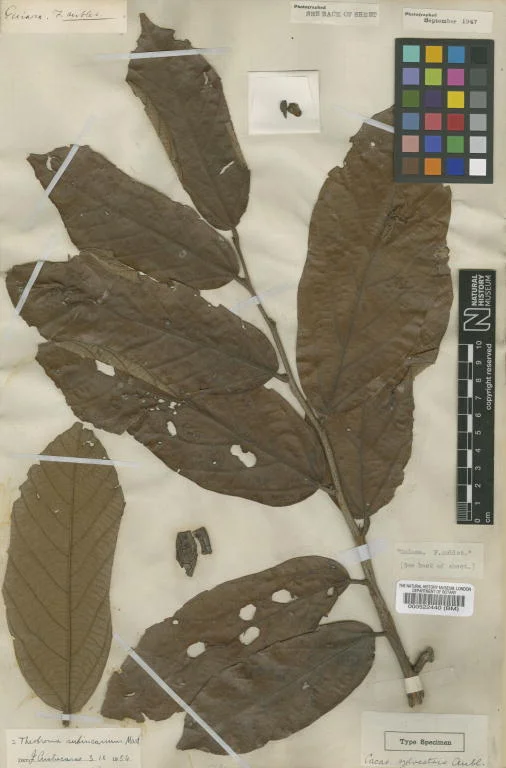
Thriving in the humid, shaded understory of the Amazon rainforest, the wild tree known as Theobroma spruceanum plays a key role in its native ecosystem. This species is named in honor of the English botanist Richard Spruce, who collected extensively in South America. It is classified within the family Malvaceae, sharing many morphological traits with commercial cacao.
The species grows naturally in lowland tropical forests, often near riverbanks or in seasonally flooded areas. It remains largely uncultivated, existing primarily in wild populations. Botanical researchers value this tree for its genetic proximity to domesticated chocolate-producing species.
This species typically grows as a small, slender understory tree with characteristic horizontal branching. The leaves are large, simple, alternate, and coriaceous, with a prominent midrib and secondary veins. They are designed to efficiently capture light in heavily shaded environments.
The inflorescences are born on the older branches or directly on the trunk. The flowers are small, with red or purplish petals and a complex structure adapted for insect pollination. The resulting fruit is a hard, woody pod containing several seeds enveloped in a sweet, edible pulp.
The primary value of this species lies in its ecological contribution to its native habitat. It provides a food source for various tropical mammals and insects that feed on its fruits and seeds. Local populations occasionally harvest the wild fruit for its sweet pulp, though it is not commercially traded.
From a scientific perspective, the plant is a valuable genetic resource. Its resistance to common tropical crop pests and diseases makes it a subject of interest for plant breeders. It is also used in conservation projects aimed at preserving the biodiversity of the Amazon basin.
The specific epithet commemorates Richard Spruce, whose botanical expeditions laid the foundation for studying Amazonian flora. Unlike the common cacao, the fruit of this species features a highly textured, ribbed outer shell. Its seeds contain chemical compounds similar to those found in commercial cocoa, though in different concentrations.
Theobroma cacao
Theobroma cacao, commonly known as the cacao or cocoa tree, is a tropical evergreen species …

Theobroma grandiflorum
A tropical rainforest tree related to cacao, native to the Amazon basin. It is widely …

Theobroma bicolor
Theobroma bicolor, commonly known as the mocambo or jaguar tree, is a wild and cultivated …

Theobroma mammosum
A tall tropical forest tree from Central America known for its unique cylindrical-oblong fruits with …