Chinese Mahogany (Toona sinensis)

Chinese cedar Chinese toon Red toon Beef and onion plant
IUCN: Least Concern
#55694D
#F4F8FD
#636A52
#98A280
#8EA086

Toona sinensis: Botany, uses, and cultivation of Chinese mahogany

Toona sinensis is a fast-growing deciduous tree with an open crown and sweeping, feather-like leaves that emerge in shades of burgundy and bronze before turning emerald green. Native to eastern, southern, and southeastern Asia, it is celebrated for its tender spring shoots with a savory onion-like aroma, while its specific epithet sinensis translates from Latin as "from China", pointing to the heart of its natural range.

This species is the most cold-hardy member of the mahogany family (Meliaceae). It was first scientifically described in 1830 by the French botanist Adrien-Henri de Jussieu as Cedrela sinensis, and in 1846 the German botanist Max Joseph Roemer transferred it to the genus Toona.

Taxonomy

  • ∟ царство Plantae
  • ∟ division Tracheophytes (Vascular Plants)
  • ∟ subdivision Spermatophytes (Seed plants)
  • ∟ Angiosperms
  • ∟ mesangiosperms (Core angiosperms)
  • ∟ eudicots
  • ∟ core eudicots
  • ∟ Superrosids
  • ∟ rosids
  • ∟ malvids
  • ∟ order Sapindales
  • ∟ family Meliaceae
  • ∟ genus Toona
  • ∟ species Toona sinensis (Chinese Mahogany)

Living Pulse

Morphology

Habit, bark, and wood

In its native Asian forests, Toona sinensis can reach up to 40 meters in height with a trunk diameter of 1.5 meters, though in temperate gardens and parks it usually grows to 20–25 meters. Mature trees develop supporting buttress roots at the base and a straight, columnar trunk.

The outer bark is gray to dark brown, smooth on young saplings but gradually splitting into vertical, shaggy strips that peel away on older trunks. Beneath it lies fibrous pink-to-red inner bark and reddish heartwood that releases a sharp scent of garlic and pepper when freshly cut.

Leaves

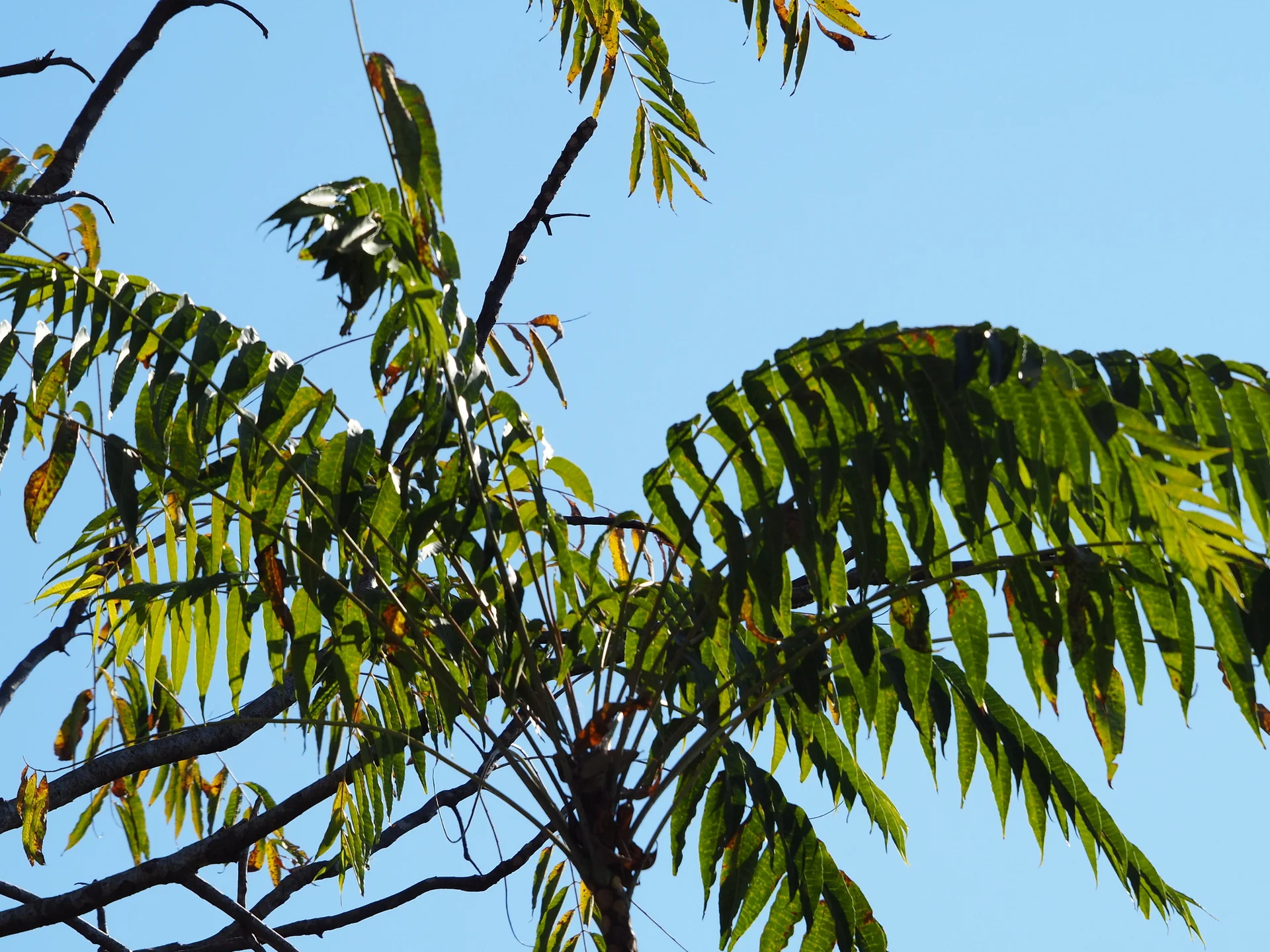
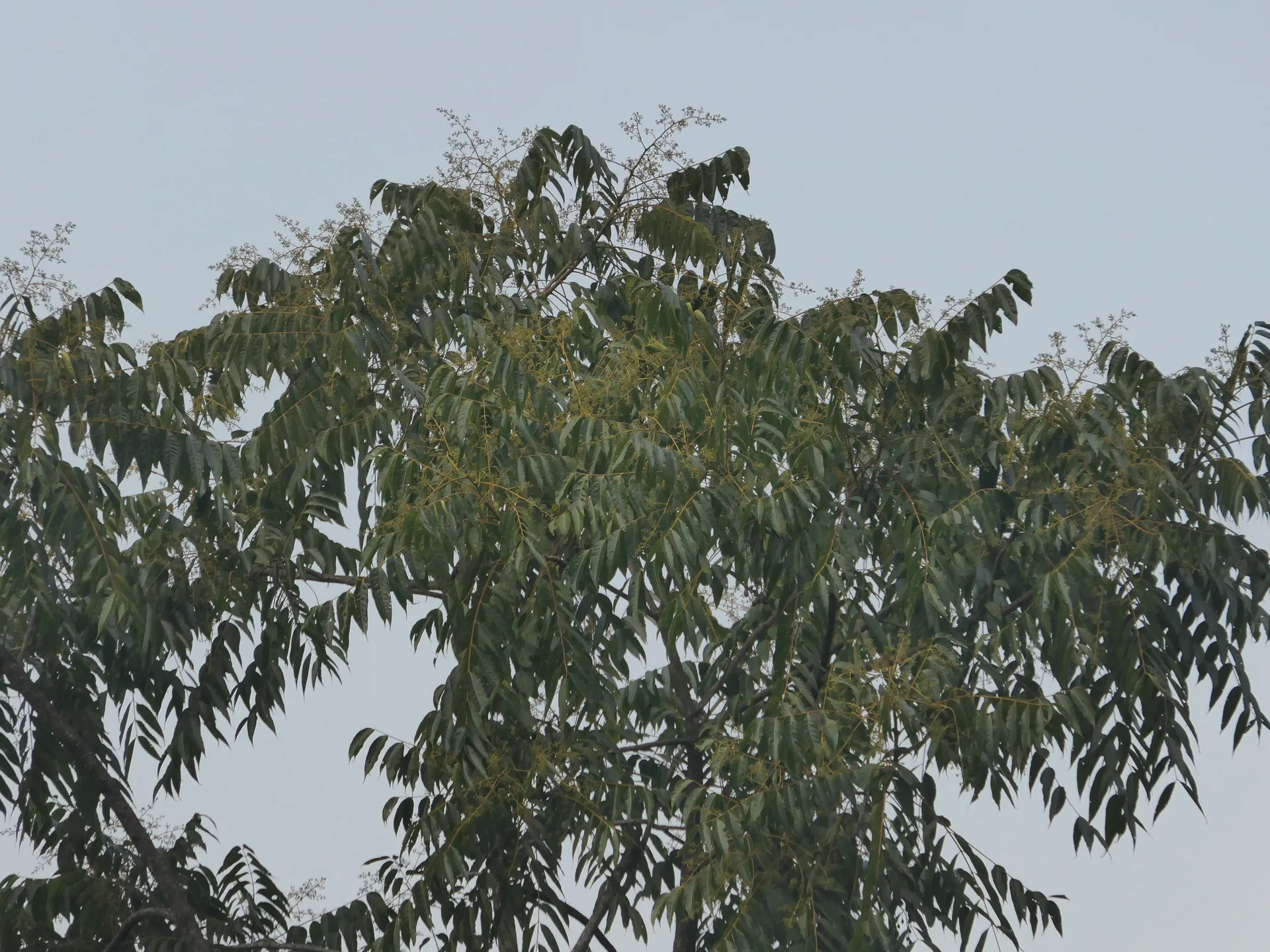
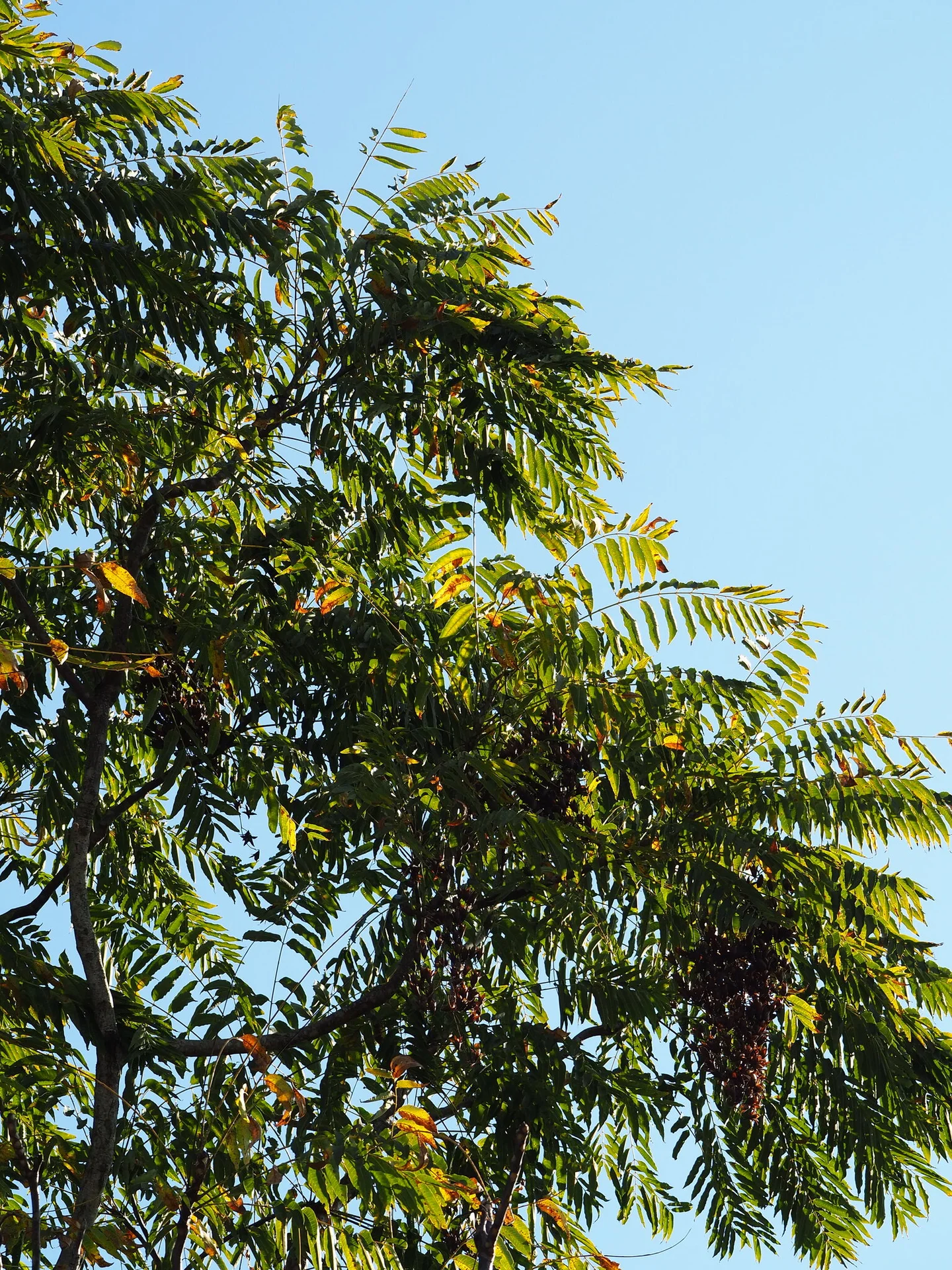
The large, spirally arranged leaves measure 32 to 120 centimeters in length and are typically paripinnate — meaning the paired leaflets line up along a central axis (rachis) without a single terminal leaflet at the tip, though an odd terminal leaflet occasionally appears. The leaf axis is often tinted reddish and bears 8 to 20 pairs of narrow, lance-shaped leaflets.

  • Each individual leaflet is 9 to 22 centimeters long and 2.5 to 5.6 centimeters wide, with an asymmetrical base and a finely serrated or smooth margin.
  • Along the midrib and the junctions where leaflet stalks meet the rachis sit microscopic club-shaped glandular hairs, while crushed foliage emits a distinct roasted-onion fragrance.

Inflorescences and flowers

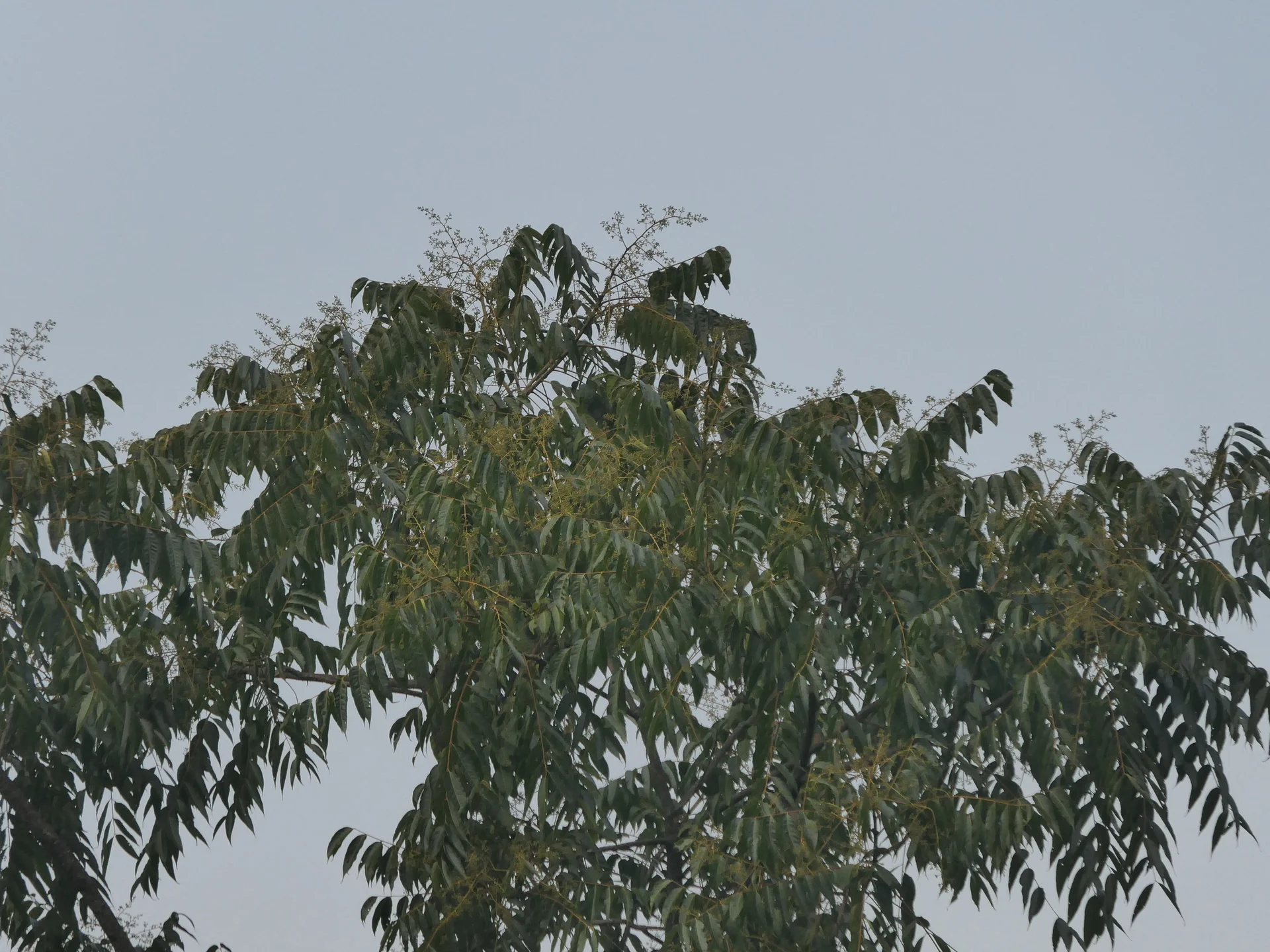
From late spring to autumn, the tree produces pendulous, branched flower clusters (panicles) measuring 30 to 100 centimeters long at the tips of the branches. The species is monoecious, bearing separate male and female flowers on the same tree.

Individual flowers are small, 3.5 to 5 millimeters across, with five white or pale pink petals and a sweet scent. Inside sits a bright orange, cushion-like nectary disk and an androgynophore — a miniature central column that lifts the reproductive organs above the base of the flower.

Fruits and seeds

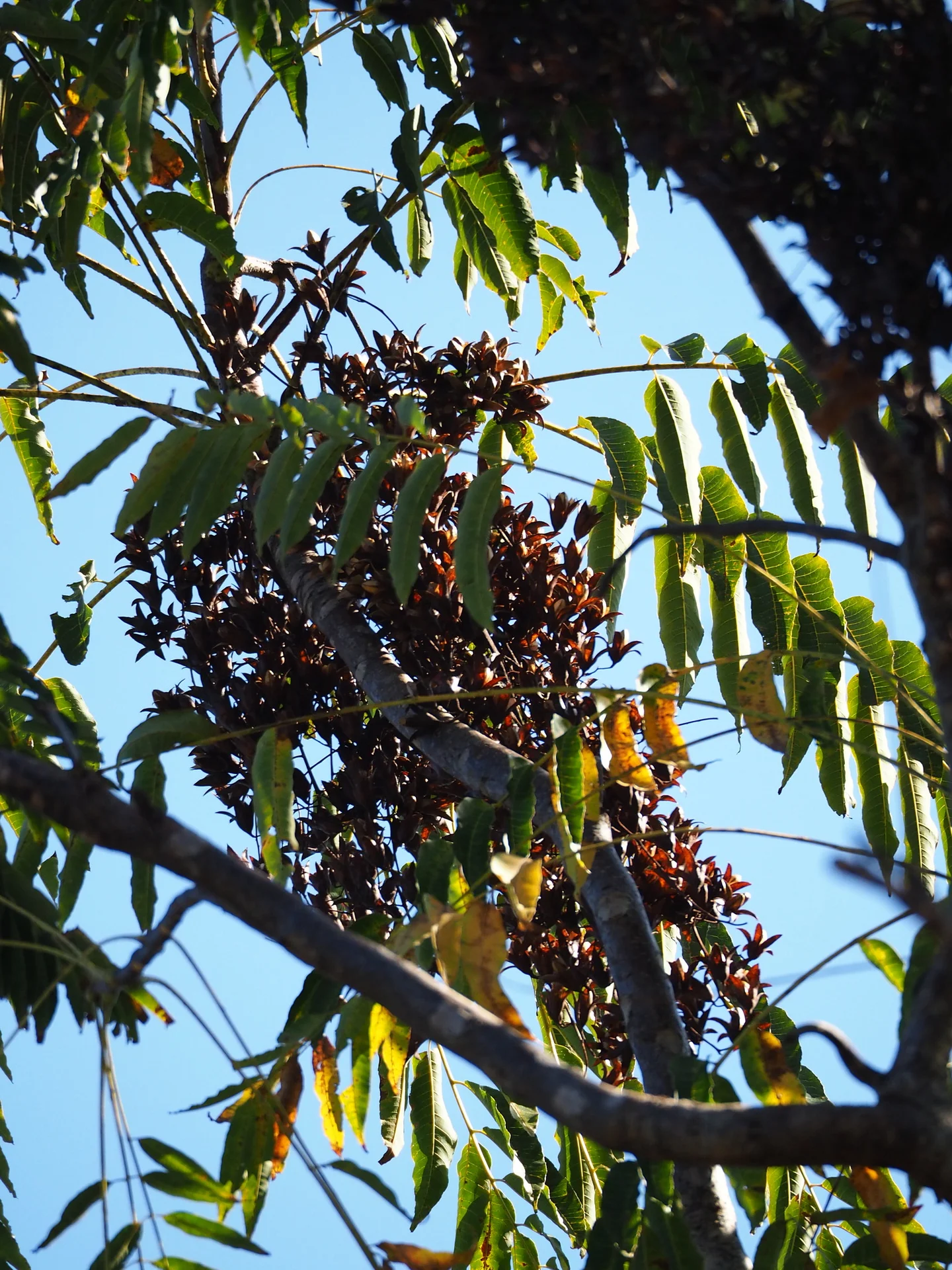
By autumn and winter, fertilized flowers ripen into woody, golden-brown capsules 1.5 to 3.5 centimeters long that split open into five valves around a central column (columella). Each capsule releases several papery seeds, 8 to 16 millimeters long, equipped with a single membranous wing at one end to catch the wind.
Flowering season

Blooms from late spring through mid-autumn depending on latitude and elevation, most commonly peaking in summer.

Jan
Feb
Mar
Apr
May
Jun
Jul
Aug
Sep
Oct
Name
Dec

Care parameters

Light

Thrives in full sun to light partial shade; at least 6 hours of direct daily sunlight promotes strong trunk development and vivid spring foliage color.

Watering

Requires regular watering during establishment to keep the soil evenly moist; mature trees tolerate moderate drought but grow best with deep watering during dry summer spells.

Temperature

Exceptionally cold-hardy for a mahogany family member, tolerating winter temperatures down to -25 °C (USDA zones 5–9); young shoots may benefit from shelter against late spring frosts.

Humidity

Adapts well to average outdoor atmospheric humidity and urban environments without requiring supplemental misting.

Toxicity

Young shoots are edible and widely used in cooking, though raw leaves contain naturally high levels of nitrites and should always be blanched in boiling water before consumption.

Applications

Culinary tradition

Across China and Southeast Asia, the tender spring buds and young leaves — known as xiāngchūn — are harvested as a prized seasonal tree vegetable. Trees that flush with deep red young leaves are favored by cooks over green-leaved forms for their richer, more complex savory flavor.

  • Because fresh shoots accumulate nitrites (around 157–160 mg/kg), cooks briefly blanch them in boiling water, which reduces nitrite levels to a safe 7 mg/kg while preserving vitamins A, C, and E, iron, and calcium.
  • Blanched leaves are finely chopped into scrambled eggs, tossed with cold tofu, or ground with salt and oil into aromatic Toona paste to season rice porridge, fried rice, and mushroom soups.

Timber and woodworking

The tree yields a hard, durable, reddish timber with a fine grain and a pleasant cedar-like scent. As a member of the mahogany family, it serves as a sustainable commercial substitute for tropical American mahogany (Swietenia) in fine furniture, interior paneling, woodcarving, and the resonant bodies of electric guitars.

Ornamental landscaping and medicine

Because it is the only species in the family Meliaceae capable of surviving freezing temperate winters, it is planted as an architectural shade and street tree in European and North American parks. In traditional Chinese medicine, leaf and bark extracts rich in quercetin (a plant antioxidant) and polysaccharides are used to aid digestion, soothe coughs, and support liver health.

Interesting facts

Sulfur chemistry and the spring flush

While most trees in the mahogany family are locked into frost-free tropical rainforests, Toona sinensis migrated northward into temperate East Asia by mastering a seasonal deciduous rhythm. When spring warmth returns, the tree rapidly pushes out tender shoots packed with volatile organosulfur compounds — sulfur-bearing aromatic molecules similar to those found in garlic and onions.

In nature, these pungent compounds act as a chemical shield that deters leaf-chewing insects precisely when the unfolded tissues are softest and most vulnerable. At the same time, the young leaves are flooded with reddish-purple anthocyanins, natural pigments that act like a botanical sunscreen to protect developing chlorophyll from intense spring UV radiation while warming the cool leaf tissue.

Two-phase flowering choreography

Although a single flower panicle holds both male and female blossoms, the tree avoids self-pollination through a precise timing mechanism known as duodichogamy. Within a single blooming cycle, the flower cluster opens its functional flowers in three alternating waves — typically starting with a male pollen-shedding phase, switching to a receptive female phase, and finishing with a second male phase.

  • Female flowers retain sterile, modified stamens (staminodes), while male flowers keep a vestigial pistil, showing how both forms evolved from a shared ancestral blueprint.
  • This synchronized relay ensures that visiting insects carry pollen between different trees, maintaining genetic vigor across mountain valleys from the Himalayas to eastern China.

A living metaphor in Chinese literature

Because an established Toona sinensis develops a towering, deeply rooted trunk that shelters the garden for generations, classical Chinese literature adopted the tree (chūn) as the emblem of a father. In traditional letters, wishing a friend's parents good health is expressed by the idiom chūn xuān bìng mào — hoping that the Toona tree (the father) and the daylily (Hemerocallis, representing the mother) flourish side by side.

Varieties and cultivars

Several distinctive cultivars have been selected for ornamental parks and urban avenues:

  • 'Flamingo' — a compact, often multi-stemmed garden cultivar prized for its brilliant shrimp-pink and coral spring foliage, which matures to creamy white and bright green in summer before turning warm orange in autumn.
  • 'Ailanthoides' — a historic cultivar selected in 19th-century Paris that retains smooth bark into maturity, giving it the clean trunk profile of Ailanthus altissima for formal street alignments.

Geography of distribution

  • China
  • North Korea
  • South Korea
  • Nepal
  • Bhutan
  • India
  • Pakistan
  • Myanmar
  • Thailand
  • Laos
  • Vietnam
  • Malaysia
  • Indonesia

Technical Information

Taxon Synonyms: Toona serrata, Cedrela sinensis, Toona sinensis var. longifolia, Cedrela sinensis var. hupehana, Toona sinensis var. schensiana, Toona sinensis var. hupehana, Cedrela glabra, Ailanthus mairei, Surenus glabra, Surenus sinensis, Cedrela longifolia, Cedrela serrata, Surenus serrata

External Databases: GBIF, POWO, Tropicos

See also

True Araucarias

True Araucarias

Araucaria sect. Araucaria

Araucaria sect. Araucaria is a botanical section of evergreen conifers native to South America. It …