Chinese lacquertree
Japanese lacquertree
Japanese sumac
Japanese varnishtree
Chinese lacquer
Urushi tree
#24290B
#C8DD81
#DFEFAC
#617032
#A5B96C
Plant palette
Toxicodendron vernicifluum: Chinese Lacquer Tree Profile and Uses
Toxicodendron vernicifluum is a medium-sized deciduous tree native to the mountain forests of China and the Indian subcontinent, long cultivated across Korea and Japan for its milky, resinous sap. Its specific epithet vernicifluum literally translates from Latin as "flowing with varnish," directly referencing the raw liquid lacquer harvested from its bark.
Belonging to the cashew and sumac family (Anacardiaceae), the species was originally described by Jonathan Stokes as Rhus verniciflua before Fred Alexander Barkley transferred it to the genus Toxicodendron in 1940, a Greek name meaning "poison tree."
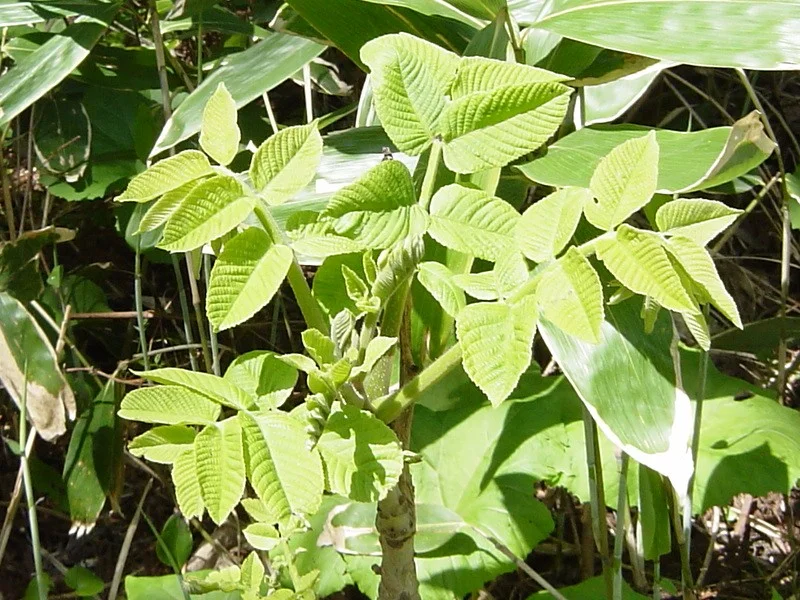
In forest habitats and traditional plantations, the tree reaches up to 20 meters in height with a straight trunk and a broad, spreading crown. Young branches are softly pubescent, while mature trunks develop rough, brownish-gray bark fissured longitudinally, housing the resin canals inside the phloem.
Foliage
The leaves are arranged alternately and are odd-pinnate, measuring 25 to 60 centimeters in total length along a finely hairy rachis—the main central axis of the compound leaf. Each leaf bears 7 to 19 (most commonly 11 to 13) ovate to oblong leaflets with entire margins and softly pubescent undersides that turn rich shades of orange and crimson in autumn.
Flowers and fruits
Inflorescences: Small, yellowish-green flowers emerge in loose, drooping axillary panicles from May to June, with functionally unisexual blooms carried on separate male and female trees.
Drupes: Pollinated female flowers mature in autumn into smooth, flattened-globose stone fruits (drupes) measuring 5 to 8 millimeters across, featuring a pale yellow, waxy outer layer over a hard endocarp.
Flowering season
Late spring to early summer (May to June)
Jan
Feb
Mar
Apr
May
Jun
Jul
Aug
Sep
Oct
Name
Dec
Applications
For more than 9,000 years—dating back to Japan's Jōmon period and early Chinese dynasties—humans have tapped the bark of Toxicodendron vernicifluum to harvest raw lacquer, known as urushi in Japan. Artisans score 10-year-old trunks with horizontal incisions between June and November, collecting roughly 250 milliliters of grayish-yellow sap per tree annually, which is then filtered, gently heated to evaporate excess water, and colored with mineral pigments like iron oxide or cinnabar.
Fine lacquerware and crafts: Applied in dozens of paper-thin layers to wooden bowls, tableware, shakuhachi flutes, taiko drums, fountain pens, and yumi archery bows, cured urushi creates an exceptionally hard, glossy surface impervious to water, acids, and heat.
Structural adhesive and kintsugi: Mixed with wheat flour or clay powder, raw sap serves as a high-strength natural glue for joining ceramics in the art of kintsugi (golden joinery) and reinforcing linen-backed lacquer styles such as Wajima-nuri.
Traditional medicine and wax extraction: Dried resin and foliage have been processed in traditional Chinese medicine to address internal parasites and control bleeding, while the waxy mesocarp of the fruits is pressed to make traditional candles and polishes.
Interesting facts
A resin that cures by absorbing moisture
Unlike conventional household varnishes that harden by evaporating chemical solvents into dry air, the sap of Toxicodendron vernicifluum cures through an enzymatic oxidation process that requires high humidity. When the tree's bark is wounded, it exudes a milky emulsion rich in urushiol—an oily mixture of catechol derivatives with unsaturated hydrocarbon side chains—alongside a copper-containing enzyme called laccase.
In a warm, moisture-rich environment (ideally 70 to 85 percent relative humidity at 20 to 25 degrees Celsius), laccase uses atmospheric oxygen dissolved in microscopic water droplets within the sap to cross-link the urushiol molecules into a dense, three-dimensional polymer mesh. In nature, this biochemical coordination seals bark injuries in damp monsoon forests where evaporation-based resins would fail to dry, sealing out wood-rotting fungi and boring insects while simultaneously deterring mammalian browsers through urushiol's potent contact allergenicity.
Enzyme-driven cross-linking: Laccase catalyzes the oxidation of catechol rings into reactive radicals that spontaneously bind with neighboring unsaturated side chains, transforming liquid sap into a cross-linked plastic-like coating.
Ultraviolet sensitivity: While cured urushi resists boiling water, alkalis, and organic solvents, prolonged exposure to direct ultraviolet sunlight gradually degrades the polymer bonds, which is why fine lacquerware is traditionally stored away from direct sun.