
Tall Tree of Heaven
Ailanthus excelsa
A fast-growing, large deciduous tree native to India and Sri Lanka, highly valued for its …
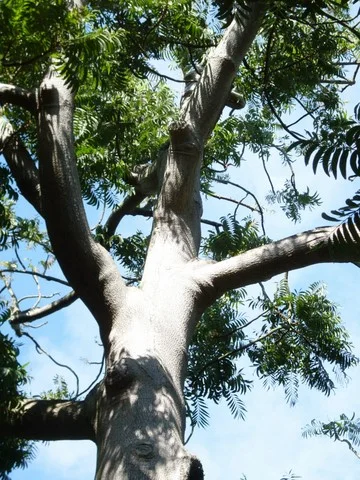
Thriving across the tropical rainforests of Asia and Australia, this tall evergreen tree plays a vital role in both local ecosystems and traditional industries. It is widely recognized for its high-quality timber and aromatic secretions, which have been harvested for generations.
Commonly known as the ferntop ash or halmaddi, it occupies a significant place in South Asian cultural practices. However, over-exploitation of its natural populations has led to strict forestry regulations to protect the species from decline.
Growing to heights of 30 to 35 meters, this tree features a straight, cylindrical trunk that can reach up to 1.2 meters in diameter. Its grey bark is characteristically rough, resembling sandpaper to the touch. The inner bark or blaze displays a distinctive yellow color speckled with red dots.
The foliage and reproductive structures exhibit several key botanical features:
Close inspection of the leaflet blades reveals numerous closely spaced oil dots visible under magnification. The prominent venation forms distinct loops well within the blade margin, with the midrib raised in a small depression on the upper leaf surface.
Flowering occurs from November to January in Australia, and from December to May in India.
The lightweight, soft wood of this species is highly valued for commercial manufacturing, particularly for producing plywood, matchwood, and high-quality charcoal. It is easily workable, making it a preferred material for light construction in its native regions.
Beyond its timber, the tree is highly valued for its chemical and medicinal properties:
Harvesting of the aromatic resin historically caused high mortality rates among wild trees due to destructive extraction methods. This ecological damage prompted the Indian Forest Department to ban resin harvesting in the 1990s, causing the global price of traditional incense ingredients to skyrocket.
The resin has a unique physical property where it remains in a flexible, semi-solid state by naturally absorbing moisture directly from the surrounding air.
Ailanthus excelsa
A fast-growing, large deciduous tree native to India and Sri Lanka, highly valued for its …

Ailanthus kurzii
A tall tropical evergreen tree native to South and Southeast Asia, known for its winged …

Ailanthus vilmoriniana
A large deciduous tree native to western China, characterized by its deep red, finely pubescent …

Ailanthus giraldii
A deciduous tree native to the mountain forests of China, characterized by its hairy leaves …