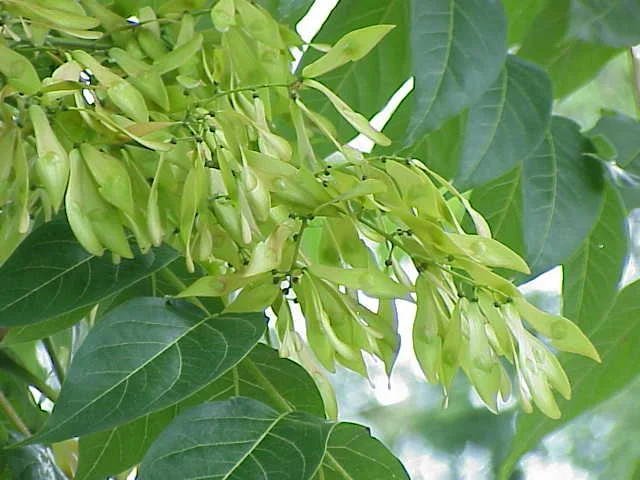
Rising rapidly toward the sky, these resilient trees earned their name from an Amboinese word meaning "tree of the gods" or "sky-stretcher." Members of the genus Ailanthus are famed for their ability to thrive in the harshest urban environments where other vegetation struggles to survive.
While native to East Asia and northern Australasia, some species have successfully colonized temperate regions worldwide due to their robust root systems and prolific seed production. Today, Ailanthus remains a subject of ecological debate, representing both a valuable pioneer tree and a challenging invasive threat.
Members of the genus Ailanthus are fast-growing deciduous trees characterized by their grand stature, often reaching heights of 25 to 45 meters. Their trunks are covered in grayish-brown bark marked by shallow furrows, supporting a broad, ovoid crown of brittle branches.
The foliage is highly distinctive and serves as a primary identifier for the genus. The large, alternate leaves are odd-pinnate and can reach up to one meter in length, carrying a strong, unpleasant odor when bruised.
Leaflets: They are arranged almost oppositely along the rachis in numbers of 9 to 41, often bearing prominent glandular teeth near the base.
Flowers: Small, greenish-yellow, and radially symmetrical, they form large panicles that are mostly dioecious, with male flowers emitting a potent odor.
Fruits: The offspring are winged samaras, which turn reddish-brown and contain a single flat, central seed optimized for wind dispersal.
Flowering season
Late spring to early summer, typically from May to July.
Jan
Feb
Mar
Apr
May
Jun
Jul
Aug
Sep
Oct
Name
Dec
Applications
Despite its reputation as an invasive weed in some areas, species of Ailanthus have several historical and practical applications. They have been planted as ornamental and pioneer trees in urban landscapes due to their rapid growth and exceptional tolerance to air pollution.
Silk Production: The leaves of these trees serve as the primary food source for the larvae of the Ailanthus silkmoth (Samia cynthia), which produces a coarse, highly durable silk.
Traditional Medicine: In traditional practices, extracts from the bark and leaves of certain species have been used to treat dysentery and intestinal parasites.
Pioneer Forestry: Due to their ability to colonize degraded soils and industrial zones, they are sometimes utilized for land reclamation and erosion control.
Interesting facts
The history of Ailanthus is rich with ecological anomalies, fossil records, and cultural adaptations across different continents.
Tree of Heaven: The name is derived from the Amboinese word ailanto, which translates to "tree of the gods" or "sky-stretcher" due to its rapid upward growth.
Fossil Heritage: Although today it is native to Asia and Australia, fossil evidence shows that Ailanthus species like A. confucii flourished across North America and Europe during the Eocene epoch.
Post-War Colonizer: In Central Europe, the tree rapidly colonized rubble and ruins of cities after World War II, earning a reputation as a resilient urban survivor.
Ecological Threat: In many parts of Europe and North America, it is classified as a highly invasive species, capable of outcompeting native flora by releasing allelopathic chemicals that inhibit other plants.