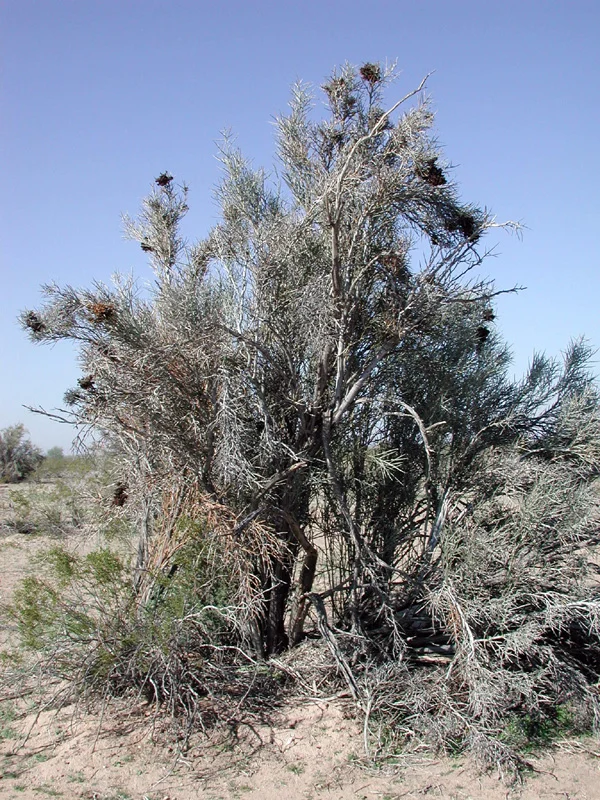
Thriving in some of the most unforgiving, edaphically dry landscapes of the New World, these resilient plants have evolved a formidable armor of dense thorns to protect their vital moisture. Castela represents an impressive evolutionary radiation of desert-adapted shrubs and small trees that command respect in their harsh native habitats. Known by evocative names like crucifixion thorn and bitterbush, they stand as testament to botanical endurance under extreme sun and aridity.
Belonging to the family Simaroubaceae, the genus was named to honor the French naturalist René Richard Louis Castel. The plants are uniquely dioecious, meaning individual specimens bear either exclusively male or exclusively female flowers, requiring cross-pollination across the arid expanses they call home.
Members of the genus Castela are characterized by their intensely branched, rigid, and intricately thorny architecture, a classic adaptation to herbivory and water loss in arid environments. The plants typically grow as stout shrubs or small trees with a rugged, scrubby appearance.
Because they are dioecious, the reproductive structures are separated by sex on different plants. The foliage is often sparse, reduced, or modified to minimize transpiration, while the formidable spines dominate the visual and tactile experience of the plant.
Applications
Due to their extreme thorniness and natural habitat, species of Castela are rarely utilized in standard landscape design, remaining primarily wild components of desert and dry scrub ecosystems. However, their dense, impenetrable growth makes them excellent natural barriers and wildlife refuges in their native ranges.
Interesting facts
The genus Castela contains several fascinating species with unique regional stories and evolutionary traits:
Galapagos endemism:Castela galapageia, commonly known as bitterbush, is a notable species found in the unique ecosystem of the Galapagos Islands.
Desert survivalists: Species like Castela emoryi, the crucifixion thorn, have evolved extreme drought tolerance, flourishing in environments that are inhospitable to most other plant life.
Naming legacy: The genus was formally described in 1806 by French botanist Pierre Jean François Turpin, who chose the name to honor his contemporary, René Richard Louis Castel.
A fascinating desert shrub of North America, characterized by sharp green photosynthetic branches, persistent fruit clusters, and unique medicinal quassinoid …