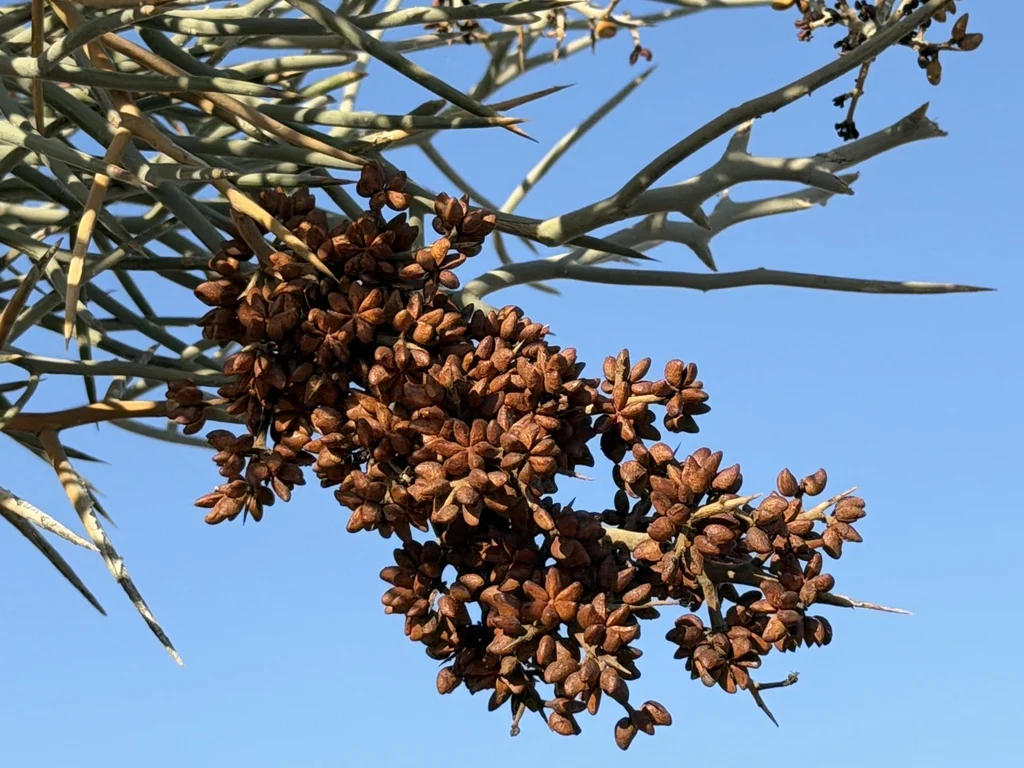
Surviving the intense mid-summer heat of the Mojave and Sonoran Deserts, Castela emoryi stands out with its sharp, green, photosynthetic branches. This species is commonly known as the crucifixion thorn, Emory's crucifixion-thorn, or by its Spanish names chaparro amargosa and corona de Cristo.
It is native to southwestern North America, spanning southern California, Arizona, and several states in Mexico, including Sonora and Baja California. The plant is dioecious and typically grows in the relatively moist gravelly soils, washes, and plains of these extremely hot and dry regions.
This hardy shrub typically remains under 1 meter in height, although exceptional specimens can grow up to 4 meters or more. It is almost entirely leafless, relying on its stiff, sharp, bright green branches to conduct photosynthesis. The leaves are ephemeral and rarely observed on mature plants.
Its small flowers give rise to distinctive clusters of fruits arranged in groups of five. These fruits transition in color from green, tan, or brown to black as they age, and they can persist on the branches for several years.
Flowering season
Mid-summer
Jan
Feb
Mar
Apr
May
Jun
Jul
Aug
Sep
Oct
Name
Dec
Applications
Historically, the Yavapai people utilized the sap from the plant's buds as a traditional dermatological aid. Modern research highlights the presence of quassinoids, such as glaucarubolone glucoside, which exhibit strong antifeedant properties against termites like Reticulitermes flavipes and show potential for controlling grape downy mildew.
Interesting facts
The species serves as an essential ecological oasis during the peak of summer when few other desert plants are active.
Mid-Summer Bloom: It flowers during the hottest months, providing a critical source of nectar for ants, wasps, and bumblebees.
Conservation Status: The plant is endangered within its California range due to threats from solar energy installations and military activities, and it is classified as salvage-restricted in Arizona.
Chemical Arsenal: It contains bioactive compounds including glaucarubol, ellagic acid, betulin, and syringaresinol, contributing to its natural defense mechanisms.
Geography of distribution
United States
Mexico
Sources
POWO: Plants of the World Online (Royal Botanic Gardens, Kew)