Emory's crucifixion thorn
Castela emoryi
A fascinating desert shrub of North America, characterized by sharp green photosynthetic branches, persistent fruit …
Hailing from the dry tropical scrublands of southern Mexico, this rare spiny shrub is characterized by its distinct leaf shape. It is endemic to the state of Oaxaca, where it survives in dry, rocky terrains under intense sunlight.
The plant grows as a rigid, thorny shrub with grayish branches. Its most distinguishing feature is the obovate leaves that possess a retuse apex, meaning the leaf tip has a shallow notch or indentation.
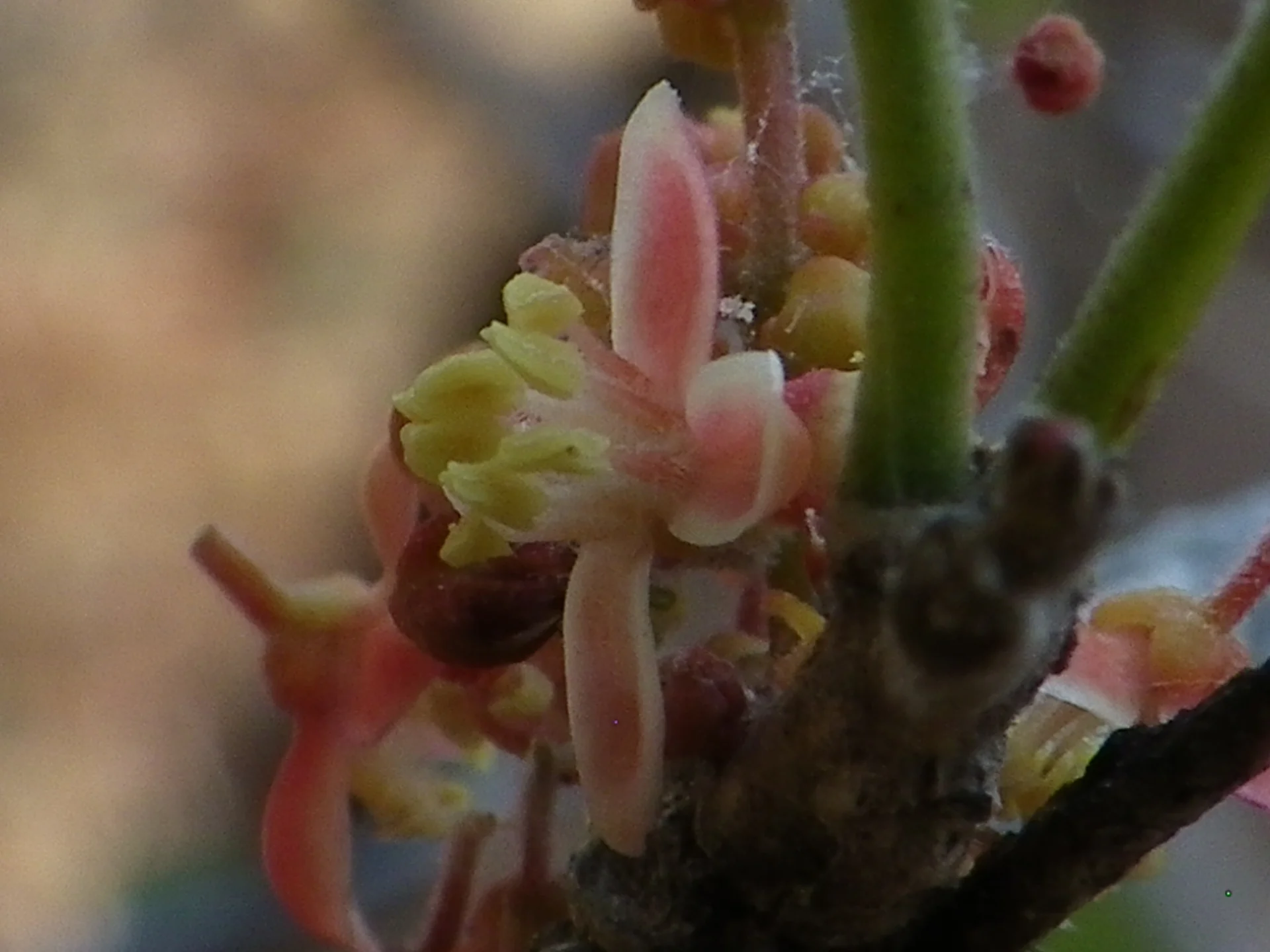
Its small, yellowish-green to reddish flowers are followed by small, single-seeded drupes. These morphological adaptations enable the plant to withstand prolonged dry seasons.
The plant contains bitter secondary metabolites typical of the Simaroubaceae family, which deter herbivores. While not widely cultivated, it has potential interest for chemical research into bioactive quassinoids.
First collected and described by the Danish botanist Frederik Michael Liebmann in 1853, the species name retusa directly references its unique notched leaves. It remains a poorly studied species due to its restricted geographical range.
Castela emoryi
A fascinating desert shrub of North America, characterized by sharp green photosynthetic branches, persistent fruit …
Castela tortuosa
A twisted, thorny desert shrub native to Mexico and Texas, widely used in traditional medicine.
Castela galapageia
A spiny, drought-resistant shrub endemic to the Galápagos Islands, known for its bitter taste and …
Castela erecta
A tough, spiny shrub native to the arid zones of North and Central America, well-known …