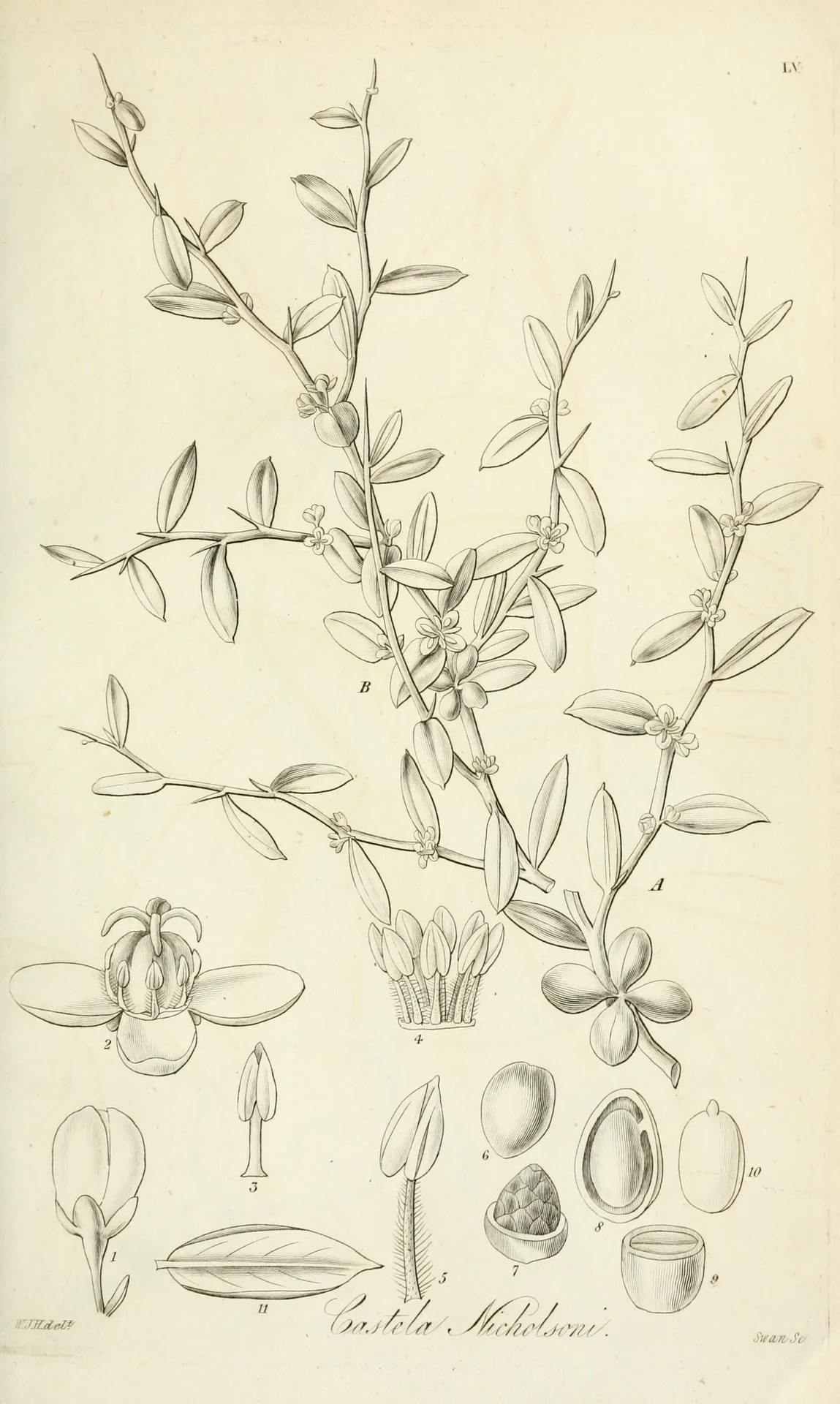
Castela erecta (Goatbush / Amargosa): Guide and Botanical Facts
Enduring the harsh conditions of arid scrublands and coastal dunes, Castela erecta develops as a rigid, intricately branched shrub. This hardy species belongs to the bitterwood family, Simaroubaceae, and is widely distributed across the Caribbean, Texas, Mexico, and parts of northern South America.
First described by the French naturalist Pierre Jean François Turpin in 1806, the plant has garnered several colloquial names due to its properties. In English-speaking regions, it is frequently referred to as goatbush, while in Spanish-speaking areas, it is known as amargosa, reflecting its intensely bitter taste.
This species forms an upright, slow-growing shrub that can reach heights of 1 to 3 meters. Its branches are stiff, greyish-green, and frequently taper into sharp, protective thorns that deter herbivores in its native desert habitats.
The leaves are small, alternate, and linear to oblong, often displaying a leathery texture with slightly rolled margins to conserve water. The small, yellowish to reddish flowers give way to clusters of small drupes that mature to a dark red or blackish color.
Applications
In traditional medicine, the bitter bark and roots of this plant have been utilized to prepare herbal infusions believed to treat digestive ailments and fevers. The high concentration of bitter compounds, typical of the Simaroubaceae family, provides natural resistance against various plant pathogens and insect pests.
Interesting facts
The plant is highly adapted to saline coastal environments and dry inland soils, showcasing the remarkable survival strategies of desert flora.
Subspecies Diversity: Two distinct subspecies are recognized: Castela erecta subsp. erecta and Castela erecta subsp. texana.
Natural Bittering Agents: The name amargosa literally translates to "bitter," owing to the presence of quassinoids that make the plant unpalatable to most grazing animals.