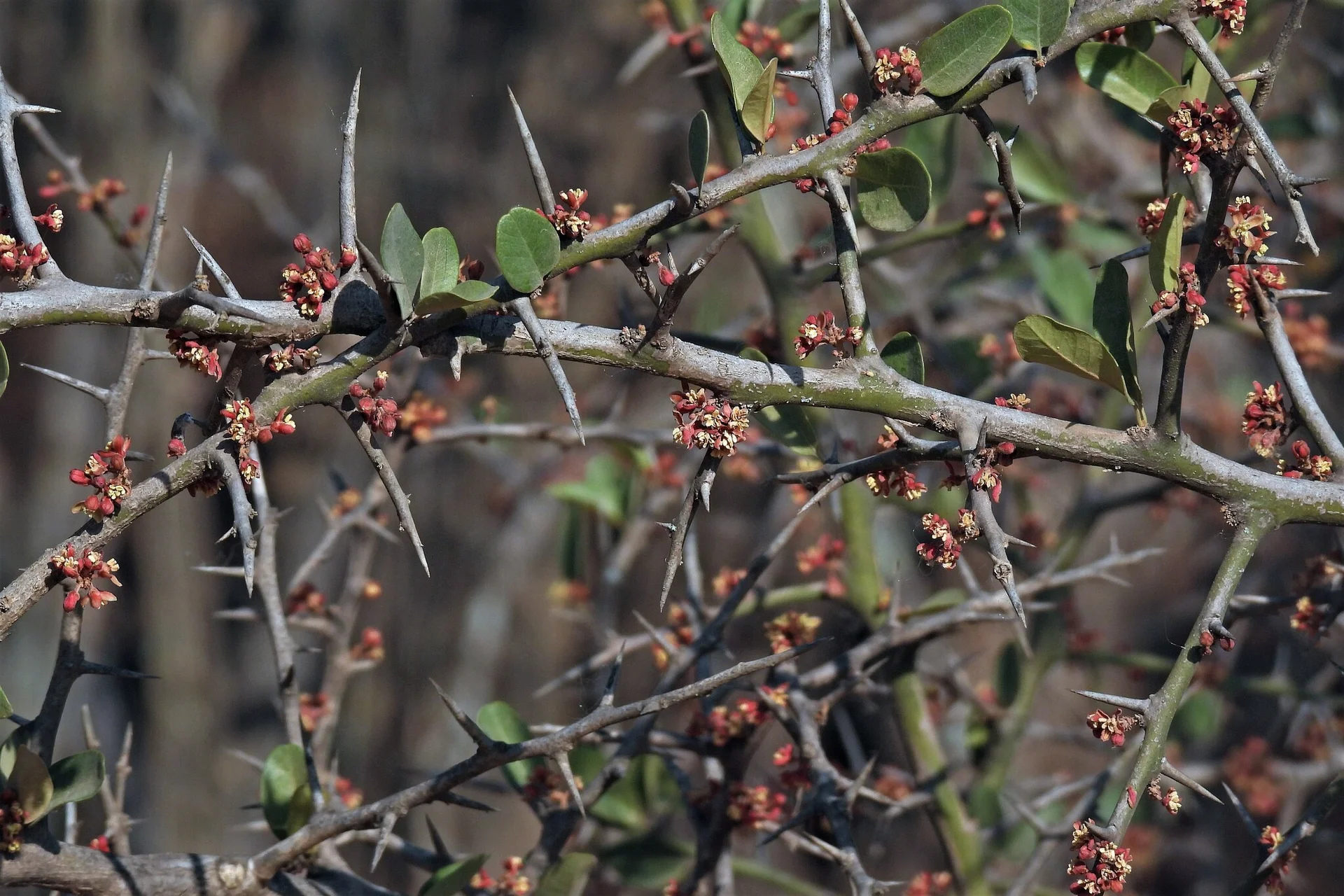
Populating the arid and semi-arid regions of South America, Castela coccinea stands as a resilient evergreen shrub within the Simaroubaceae family. This species thrives in dry forest environments and rocky slopes at altitudes reaching up to 1,000 meters above sea level.
First described by the German botanist August Heinrich Rudolf Grisebach in 1874, the plant honors the French naturalist René Richard Louis Castel. The specific epithet coccinea translates to "scarlet," highlighting the vivid coloration of its botanical structures.
This woody plant typically forms a dense, branching shrub with evergreen foliage adapted to tolerate drought conditions. Its rigid branches are often armed with spines or thorn-like projections, typical of many members of the genus Castela.
The small leaves are tough and leathery, minimizing water loss in hot climates. Its flowers are generally inconspicuous, followed by small drupaceous fruits that showcase the scarlet tones from which the species derives its name.
Interesting facts
The species exhibits extreme tolerance to drought and poor soils, allowing it to colonize challenging habitats in the Gran Chaco and surrounding regions.
Scarlet Epithet: The name coccinea refers to the brilliant scarlet coloration of its key structures, a feature that distinguishes it visually.
Drought Adaptation: Its evergreen nature and specialized leaf structures allow it to maintain foliage throughout the dry season.
Geography of distribution
Argentina
Bolivia
Paraguay
Sources
POWO: Plants of the World Online (Royal Botanic Gardens, Kew)