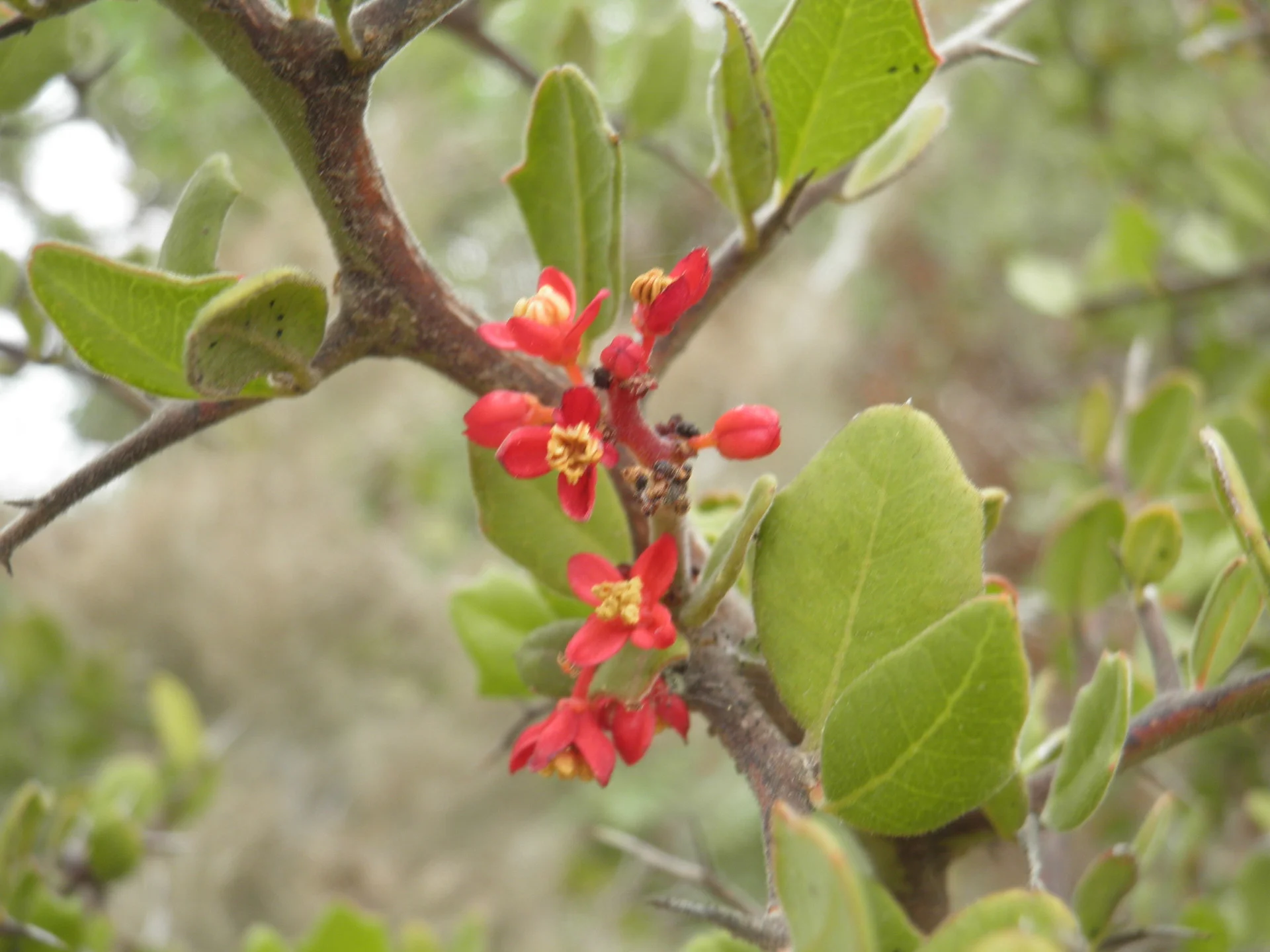
Endemic to the desert scrublands of Baja California Sur, Castela peninsularis forms a low, densely branched, thorny shrub adapted to extreme aridity. It inhabits dry gravelly plains and rocky slopes where water is scarce.
This resilient member of the Simaroubaceae family survives long dry spells through specialized leaf physiology. It serves as a vital component of the local desert ecosystem by stabilizing soil and providing shade.
This shrub typically reaches a height of 0.5 to 1.5 meters, developing a compact, rounded form. The rigid stems are covered in light grey bark and armed with sharp, woody spines.
The leaves are small, narrow, and lanceolate, often exhibiting a greyish-green hue due to a fine layer of protective hairs. These hairs help reflect sunlight and reduce transpiration in desert conditions.
Key reproductive traits of this species include:
Flowers: Small, unisexual, with four reddish or deep orange petals, blooming in the leaf axils.
Fruit: Small, globose drupes that turn a vibrant red at maturity, carrying a single hard seed.
Flowering season
Blooming usually occurs from late spring through late summer, typically between May and September.
Jan
Feb
Mar
Apr
May
Jun
Jul
Aug
Sep
Oct
Name
Dec
Applications
Like its close relatives, the plant contains bitter quassinoids that have attracted pharmacological interest. Local communities have occasionally used the bitter wood and bark extracts to treat stomach disorders.
Research indicates these bitter compounds may possess antimicrobial properties. However, there are no widespread commercial or agricultural applications for this wild species.
Interesting facts
The species was formally described in 1909 by the renowned American botanist Joseph Nelson Rose. Its specific epithet refers to the Baja California Peninsula, which is its sole native habitat.
Its spines not only protect the plant from grazing desert animals but also help shade the stems from intense solar radiation.
Geography of distribution
Mexico (Baja California Sur)
Sources
Plants of the World Online (POWO): Verified taxonomic data and geographic distribution records.
International Plant Names Index (IPNI): Original publication citation details by Joseph Nelson Rose.
World Flora Online (WFO): Taxonomic classification within the Simaroubaceae family.