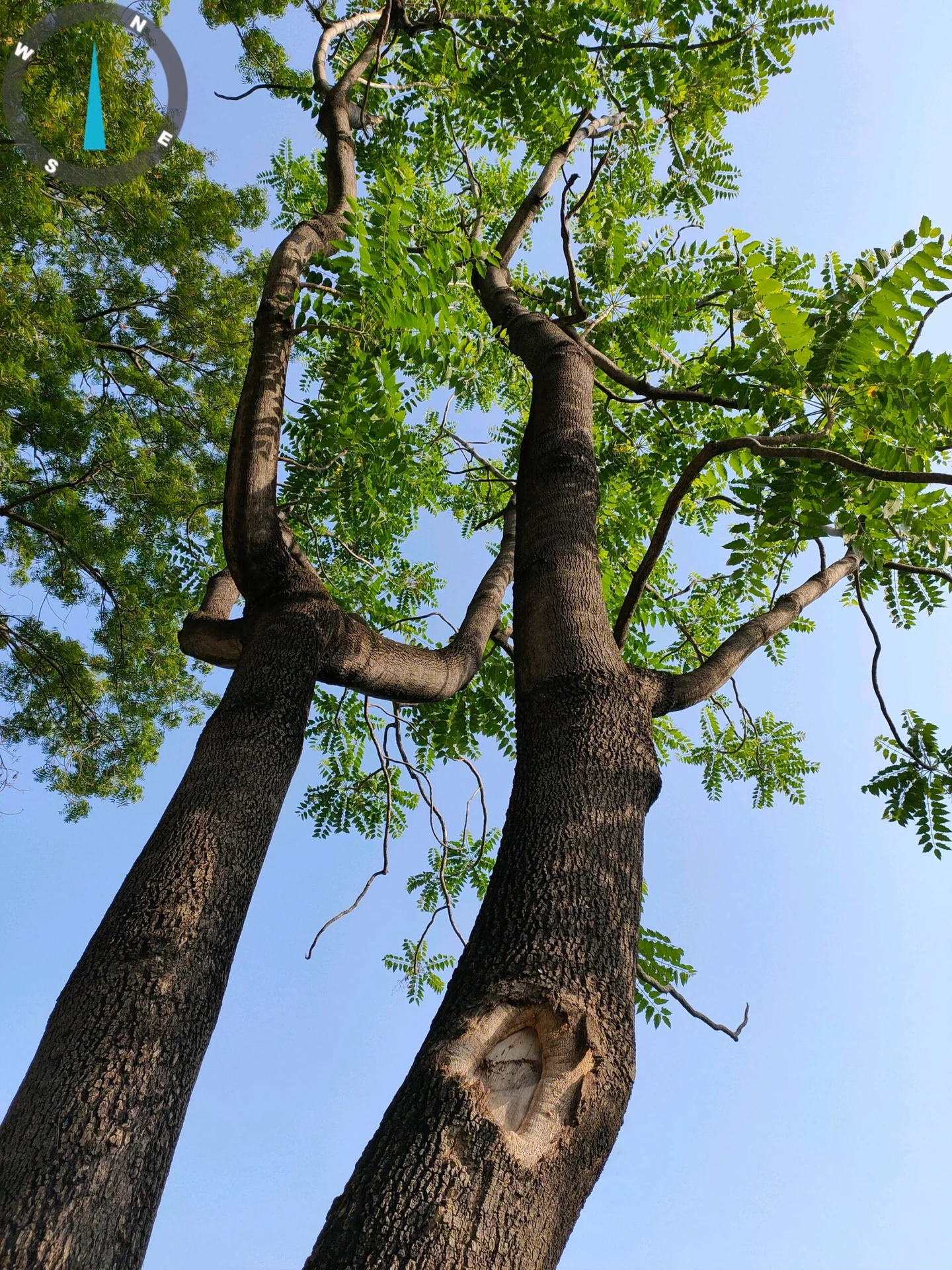
Entire-leaved tree of heaven
(Ailanthus integrifolia)
White Siris
IUCN: Вызывает наименьшие опасения
Ailanthus integrifolia: White Siris Tree Guide
High in the dense canopy of Southeast Asian rainforests, a towering giant breathes life into the ecosystem with its soaring crown and winged seeds. This impressive species is Ailanthus integrifolia, a tree whose presence defines the upper layers of humid tropical forests from India to the Solomon Islands.
Historically known to local communities for its light yet sturdy timber, it is a vital part of the regional biodiversity. The species thrives in low-to-mid elevation zones, adapting seamlessly to the challenges of wet, humid climates.
Its common name, White Siris, reflects the pale coloration of its wood and bark. Today, it remains a symbol of undisturbed primary forests, harboring numerous canopy-dwelling organisms.
The majestic silhouette of Ailanthus integrifolia is characterized by a straight, cylindrical trunk that can exceed 1 to 2 meters in diameter. Standing at heights of up to 45 meters, this tree features a smooth, light greyish-brown bark.
Its large, compound leaves are arranged alternately along the branches, often measuring up to 90 centimeters in length. The leaflets are asymmetrical at the base, having completely smooth or entire margins which distinguish them from related species.
During the blooming period, the tree produces small, yellowish-green flowers clustered in large panicles. The reproductive and dispersal mechanisms include:
Flowers: Small, unisexual or bisexual, and lightly fragrant, attracting various insect pollinators.
Fruits: Large, flattened, and winged samaras, which are twisted to aid wind dispersal over long distances.
Subspecies: Distinct variations like Ailanthus integrifolia subsp. calycina exhibit slight differences in floral structure.
Applications
The economic value of Ailanthus integrifolia lies primarily in its lightweight, easily workable wood. It is commonly utilized in the manufacturing of matchwood, packing boxes, and paper pulp.
Additionally, local communities utilize the species in traditional medicine and daily life:
Traditional Medicine: The bitter bark is sometimes decocted to treat digestive issues, fevers, and minor skin ailments.
Aromatic Resins: A sticky resin extracted from the trunk is occasionally used as an ingredient in local incense formulations.
Ecosystem Services: Due to its rapid growth, it plays a vital role in forest regeneration and soil stabilization in logged areas.
Interesting facts
Interestingly, Ailanthus integrifolia is highly resilient and is classified as Least Concern on the IUCN Red List. It thrives at elevations up to 900 meters above sea level, indicating its high adaptability to varying forest terrains.
Here are several intriguing facts about this species:
Subspecies Diversity: The species is divided into two distinct subspecies, namely Ailanthus integrifolia subsp. calycina and Ailanthus integrifolia subsp. integrifolia.
Broad Geographic Span: Its native range stretches from India and Vietnam across the Indonesian archipelago to Papua New Guinea and the Solomon Islands.
Wind Dispersal Mastery: The twisted shape of its winged samaras allows the seeds to spin like helicopters, ensuring they travel far from the parent tree.