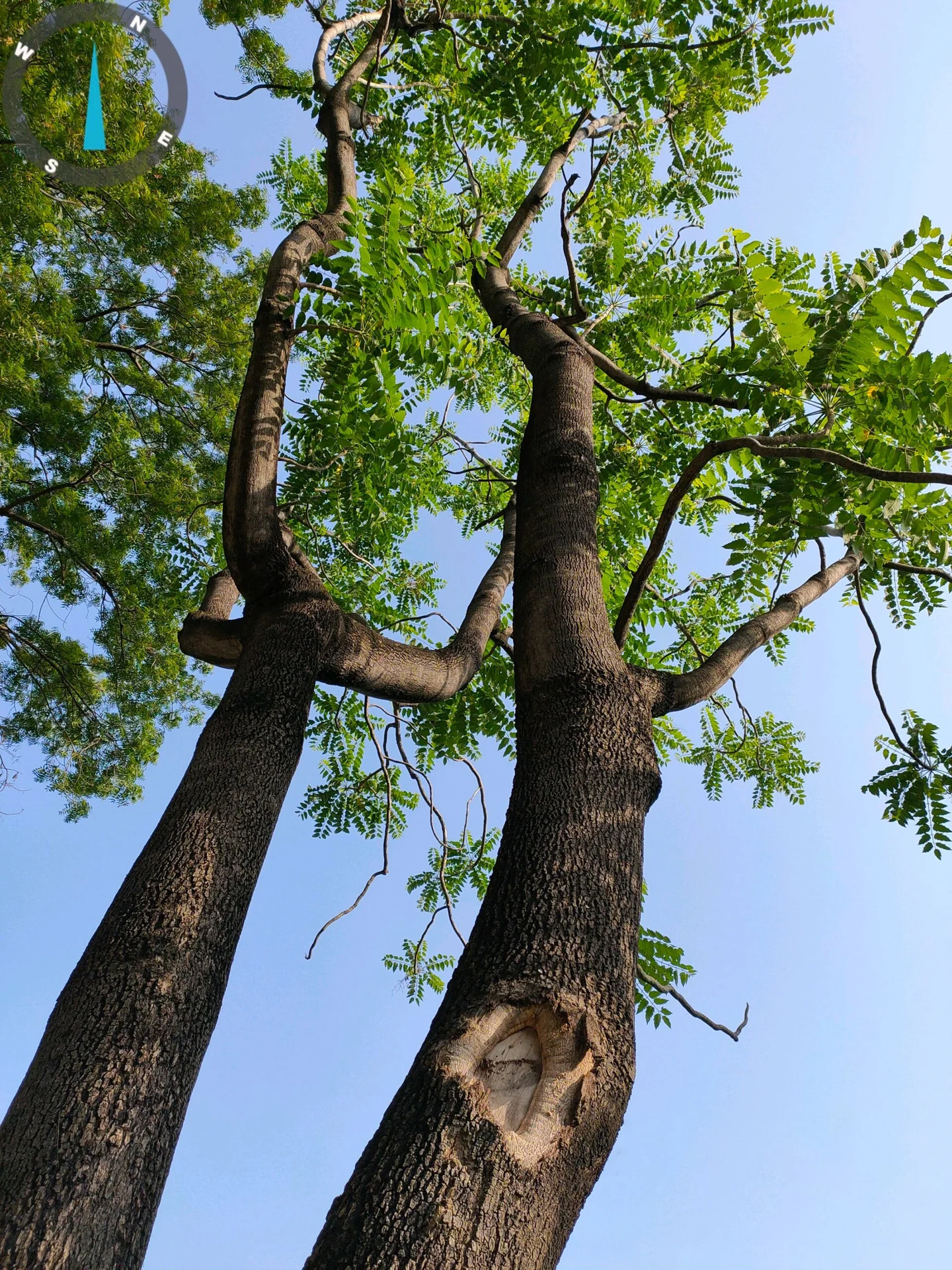
Calyxed Entire-leaved Tree of Heaven
(Ailanthus integrifolia subsp. calycina)
Large-calyx tree of heaven
Da'e chouchun
#BBD5F8
#60683A
#2A2B17
#516951
#8EA8C4
Plant palette
Ailanthus integrifolia subsp. calycina: Large-Calyx Tree of Heaven
Reaching heights of up to 30 meters, Ailanthus integrifolia subsp. calycina commands attention in the dense forest canopies of Southeast Asia and southern China. This impressive evergreen or semi-deciduous tree plays a vital role in tropical forest ecosystems.
Its natural range spans across Vietnam, India, and the Yunnan province of China. The subspecies thrives in humid, subtropical climates, often growing alongside other large forest trees.
This tree is distinguished by its large stature and compound foliage. The even-pinnate leaves are clustered at the tips of branches, featuring 6 to 7 pairs of alternate leaflets that are sparsely pubescent when young.
The leaflets are ovate or oblong-ovate, showing a dark green color on the upper surface and a lighter green underneath. Each leaflet features an acuminate apex and a highly oblique base with 1 to 6 small, translucent glands on the margins.
The fruit is a dry, oblong samara that is often twisted at the apex and exhibits a reticulate pattern. A single compressed seed is situated right in the center of the wing, facilitating wind dispersal between January and March.
Flowering season
Flowers typically appear during the autumn, and the fruiting period extends from January to March.
Jan
Feb
Mar
Apr
May
Jun
Jul
Aug
Sep
Oct
Name
Dec
Applications
The lightweight wood is utilized locally for making matches, packing cases, and light construction. It is valued in forestry for its fast growth and potential in reforestation projects.
Chemical compounds extracted from the bark have shown interest in pharmacological studies. Traditional communities occasionally use the leaves and bark in local medicinal preparations.
Interesting facts
The seeds are uniquely positioned in the exact center of the winged samaras, helping them spin like helicopter blades when falling.
The leaflets possess translucent glands near the base, which emit a distinct odor when crushed.
It is one of the tallest members of the Simaroubaceae family found in the regions of Yunnan and Vietnam.