Ailanthus altissima: The Resilient Tree of Heaven and Its Global Journey
For centuries, the late spring buds of the tree of heaven signaled the end of winter to scholars near the Yellow River, long before this resilient species embarked on its tumultuous journey to the West. Commonly known as the tree of heaven or ailanthus, this deciduous tree is celebrated for its ability to thrive in the most challenging urban environments.
With its rapid growth rate, the species can reach heights of 15 meters in just 25 years, colonizing disturbed landscapes with remarkable speed. This exceptional vigor has earned it both admiration for its resilience and notoriety as a highly aggressive invader in many temperate regions worldwide.
Its deep adaptation to poor soils, drought, and high pollution levels makes it a unique botanical subject. A closer look at its biology reveals the complex relationship between human history and this persistent tree.
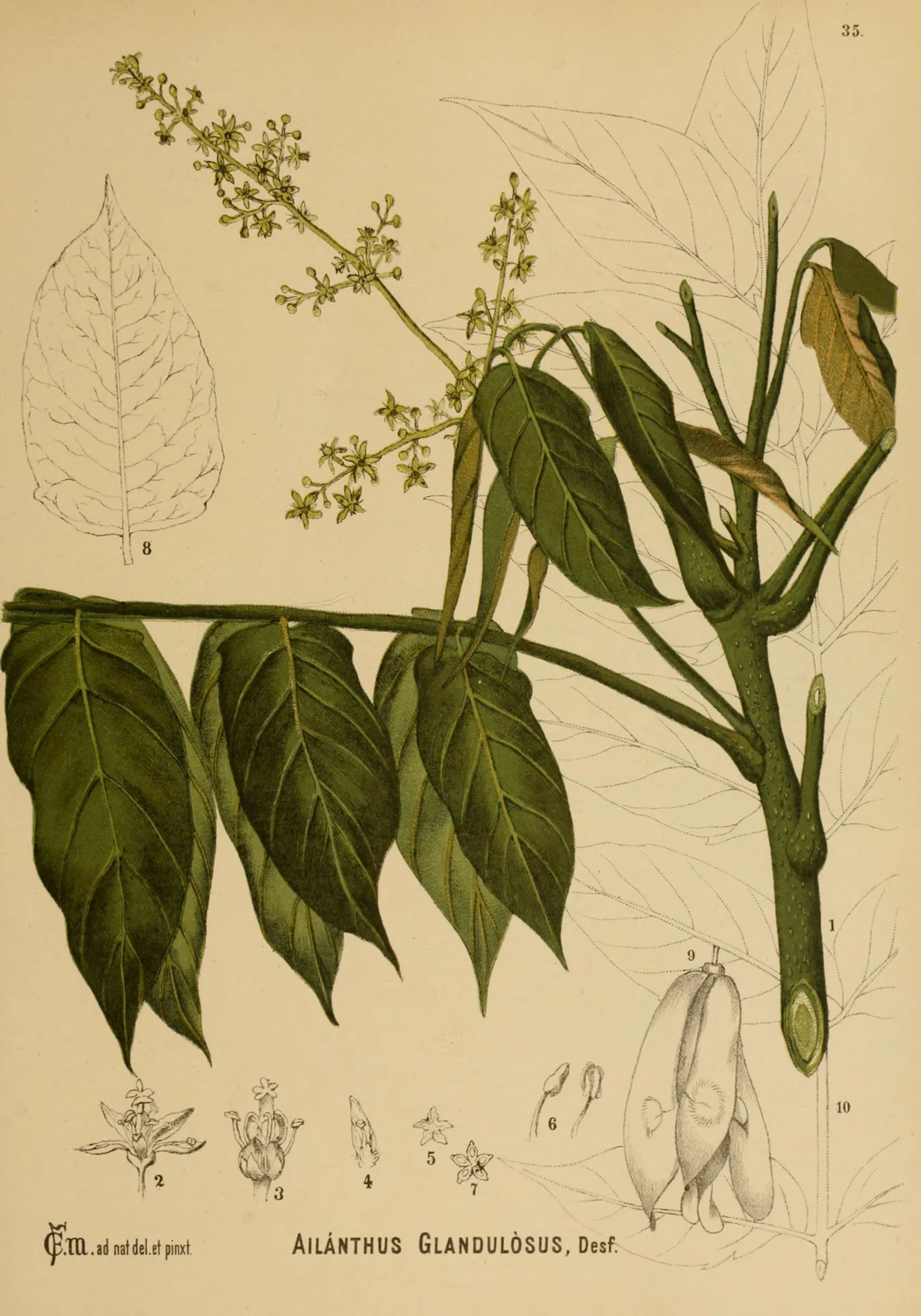
Botanical illustration
Фото: BioDivLibrary / Лицензия: Public Domain Mark
Morphology
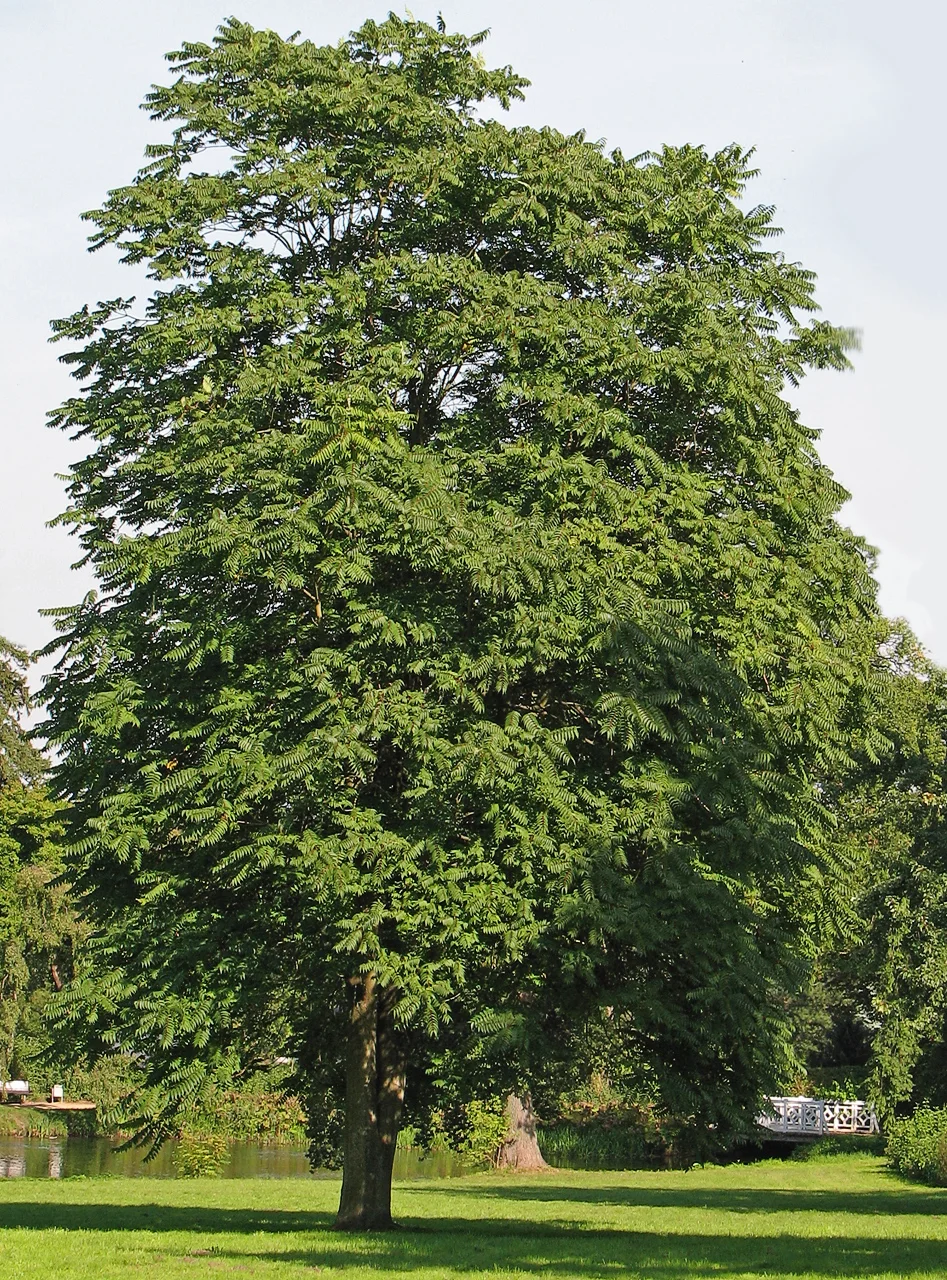
The structural characteristics of Ailanthus altissima reflect its adaptation to rapid colonization and environmental stress. It is a medium-sized tree, typically reaching heights between 17 and 27 meters with a trunk diameter of up to 1 meter. Its bark remains smooth and light grey during youth, gradually developing shallow, tan fissures as the specimen matures.
One of the most distinctive sensory features of this species is its potent aroma. All parts of the plant, especially when bruised, emit a strong odor often compared to rancid peanuts or cashews. The stout, reddish-brown twigs feature prominent heart-shaped leaf scars and raised lenticels that develop into fissures with age.
The foliage and reproductive structures of the tree display remarkable complexity:
Leaves: Large pinnately compound leaves range from 30 to 90 centimeters in length and bear 10 to 41 leaflets. The ovate-lanceolate leaflets are dark green above with lighter veins and whitish-green underneath. Each leaflet features two to four small teeth near its base, with each tooth hosting a specialized gland.
Flowers: Small, yellowish-green to reddish flowers gather in terminal panicles reaching up to 50 centimeters in length. The species is dioecious, meaning individual trees are either male or female. Male flowers produce a strong, foul scent to attract pollinators and are produced in much greater abundance than female ones.
Fruits: The female trees produce large clusters of twisted, winged samaras, each about 2.5 centimeters long and containing a single central seed. Their propeller-like shape causes them to spin during fall, facilitating dispersal by wind and water over significant distances.
Applications
Despite its reputation as an invasive weed, Ailanthus altissima has a rich history of utility in both traditional industries and medicine. Historically, its leaves served as the primary food source for the caterpillars of the ailanthus silkmoth (Samia cynthia). These insects produce a durable, coarse silk known as Shantung or eri silk, which has been prized in China for centuries.
The pale yellow wood of the tree is dense and flexible, making it ideal for crafting traditional Chinese kitchen steamers. In addition, its timber provides an abundant source of firewood and charcoal, although the wood must be dried using specific techniques to prevent cracking. Its extreme tolerance to sulfur dioxide, ozone, and salt once made it a popular choice for urban afforestation along highly polluted highways.
Traditional Chinese medicine utilizes nearly every part of the tree for therapeutic purposes:
Root Bark: Known as chun bai pi, the dried root bark acts as an astringent and antipyretic to treat dysentery and internal hemorrhages.
Leaves: Applied topically in traditional recipes to alleviate itching, eczema, and even to stimulate hair growth when combined with peach leaf extracts.
Samaras: Recognized as feng yan cao, the winged fruits serve as a homeostatic agent and have shown clinical efficacy in treating certain vaginal infections.
Interesting facts
The cultural footprint of Ailanthus altissima spans ancient eastern philosophy and modern western literature. In the oldest surviving Chinese dictionary, the Erya, written in the third century BCE, it was listed second among all trees. In traditional literature, a mature tree represents a father, leading to the polite letter writing expression wishing a friend's father and mother health by referring to them as the ailanthus and the daylily.
In the West, the species became an iconic symbol of urban resilience. The bestselling 1943 novel A Tree Grows in Brooklyn by Betty Smith used the tree as its central metaphor, describing its ability to grow out of cement and thrive without sun or water. This tenacity also earned it the colloquial American nickname ghetto palm due to its abundance in neglected urban lots.
Several other intriguing botanical and historical facts highlight its unique nature:
Chemical Warfare: The roots and bark secrete ailanthone, a potent allelopathic chemical that acts as a natural herbicide, suppressing the growth of neighboring plant species to eliminate competition.
Noguchi's Centerpiece: Renowned sculptor Isamu Noguchi designed his museum garden in Queens around a single 75-year-old tree of heaven, which was later carved into benches and art pieces when it died in 2008.
Insect Relationships: The tree serves as the preferred host for the invasive spotted lanternfly, which absorbs the tree's bitter quassinoid compounds to defend itself against avian predators.