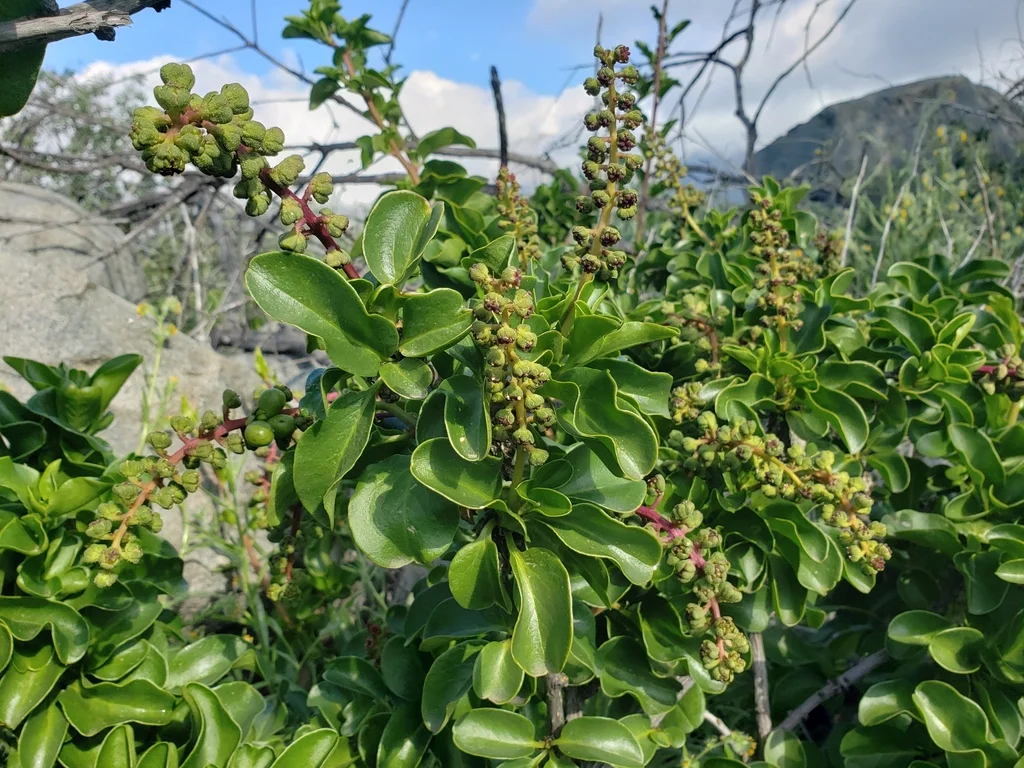
Restricted entirely to the diverse temperate and Mediterranean climates of Chile, the genus Anisomeria represents a unique group of plants within the family Phytolaccaceae. These plants are endemic to the region, growing primarily in coastal scrublands, rocky hillsides, and forest edges.
First described in 1832 by the British botanist David Don, the genus contains a small number of recognized species, with Anisomeria coriacea serving as the type species. Known locally for their medicinal and purgative properties, they occupy a distinctive niche in South American botany.
Members of Anisomeria are typically low-growing shrubs, subshrubs, or perennial herbs characterized by thick, coriaceous leaves. The leaves are alternate, entire, and show strong adaptations to dry or coastal environments.
Their flowers are arranged in dense, upright terminal racemes. The flowers are small, regular, and typically lack petals, consisting instead of persistent sepals and multiple stamens. The superior ovary develops into fruit structures that are characteristic of the pokeberry family, containing dark seeds.
Applications
Historically, the roots and leaves of Anisomeria coriacea, commonly known as yerba purga, have been utilized in traditional Chilean medicine as a strong purgative and emetic agent. However, due to the high concentration of active compounds, their use requires extreme caution as they can be highly toxic in large doses.
The plants also play an ecological role in stabilizing soil in sandy coastal dunes and hillside habitats where they occur naturally.
Interesting facts
All recognized species of Anisomeria are endemic to Chile, meaning they cannot be found growing naturally anywhere else in the world.
The common name "yerba purga" directly references the plant's traditional use as a powerful laxative and purgative remedy by local populations.
The genus name Anisomeria refers to the unequal parts of the flower structure, highlighting a key taxonomic feature used to distinguish it from related genera.